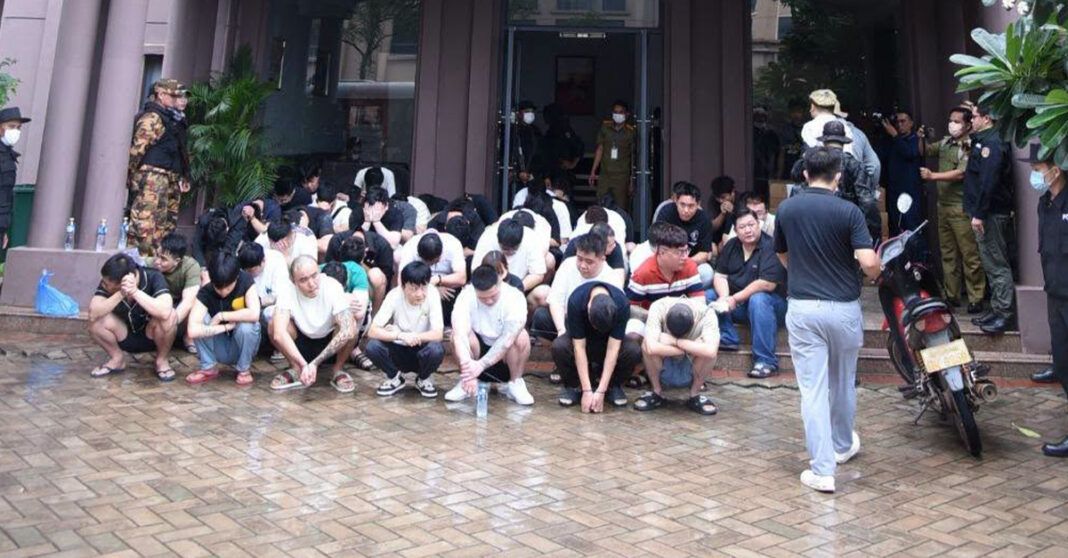
Vientiane police launched a significant enforcement operation on 8 August, targeting a telecommunications fraud and online gambling racket operating from a building within the Thatluang Lake Special Economic Zone. The coordinated raid resulted in the detention of 261 suspects representing seven different nationalities, marking one of the most substantial busts in Laos's ongoing campaign against organised digital crime networks.
The geographic and demographic composition of those apprehended reveals the transnational nature of the operation. Chinese nationals comprised the largest contingent at 153 individuals, underscoring the region's vulnerability to organised fraud syndicates based in or coordinated from the People's Republic. Vietnamese suspects numbered 61, followed by 36 Thai nationals. The remaining detainees included five Taiwanese, two Malaysian, two South Korean, and two Myanmar citizens. The presence of Malaysian nationals, though small in absolute terms, highlights how these networks recruit operatives across Southeast Asia to manage different functions within their criminal infrastructure.
The volume of equipment recovered during the operation illustrates the industrial scale of the scam enterprise. Police seized nearly 500 desktop computers and laptops, which would have been deployed for call centres, data management, and customer targeting operations. Additionally, authorities confiscated 2,355 mobile phones, suggesting the operation maintained multiple communication channels to contact victims and coordinate fraudulent transactions. Such quantities of hardware indicate a sophisticated, well-capitalised criminal organisation rather than an ad-hoc scheme.
Investigations confirmed that the Thatluang Lake building was registered to Lao Thatluang Investment Development Co., Ltd., raising questions about how criminal enterprises secure premises within special economic zones ostensibly subject to heightened regulatory oversight. The discovery suggests either a deliberate exploitation of regulatory gaps within SEZs or potential complicity by intermediaries in the registration process. Laotian authorities have indicated their investigation remains active, with particular focus on identifying the operation's architects and major conspirators who likely operated remotely from other jurisdictions.
This raid represents merely one component of a comprehensive national crackdown on scam networks that Lao authorities have escalated throughout 2024. The government has recognised that telecommunications fraud and online gambling operations operating from Laotian territory pose serious reputational and security concerns, potentially destabilising the country's investment climate and inviting international pressure. The visible enforcement response demonstrates a shift toward more assertive policing of these operations.
The deportation and extradition procedures following the raid underscore regional cooperation frameworks. On 10 August, just two days after the initial bust, Laotian authorities transferred 41 Thai suspects to Thailand via the 1st Lao-Thai Friendship Bridge. This followed an earlier handover of 32 Thai nationals through the same crossing on 6 August, bringing the cumulative total of Thai deportations to at least 73 individuals. Such rapid processing suggests bilateral coordination protocols that facilitate swift movement of suspects across borders when home countries possess jurisdiction.
These Thai deportations relate directly to an earlier major operation conducted on 18 July, when police raided the ST Vegas complex located in Dongphosy village, Hatsayfong district, Vientiane. That enforcement action yielded 589 suspected scammers, predominantly Thai nationals, though the operation also ensnared Laotian, Vietnamese, and Cambodian perpetrators. The ST Vegas facility apparently represented another significant hub within the broader criminal ecosystem, suggesting multiple operational nodes rather than a single centralised facility.
For Malaysian policymakers and security agencies, these developments carry particular relevance given the presence of Malaysian nationals within Laotian scam networks. The involvement of two Malaysian detainees indicates recruitment into lower-level operational roles, likely as money runners, victim liaisons, or intermediaries leveraging their domestic banking relationships. Malaysia's own substantial problem with telecom fraud victimisation has created demand for operatives with local knowledge and access to financial systems.
The Thatluang Lake and ST Vegas operations exemplify how Southeast Asia's porous borders, inadequate digital crime resources, and economic disparities create ideal conditions for transnational scam enterprises. Laos, positioned geographically between Thailand and Vietnam with less developed cybercrime investigative capacity, has become a preferred operational base for these networks. The special economic zones, designed to attract investment and provide tax incentives, paradoxically offer regulatory ambiguity that sophisticated criminals exploit.
Looking forward, the sustainability of Laos's enforcement efforts remains uncertain. While the immediate busts represent impressive outcomes in terms of arrests and asset seizure, the underlying drivers of scam production—the profitability of fraud targeting Southeast Asian populations and the difficulty in attributing digital crimes across jurisdictions—persist. Regional governments must develop harmonised approaches to digital crime prevention, including standardised data protection requirements, mutual legal assistance frameworks, and coordinated border security protocols.

