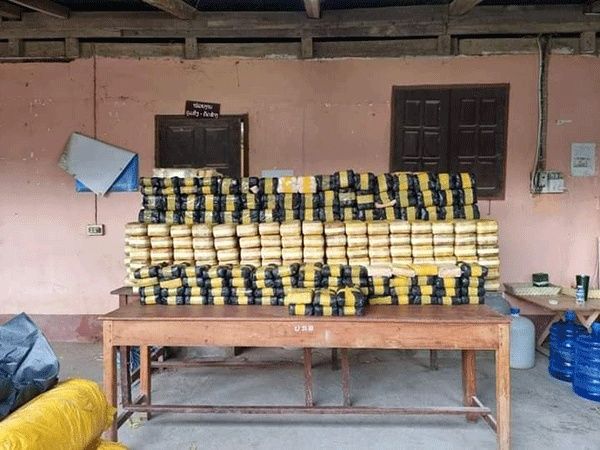
Drug trafficking has emerged as the defining security challenge in Xaysomboun province, with narcotic-related crimes representing nearly half of all criminal cases investigated by local authorities during the first six months of 2024. Of 54 recorded offences across the province, 24 involved drug-related activity, underscoring how thoroughly narcotics have penetrated the criminal landscape in this central Laotian region. The concentration of drug cases reveals a deeply troubling security picture that extends beyond simple possession, suggesting systematic trafficking operations that warrant coordinated national intervention and heightened enforcement capacity.
The progression of these investigations reveals significant gaps in the provincial justice system's ability to resolve cases efficiently. While authorities managed to conclude and forward only two drug cases to prosecutors during the six-month window, 22 remain suspended in investigative limbo—a backlog that potentially undermines deterrence and allows criminal networks to continue operating with diminished immediate legal consequences. This processing bottleneck across the broader criminal docket, where 29 cases await investigation, suggests that Xaysomboun's Public Security Force faces resource constraints or investigative capacity limitations that hamper its effectiveness against organised crime. The situation parallels challenges in other Southeast Asian jurisdictions grappling with underfunded law enforcement agencies confronting transnational trafficking organisations.
Xaysomboun's drug crisis reflects a nationwide problem consuming Laotian authorities' attention at the highest levels. When Police Lieutenant General Vanthong Kongmany, the national Minister of Public Security, visited the province on August 7, his agenda centred squarely on intensifying drug enforcement operations. The minister's directives to strengthen actions against trafficking and suppress consumption of emerging drug variants signal recognition that traditional policing approaches have proven insufficient. This top-down pressure, while politically necessary, also exposes the ministry's acknowledgment that provincial forces require substantial additional support and strategic guidance to reverse the trend of rising drug criminality.
National statistics paint an even more alarming picture than Xaysomboun's local figures suggest. Across Laos, authorities processed 1,786 drug-related cases during the identical six-month period, resulting in 4,025 arrests including 93 foreign nationals. These nationwide totals indicate that drug trafficking has evolved from a localised problem into a coordinated criminal enterprise with international dimensions, likely involving supply chains connecting distant production regions with distribution networks throughout the country. The arrest of nearly 100 foreign nationals implies that Laos has become either a significant transit point for regional trafficking operations or a destination market for international criminal syndicates seeking to exploit the country's geographic position and porous borders.
The government's commitment to narcotics suppression has now accumulated five years of sustained focus, having been formally designated a national agenda half a decade ago. This extended timeline suggests that despite official prioritisation, underlying drivers of trafficking—including poverty, limited economic alternatives, geographic proximity to opium-producing regions, and demand from neighbouring markets—remain largely unaddressed. The continued growth in drug cases despite this national campaign raises uncomfortable questions about whether enforcement-heavy approaches alone can curb supply and demand without complementary economic development, addiction treatment infrastructure, and cross-border cooperation initiatives that address trafficking routes upstream.
Beyond narcotics, the Minister's visit revealed an expanding security mandate that reflects evolving criminal methodologies. Authorities have now incorporated cybercrime and online activity monitoring into provincial policing priorities, reflecting sophisticated criminals' increasing reliance on digital platforms for coordination, money laundering, and market communication. This expansion of enforcement focus acknowledges that traditional street-level policing proves inadequate against criminal networks exploiting technological advantages. Malaysian and regional security officials monitoring developments in Laos should recognise this shift as indicative of broader Southeast Asian trends, where organised crime increasingly manifests through digital channels that transcend territorial boundaries and overwhelm conventional investigative capacities.
Road safety emerged as a collateral concern during ministerial discussions, revealing how cascading security failures create compound societal damage. Within Xaysomboun's six-month period, 60 traffic accidents resulted in four deaths, 80 injuries, and damage estimated at over 2.56 billion kip. While superficially distinct from drug enforcement, traffic fatalities often correlate with substance abuse and suggest that drug availability simultaneously creates public health and transportation safety crises beyond the criminal justice domain. The scale of economic losses from traffic incidents alone demonstrates how security challenges impose hidden costs extending far beyond law enforcement budgets into healthcare, insurance, and infrastructure replacement expenditures.
The provincial government's management of foreign nationals and tourism activities adds another dimension to security concerns. During the review period, authorities inspected 1,698 tourists, of whom 396 were foreign visitors, suggesting significant international exposure for the region. This tourism throughput creates both economic opportunity and security vulnerability, as international visitor flows potentially facilitate money laundering, human trafficking recruitment, and narcotics movement across borders. The minister's emphasis on professional immigration management and expertise-based personnel assignments indicates recognition that inadequately trained officers in transit hubs become liabilities rather than assets in border security operations.
Laos's drug crisis carries significant implications for Malaysia and other Southeast Asian neighbours, particularly regarding transnational criminal networks' expansion patterns. If Xaysomboun's 44 percent drug crime rate reflects regional trends, trafficking organisations are consolidating control over provincial territories and establishing logistical hubs that may support distribution into downstream markets including Thailand, Vietnam, and potentially Malaysia through maritime and land routes. Malaysian authorities monitoring Laotian developments should recognise that enforcement gaps and case processing delays in Xaysomboun create opportunities for organised crime to expand operational scope, scale production capacity, and establish smuggling infrastructure that ultimately threatens stability throughout the region.
The minister's emphatic call for stronger ideological education and improved leadership practices suggests organisational dysfunction extending beyond resource limitations. His urging that officers acknowledge weaknesses, avoid passive compliance, and accept direct responsibility indicates previous accountability failures and potential institutional corruption undermining enforcement efforts. Strengthening personnel discipline and professional standards represents necessary internal reform, yet depends upon career advancement incentives, compensation packages, and institutional reputation improvements that Laotian government resources may struggle to provide comprehensively. Without addressing these organisational factors alongside operational enforcement, even well-intentioned policy interventions risk implementation failures that perpetuate existing security vulnerabilities.
Looking forward, Xaysomboun's experience suggests that provinces throughout Laos face intensifying criminal pressures that require sustained investment in investigative capacity, regional cooperation frameworks, and complementary development initiatives. The minister's visit, while symbolically important, cannot substitute for permanent institutional strengthening, equipment provision, and training investments that would enable the provincial force to clear its investigative backlog and respond with adequate speed to emerging threats. Regional observers including Malaysian authorities should monitor whether national commitments translate into tangible resource allocation or whether Xaysomboun and similar provinces continue operating with inadequate capacity to manage escalating criminal complexity. The distinction will likely determine whether Laos successfully regains control of its drug crime trajectory or whether trafficking organisations continue exploiting provincial enforcement gaps to expand their regional operational footprint.

