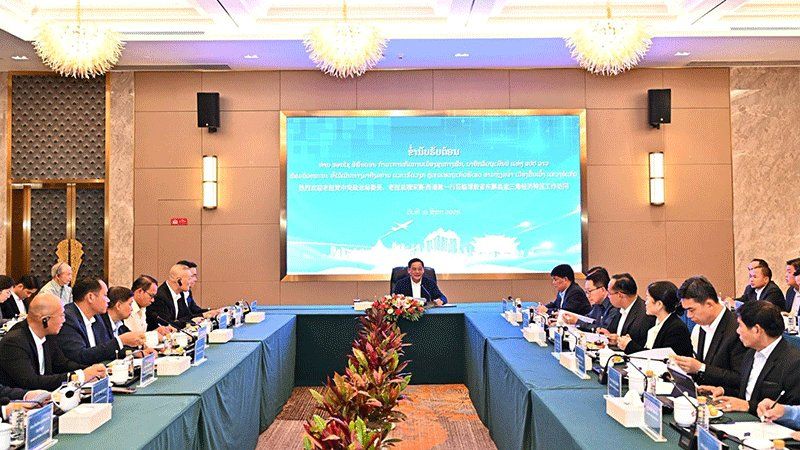
Laos's Prime Minister Sonexay Siphandone has signalled the government's intention to impose stricter controls over the Golden Triangle Special Economic Zone (GTSEZ), one of Southeast Asia's most strategically positioned but underperforming development corridors. During a working visit to the Zone on Tuesday, August 18, Dr Sonexay outlined a comprehensive reform agenda aimed at tightening oversight mechanisms, enhancing sustainability practices, and improving the investment climate—marking a significant policy shift for the region's approach to managing cross-border economic activity.
The Golden Triangle SEZ, situated in Tonpheung district within Bokeo province and straddling the borders where Laos, Myanmar, Thailand and China converge, has accumulated approximately US$10 billion in investments since its establishment in 2007. Yet this substantial capital infusion has not translated into the anticipated economic returns, a reality that appears to have prompted the Prime Minister's critical reassessment of the Zone's governance framework. The Zone spans 10,000 hectares, with 3,000 hectares allocated for commercial activities and 7,000 hectares preserved as forested areas, positioning it as a potentially significant economic engine for northern Laos and the wider Mekong subregion.
Despite nearly two decades of operation, performance metrics reveal troubling inefficiencies within the Zone's management structure. Only 60 per cent of activities specified in investment contracts have been realised, a shortfall that Dr Sonexay attributed directly to inadequate oversight and insufficient enforcement of development standards. This performance gap is particularly significant given the Zone's premium location along the Mekong River and its proximity to major consumer markets across the border, suggesting that regulatory failures rather than market conditions bear responsibility for the underutilisation of invested capital.
Dr Sonexay's intervention reflects growing international pressure on Southeast Asian economic zones to demonstrate genuine developmental outcomes rather than merely serving as investment repositories. His call for stricter enforcement of the Law on Enterprises represents an acknowledgment that the Zone's current regulatory environment has permitted companies to operate with insufficient accountability. The Prime Minister specifically mandated that all transactions involving trade, investment, wages and services be routed through the Lao banking system—a measure designed to enhance financial transparency and prevent informal economic activity that could undermine both government revenue collection and labour protections.
The Prime Minister identified six priority sectors worthy of enhanced investment and development: tourism, manufacturing, processing, transport, education and public health. This sectoral prioritisation signals a deliberate effort to move the Zone away from low-value-added activities and speculative real estate development toward higher-multiplier activities that generate sustainable employment and skills development. Tourism, in particular, represents an underutilised opportunity given the Zone's location within the famous Golden Triangle geographic formation and its accessibility to regional travel networks.
Boundary management has emerged as a critical governance concern. Dr Sonexay instructed authorities to strengthen entry and exit controls at the Zone, addressing apparent security and regulatory gaps. Given the Zone's position adjacent to three national borders and its substantial population—currently comprising more than 10,000 registered workers, along with approximately 10,000 additional investors, business operators, residents and tourists—effective border administration has become essential for maintaining operational integrity. The presence of over 400 government officials from various sectors working within the Zone suggests that capacity exists, but coordination and enforcement mechanisms require substantial strengthening.
The Prime Minister also directed the Zone's Management and Administration Committee to enhance operational effectiveness, implying that existing governance structures have proven inadequate. This institutional restructuring addresses a longstanding Southeast Asian challenge: ensuring that special economic zones maintain sufficient autonomy to attract investment while remaining subject to sufficient oversight to prevent regulatory capture and ensure alignment with national development objectives. The committee's mandate would presumably expand to include enforcement authority and inter-agency coordination.
International cooperation emerged as another dimension of the reform agenda. Dr Sonexay called for expanded airline connections linking the Zone to regional centres and for improved mechanisms to manage migrant workers from neighbouring countries. This emphasis reflects the Zone's reality as a genuinely transnational economic space where workers, investors and consumers cross borders daily. Enhanced transportation infrastructure and formalised cross-border labour protocols would reduce friction in economic operations while improving working conditions and tax compliance across the border region.
The concession agreements governing individual investments require modernisation to align with current Lao legislation and international standards. This suggests that many existing concessions were granted under less stringent regulatory frameworks and may contain provisions that shield investors from contemporary accountability requirements. Updating these agreements would represent a delicate balancing act—protecting legitimate investor interests while extending government regulatory authority over operations that have proceeded with insufficient oversight.
For Malaysia and other Southeast Asian economies, the Golden Triangle SEZ situation carries instructive implications. The Zone demonstrates that geographic advantage and substantial capital investment prove insufficient without robust institutional frameworks, effective inter-agency coordination, and genuine commitment to enforcing regulatory standards. Malaysian policymakers overseeing special economic zones and similar corridors, including those along the ASEAN-China borderlands, should recognise that investors require predictable regulatory environments coupled with transparent enforcement rather than regulatory ambiguity that creates opportunities for rent-seeking behaviour.
The Prime Minister's emphasis on sustainable development rather than raw investment quantum reflects an evolving regional understanding that development zones must generate genuine economic transformation rather than merely shifting capital around. As Laos positions the Golden Triangle SEZ within broader regional integration frameworks like the Mekong subregional arrangements, stronger governance will prove essential for attracting quality investment and ensuring that the Zone delivers benefits to host communities rather than concentrating wealth among connected investors and concessionaires.
Dr Sonexay's reform agenda signals that Laos intends to transform the Golden Triangle SEZ from a under-managed investment repository into a genuinely functional development corridor. Success will require sustained political commitment, adequate resource allocation to enforcement mechanisms, and willingness to challenge entrenched interests that have benefited from the Zone's previous regulatory laxity. For regional observers, the coming months will reveal whether pronouncements translate into institutional practice or whether the Zone continues along its current trajectory of underperformance beneath the surface of accumulated investment figures.

