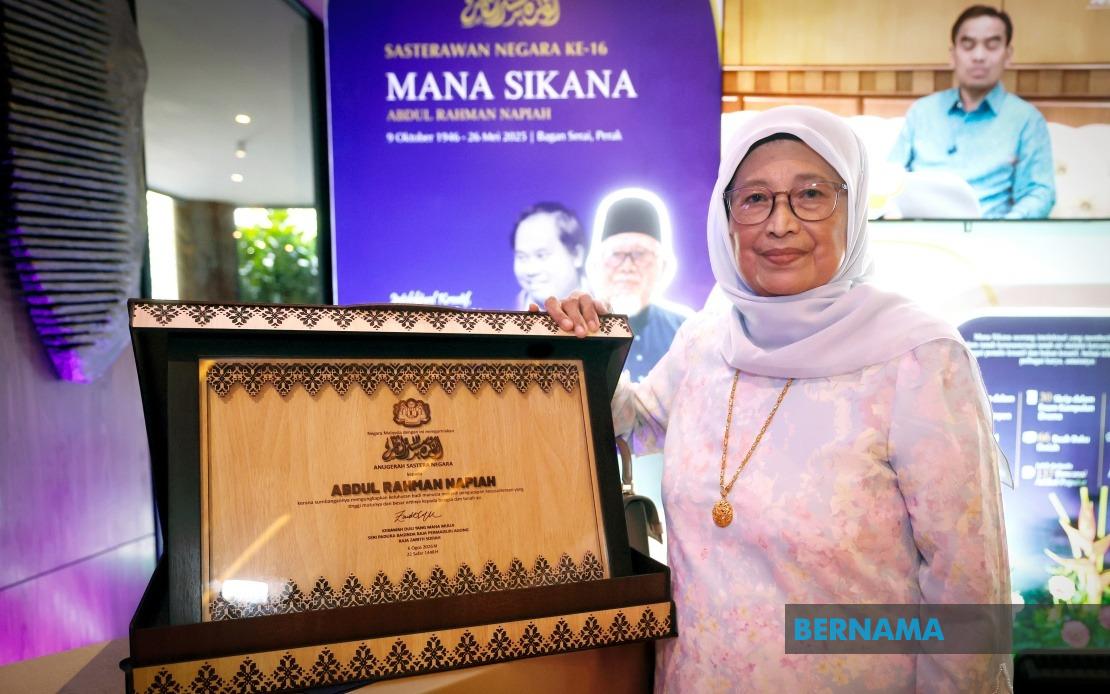
The 16th National Laureate award has been conferred posthumously upon the late Dr Abdul Rahman Napiah, better known by his literary pseudonym Mana Sikana, honouring a career spanning nearly six decades that fundamentally shaped Malaysia's literary landscape. Salmah Ali, the 82-year-old widow of the renowned author and scholar, accepted the prestigious honour on his behalf during a ceremony held in Kuala Lumpur on August 6, presented by Her Majesty Raja Zarith Sofia, Queen of Malaysia. Education Minister Fadhlina Sidek attended the occasion, underscoring the government's recognition of Mana Sikana's outsized influence on the nation's cultural and intellectual development.
Mana Sikana's path to this pinnacle recognition was marked by an extraordinary breadth of literary and academic achievement that extended well beyond traditional boundaries of creative writing. Beginning his career as a schoolteacher, he gradually transitioned into higher education, eventually attaining the rank of professor and establishing himself as a thought leader in literary theory, criticism, and discourse. His intellectual journey took him through several prestigious Malaysian institutions, most notably Universiti Kebangsaan Malaysia, while also securing appointments at Nanyang Technological University in Singapore and Universiti Pendidikan Sultan Idris. This transnational academic engagement positioned him as a regional authority on literature and allowed him to disseminate Malaysian literary thought across Southeast Asia.
What distinguished Mana Sikana's contribution was his refusal to compartmentalise his talents into either academic or creative spheres. During his years based in Johor Bahru, he actively produced drama works for Singaporean radio and television networks while simultaneously managing teaching responsibilities—a pattern that reflected his deep conviction that literature should permeate multiple media and reach audiences beyond university lecture halls. Malaysian television screens frequently featured his dramatic compositions, demonstrating his commitment to democratising literary excellence and making sophisticated storytelling accessible to the general public. This multi-platform approach to literary dissemination remains instructive for contemporary creators navigating an increasingly fragmented media landscape across Southeast Asia.
Salmah Ali's emotional account of accepting the award revealed the poignancy of posthumous recognition. She disclosed that her husband had been informed before his death that he might receive this honour—a glimmer of hope that sustained him even as his health deteriorated. The timing of his passing in May of the previous year proved particularly bittersweet; on the very day he suffered the fatal heart complications that would claim his life, Mana Sikana had been presenting an academic working paper at Dewan Bahasa dan Pustaka, Malaysia's premier language and literature institution. His sudden illness that evening, characterised by severe stomach pain and vomiting, necessitated emergency hospitalisation from which he would not recover. His passing at the age of 80 robbed him of witnessing the formal recognition of contributions he had consciously pursued throughout his working life.
The widow's reflections offered glimpses into how Mana Sikana's literary passion extended into his domestic sphere and personal relationships. He remained committed to transmitting his knowledge and enthusiasm for literature to his four children and twelve grandchildren until the very end of his life, suggesting that his engagement with literary matters transcended professional obligation and represented a fundamental aspect of his worldview. This intergenerational transmission of literary values within families constitutes an often-overlooked mechanism through which cultural excellence sustains itself across time. For Malaysia, which faces contemporary challenges in cultivating literary engagement among younger generations increasingly oriented toward digital media, Mana Sikana's example of embedding literary discussion within family life offers instructive lessons.
Mana Sikana was born on October 9, 1946, in Bagan Serai, Perak, establishing him as a child of Malaysia's early independence period. His formative years coincided with the nation's efforts to construct a distinctive national literature that could simultaneously draw upon indigenous Malay-language traditions and engage with modernist literary movements globally. His career trajectory—progressing from schoolteacher to academic professor—mirrored the broader expansion of Malaysia's higher education system during the late twentieth century and his professional advancement reflected the growing recognition that literature warranted serious scholarly attention within universities. The National Laureate designation represents the culmination of a career devoted to establishing literature's centrality to national identity and intellectual discourse.
Education Minister Fadhlina Sidek's remarks at the presentation ceremony characterised Mana Sikana's selection as recognition of his fundamental role in strengthening national literature through multiple modalities. Her emphasis on his contributions to creative writing, literary theory, criticism, and academic discourse encompassed the full spectrum of literary endeavour, acknowledging that excellence in literature demands not only creative talent but also rigorous analytical frameworks and pedagogical commitment. This holistic understanding of literary contribution reflects contemporary international consensus that the healthiest literary ecosystems require practitioners who simultaneously create, analyse, teach, and mentor new generations.
The conferment of the National Laureate award carries particular significance for Malaysia's regional position within Southeast Asia. As the nation continues positioning itself as a knowledge and creative hub for the region, honouring figures like Mana Sikana who bridged Malaysian and regional intellectual communities reinforces commitments to cultural excellence and cross-border scholarly exchange. His teaching positions across multiple countries and his engagement with international universities demonstrated that Malaysian literary thought possessed sufficient sophistication and originality to merit serious engagement from international scholars and students.
Salmah Ali's expression of bittersweet emotion—pride and happiness intermingled with deep sadness at his absence—captured the inevitable poignancy of posthumous recognition. While the award vindicated her late husband's lifelong conviction that his literary and academic work merited acknowledgment, it could not provide him the satisfaction of witnessing that recognition or the opportunity to deliver remarks reflecting upon his career. The fact that he had specifically hoped to receive this particular honour, as his widow disclosed, renders his death mere months before the announcement a particular tragedy for Malaysian letters.
The National Laureate distinction serves multiple functions within Malaysia's cultural apparatus. It signals to emerging writers and scholars the kinds of sustained excellence and multifaceted contribution that the nation values most highly. For international observers and regional peers, it demonstrates Malaysia's commitment to honouring intellectual achievement and cultural production. Most importantly, by recognising figures like Mana Sikana who devoted themselves to expanding literature's reach across media platforms and geographical boundaries, the honour affirms that literary excellence remains central to national development and regional intellectual leadership.

