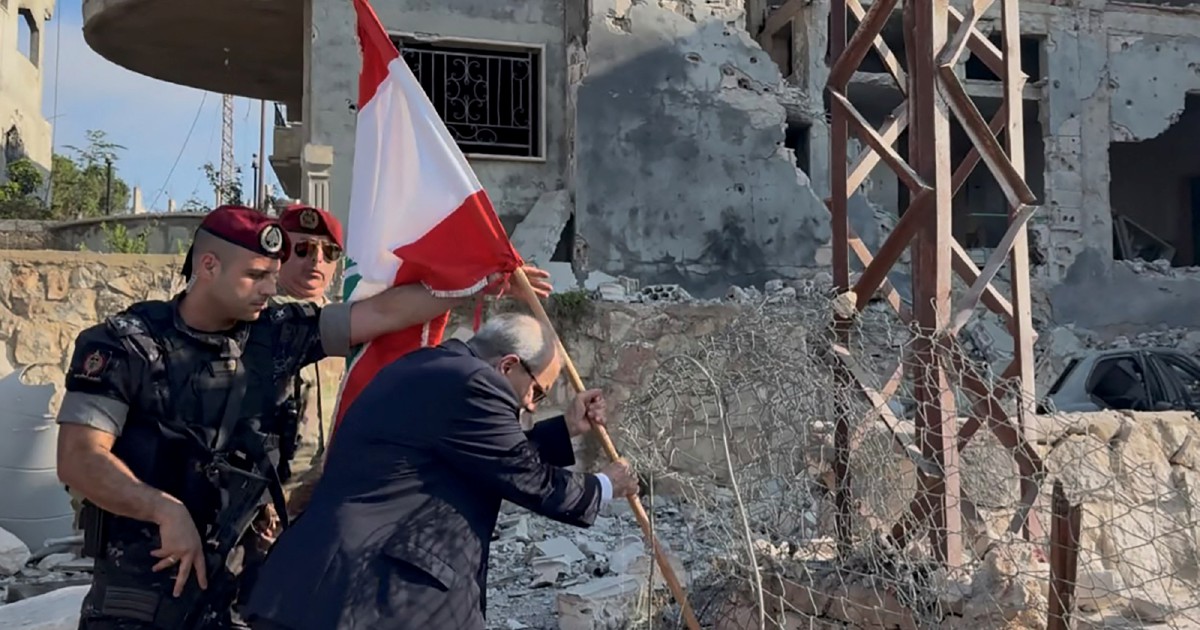
Lebanese Prime Minister Nawaf Salam has affirmed that his government is actively pursuing a complete Israeli withdrawal from territories currently under occupation, marking a significant policy statement as Beirut works to reassert control over areas devastated by recent conflict. The announcement, made during a visit to Zawtar al-Gharbiyah on Wednesday, underscores Lebanon's determination to restore sovereignty over border regions while the nation's military apparatus expands its footprint in strategically important locations.
Salam's remarks arrive at a pivotal moment for Lebanese state-building efforts. The deployment of the Lebanese Armed Forces to villages previously beyond the reach of central government control represents a tangible step towards reconstructing state authority in the south. This military repositioning signals that Beirut views the current political moment as an opportunity to reclaim territory and establish the institutional presence necessary for genuine sovereignty, a condition that has eluded much of southern Lebanon for years due to competing power structures.
The push for complete Israeli withdrawal reflects broader Lebanese aspirations to end a cycle of occupation and cross-border military operations that have defined the country's modern history. For decades, Israeli forces have maintained positions in Lebanese territory, citing security concerns related to militant groups operating in the region. However, the Lebanese government's insistence on total withdrawal represents its vision of a future where the nation controls its entire territory and can independently manage its border affairs without external military presence.
For Malaysia and other Southeast Asian nations monitoring Middle Eastern developments, Lebanon's situation underscores the fragility of ceasefire arrangements in the region and the complex negotiations required to achieve lasting peace. The Lebanese case demonstrates how military deployments and territorial control remain central to resolving long-standing disputes, even as international diplomatic pressure mounts for peaceful settlements. Regional observers from ASEAN countries, which themselves grapple with maritime and territorial disputes, may recognise familiar patterns in how state consolidation and military presence function as prerequisites for genuine sovereignty discussions.
The timing of Salam's statement carries strategic weight. By personally visiting a recently-secured village and making these declarations, the Prime Minister is attempting to project an image of a strengthened central state capable of enforcing its will across the national territory. This performative dimension of politics serves multiple audiences: domestic constituencies seeking reassurance that their government is protecting national interests, neighbouring states that may question Lebanese resolve, and international powers invested in regional stability.
Lebanon's path toward enforcing this withdrawal demand will likely require sustained diplomatic engagement. The country's weakened economy, ongoing political divisions, and dependence on international support create constraints on how aggressively Beirut can press its position. Nevertheless, the government's public commitment to complete withdrawal establishes a negotiating baseline and signals to the international community that Lebanon will not accept partial solutions or indefinite Israeli military presence in Lebanese sovereign territory.
The deployment of Lebanese army units southward also represents a significant test of state capacity. Lebanon's security forces have historically struggled to maintain uniform control over all regions, particularly in areas where alternative power structures or armed groups hold sway. The ability to sustain military presence in these border villages will demonstrate whether the central government has genuinely strengthened its grip on territory or whether this represents a temporary assertion of authority that could unravel under pressure.
Regional powers including Iran, Saudi Arabia, and Turkey all maintain interests in Lebanon's political trajectory. Each has different preferences regarding Israeli presence, state strength, and the balance of power between the Lebanese government and non-state actors. The Prime Minister's statement must therefore be understood within this multipolar context, where external actors exert influence over what Beirut can realistically achieve through negotiations.
International law formally supports Lebanon's position on territorial integrity and the right of states to control their entire territory free from foreign military occupation. This provides diplomatic cover for Beirut's demands, even if enforcement mechanisms remain weak. The United Nations, through various resolutions spanning decades, has called for Israeli withdrawal, though implementing these resolutions has proven persistently difficult without broader regional political consensus.
The coming months will test whether Salam's government can translate these ambitious pronouncements into concrete outcomes. Negotiations with Israel, mediated by international actors, will determine whether complete withdrawal occurs rapidly, gradually, or becomes another indefinite sticking point in Lebanese-Israeli relations. The deployment of Lebanese forces must be coupled with genuine political will and international backing to succeed in dislodging an occupying power that has justified its presence through security arguments that Israeli officials continue to emphasise.
For Lebanon's neighbours and the broader Southeast Asian region, this development illustrates how territorial disputes and military occupation remain unresolved issues that shape regional politics and international relations. Lebanon's struggle mirrors broader global challenges of enforcing state sovereignty and resolving conflicts through negotiation rather than force. The international community's handling of the Lebanese-Israeli situation may influence how other disputed territories are addressed in coming years, making this more than a local Middle Eastern issue.

