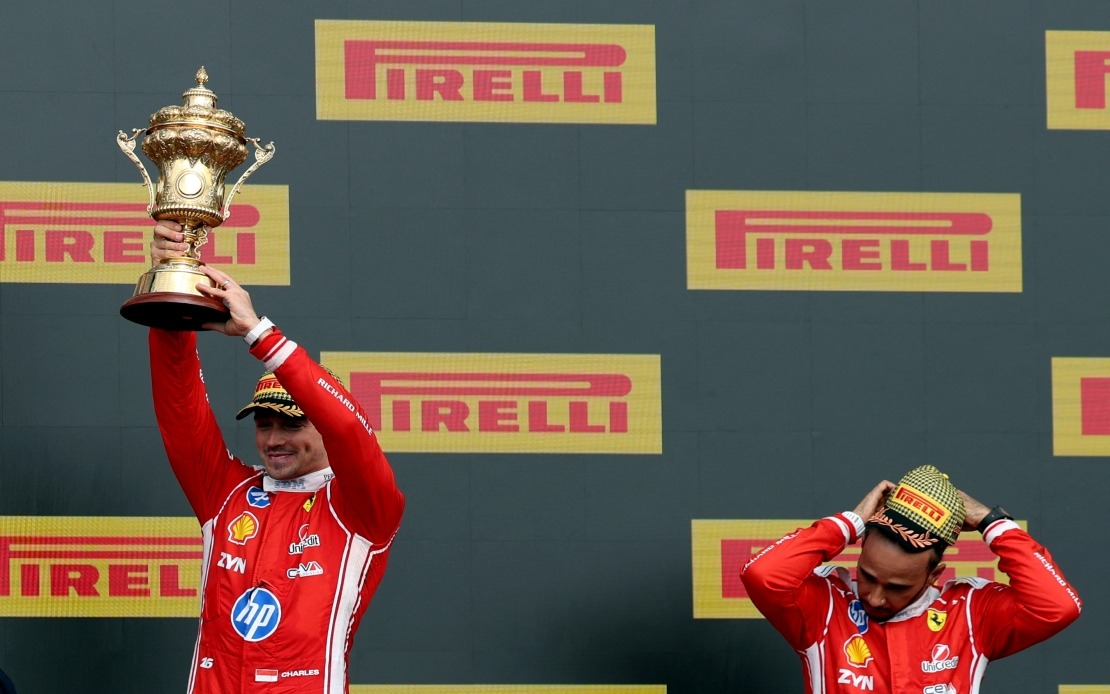
Ferrari's Charles Leclerc secured a hard-fought victory at Silverstone on Sunday, capitalising on a crucial mechanical failure that derailed championship leader Kimi Antonelli's strong comeback bid in a race defined by late-stage drama and controversial pit-stop strategy calls. The result marks Leclerc's first triumph since the 2024 United States Grand Prix and represents another significant breakthrough for Ferrari's recent resurgence, which has gathered momentum following an impressive victory in Spain two races prior.
The race unfolded with remarkable swings in fortune. Leclerc, starting from second on the grid, executed a perfectly-timed launch at the opening corner to sweep past pole-sitter Antonelli and immediately assert control. Hamilton capitalised on the same moment to demote the Mercedes driver to third position, forcing Antonelli to recover from a less-than-ideal beginning. Leclerc methodically extended his advantage throughout the opening phase of the race while Hamilton encountered difficulties with front tyre graining, a condition that eventually allowed Antonelli to move past him at Copse on lap 11 with fresher rubber providing superior grip.
The strategic battle between Ferrari and Mercedes unfolded across the pit-stop cycles, with Ferrari electing to bring Leclerc in on lap 25 to secure track position. Mercedes responded by keeping Antonelli on track for another 10 laps, a calculated gamble designed to give the 19-year-old championship leader a decisive advantage through the fresher tyre compound. The mathematics appeared sound: Antonelli emerged from his pit stop roughly seven seconds adrift of Leclerc but equipped with considerably fresher soft tyres that theoretically offered superior performance over the remaining stint. The Mercedes driver's superior straight-line speed, a characteristic advantage that has distinguished the team throughout this season, promised a compelling closing phase.
Antonelli's recovery proved rapid and decisive. The gap compressed from seven seconds to under three seconds by the time roughly 11 laps remained, and the Mercedes driver appeared genuinely poised to capitalise on his advantage and seize control of the race. The momentum clearly favoured the championship leader, whose relentless pace suggested that victory remained well within grasp despite the earlier restart complications. However, at precisely the moment when Antonelli seemed destined to wrest the lead from Leclerc, his car struck one of the Copse corner curbs, a moment that would ultimately prove fatal to his victory aspirations.
Antonelli's immediate diagnostic assessment proved accurate: something had broken on impact. Mercedes initially suspected front-wing damage before determining that the front-left wheel shield had been compromised, a component failure that would prove catastrophic to the remainder of his race. The team removed the damaged part during an unscheduled second pit stop, but the underlying steering damage persisted, forcing Antonelli to navigate the remainder of the circuit while repeatedly running over kerbs and struggling to maintain clean lines through critical corners. What had been a position of strength transformed into a battle for damage control, with Antonelli conscious that remaining points were better than nothing.
Leclerc appeared destined for a commanding victory as the race entered its final stages, with the Ferrari driver primed to cross the finish line approximately 30 seconds clear of his nearest rival. That margin evaporated when Max Verstappen spun into the gravel at Stowe corner with four laps remaining, triggering a Safety Car that bunched the field and rejuvenated several drivers' championship prospects simultaneously. The bunching created tactical complications for the pit crews working the final phases of the race.
Ferrari's response to the Safety Car situation proved decisive. The team elected to bring the lead car into the pits for fresh soft tyres, a decision that placed Leclerc's advantage momentarily in jeopardy as he dropped behind George Russell momentarily. Mercedes, by contrast, opted to leave Russell on track without an additional stop, a calculation that proved invaluable when the race finished behind the Safety Car after a planned final restart was abandoned. Leclerc inherited the victory despite the pit stop, while Russell's decision to remain trackside meant he emerged in second place ahead of Hamilton, a late-race choreography that prevented the champion from utilising his fresh tyre advantage.
The decision to abandon the planned restart decision triggered audible frustration among spectators at Silverstone, with sections of the crowd vocalising their disappointment that the season finale lacked a climactic one-lap sprint to the finish. The FIA subsequently acknowledged that an earlier message indicating racing would resume had been issued in error because of a software malfunction in their notification systems, an explanation that provided little consolation to those who had anticipated a thrilling final lap.
Leclerc's victory carries profound implications for the championship momentum entering the subsequent races. The Ferrari driver expressed obvious relief and satisfaction following the result, describing the emotional weight of finally securing victory following what he characterised as particularly challenging preceding weekends. His commentary reflected the genuine struggle the team has experienced to optimise car setup and driver confidence following earlier performance plateaus. The restoration of that confidence, which Leclerc suggested emerged during Saturday's sprint session before reaching optimal parameters on Sunday's race day, represents a critical psychological achievement beyond the simple points accumulation.
Antonelli's mechanical misfortune transforms both the immediate race outcome and the broader championship trajectory. The Mercedes driver's extraordinary winning streak of five consecutive victories through Monaco had established a commanding championship lead of 66 points, a margin that appeared insurmountable given the remaining races and the competitive regulations framework. That advantage suddenly feels considerably more vulnerable following Sunday's dramatic collapse, with Leclerc's resurgent form and Ferrari's apparent resolution of recent technical difficulties presenting genuine renewed threats to Mercedes' dominance.
The 19-year-old Antonelli demonstrated commendable professionalism throughout his mechanical crisis, continuing to push despite the obvious steering complications and accepting the reality that points were preferable to a complete retirement. His philosophical post-race assessment acknowledged the cruel fortune that can define Formula One, particularly on occasion when marginal contact with circuit infrastructure triggers component failures that derail carefully executed strategies.
Russell's ascension to second place capped a race that saw the Mercedes driver navigate multiple complications, including early gearbox concerns and an unscheduled pit stop to address a slow right-rear puncture. Hamilton's journey proved more straightforward following his initial false-start penalty, though the five-second time penalty briefly dropped him significantly in the running order before his demonstrated racecraft allowed him to reclaim third position ahead of Verstappen following several laps of hard competitive racing.
The result reinforces Ferrari's momentum and suggests that the second half of the season will prove considerably more competitive than recent weeks suggested, with multiple teams nursing genuine prospects of championship advancement and victory.

