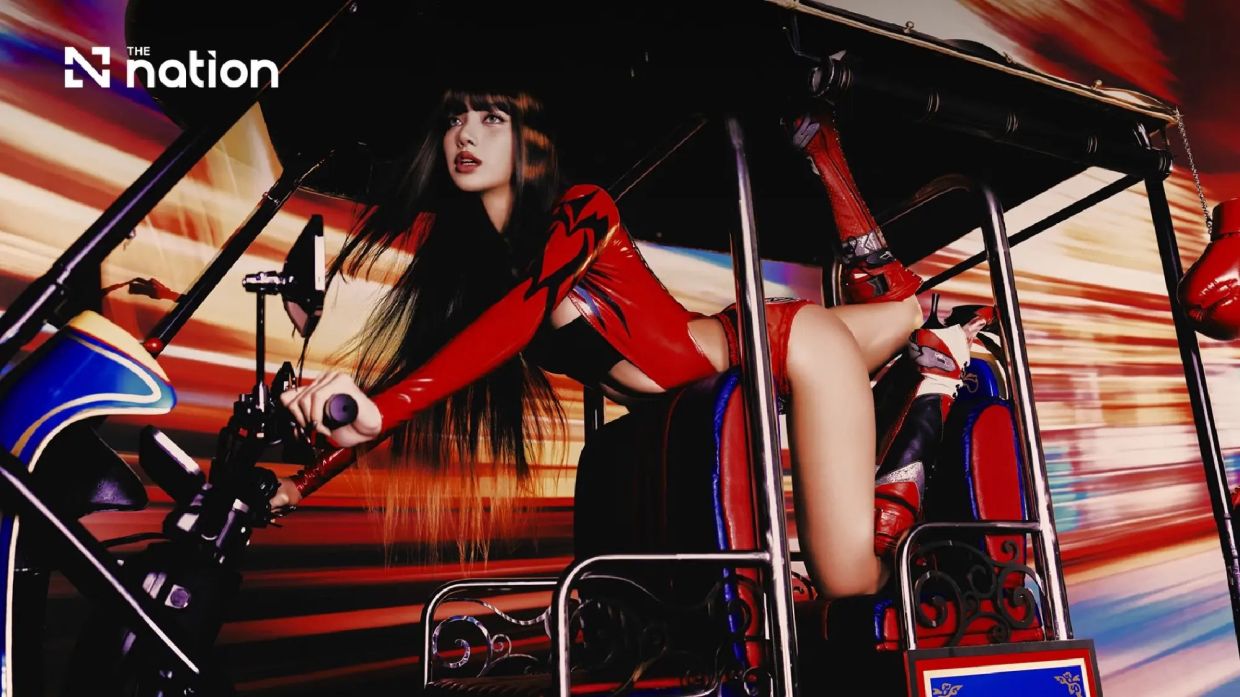
Thai pop superstar Lalisa Manobal, better known as Lisa from the global phenomenon BLACKPINK, has unveiled a visually striking campaign for her forthcoming single "SaWaDiKa" that places two of the kingdom's most instantly recognizable symbols—the combat sport of Muay Thai and the ubiquitous three-wheeled tuk-tuk—at the very centre of her artistic vision. Released through official promotional imagery, the campaign demonstrates a sophisticated approach to cultural representation, one that neither romanticizes nor caricatures Thai identity but instead recontextualizes familiar national symbols through a lens of contemporary high fashion and contemporary athleticism.
The campaign's visual language reveals Lisa in custom-designed contemporary interpretations of traditional Muay Thai boxing attire. Most prominently, the imagery showcases her wearing boxing shorts emblazoned with "LISA" across the waistband, a direct nod to the ceremonial importance of a fighter's name in the ring. Rather than presenting an historically accurate reproduction of traditional ring wear, the concept deliberately merges elements of combat sport aesthetic with futuristic fashion sensibilities, creating a hybrid visual identity that speaks to both her Thai roots and her position within the international luxury fashion sphere.
Another striking image positions Lisa astride a distinctively painted tuk-tuk in shades of blue and red—itself a fixture of Bangkok's daily urban landscape—while she wears a sleek leather bodysuit paired with lace-up high-heeled boots that echo traditional boxing footwear. The photographic composition employs streaked lighting effects that generate a visual impression of velocity and forward momentum, transforming the humble three-wheeler from a practical mode of transport into a symbol of dynamic cultural assertion. This aesthetic choice carries particular significance for Southeast Asian audiences familiar with tuk-tuks as omnipresent but often overlooked elements of their own urban environments, here elevated to global prominence.
The single itself carries a title with linguistic and cultural resonance that extends beyond mere wordplay. "SaWaDiKa" represents a stylized rendering of "sawasdee ka," the Thai language's polite greeting exchanged countless times daily across the kingdom. By selecting this phrase as the title for an international music release, Lisa and her creative team have effectively positioned an everyday expression of Thai courtesy and warmth at the narrative core of the campaign, suggesting that cultural identity need not manifest through spectacle or exoticism but can instead be found in the ordinary courtesies that define a society.
The rollout strategy that preceded the official announcement demonstrated sophisticated marketing coordination across multiple continents. Large-scale outdoor displays bearing the message "HELLO สวัสดีค่ะ [Sawasdee ka]" appeared simultaneously in major global cities including Bangkok, New York, Los Angeles, and Mexico City, functioning simultaneously as teaser materials and as visual proof of Thailand's growing cultural footprint in international markets. The coordinated global deployment of a Thai-language greeting represents an unusual marketing approach in the Western pop music industry, where English-language dominance has historically been treated as non-negotiable for international commercial success.
Thapanee Kiatphaibool, governor of the Tourism Authority of Thailand, publicly endorsed the campaign through a statement posted beneath Lisa's Instagram announcement, describing the singer's adoption of the Thai greeting as a reinforcement of the nation's international brand identity. This institutional validation underscores how contemporary celebrity has become intertwined with national soft power initiatives. Lisa's appointment in 2025 as "Amazing Thailand Ambassador" formalized what had been an organic cultural phenomenon—a Thai artist of unprecedented global reach using her platform to consistently centre her national identity rather than obscure or downplay it, a choice that runs counter to historical patterns in the music industry where artists from non-English-speaking countries have often felt compelled to minimize linguistic and cultural particularities in pursuit of mainstream international audiences.
"SaWaDiKa" functions as the first single from Lisa's forthcoming six-track EP "PRESS PLAY," scheduled for release on October 23, 2026. The official framing of this EP positions it as both a return to the artist's foundational influences and a retrospective celebration of her trajectory from provincial Thailand to the apex of global entertainment. According to the campaign materials, the project will contain six compositions, though the titles of the remaining five tracks have not yet been disclosed, maintaining audience anticipation across the extended promotional cycle leading toward the full project's unveiling.
This latest release continues a deliberate visual and thematic pattern that Lisa has established throughout her solo career, one that consistently privileges Thai cultural representation rather than treating it as incidental background. Her 2021 debut solo single "LALISA," drawn directly from her birth name, deliberately incorporated traditional Thai dress, dance-inspired visual elements, and musical production choices that reflected her cultural inheritance. The accompanying music video presented her adorned in an elaborate gold-toned Thai-inspired costume and headdress, positioned against architectural elements and visual references to her native Buri Ram province, a choice that centered rather than marginalized her geographic origins.
The subsequent 2024 release "Rockstar" extended this thematic thread into a contemporary urban context, filming its music video against the streetscapes of modern Bangkok, specifically utilizing Yaowarat Road in the city's historic Chinatown district alongside other recognized Bangkok locations. That project demonstrated an evolution in how Lisa approached cultural representation, transitioning from heritage-focused imagery toward the incorporation of lived urban Thai experience as transmitted through recognizable contemporary geography. "SaWaDiKa" now builds upon this foundation by adding Muay Thai—a martial art with centuries of cultural and spiritual significance in Thai society—the tuk-tuk as a symbol of Southeast Asian urbanism, and the Thai language itself as literal text within the global campaign.
For Malaysian and broader Southeast Asian audiences, the campaign carries implications extending beyond entertainment consumption. Lisa's consistent assertion of Thai cultural identity on the global stage has coincided with increased international interest in Southeast Asian markets and aesthetics more broadly. Her strategic elevation of everyday Thai symbols—a greeting, a vehicle type, a martial art—suggests a model by which regional artists might engage with global audiences without requiring cultural subordination or erasure, a particularly salient observation in markets like Malaysia where regional identity often competes with global English-language entertainment dominance.
The song's official release schedule reflects the global reach of Lisa's fanbase while maintaining particular respect for her domestic market. "SaWaDiKa" will become available at 5pm Pacific Time and 8pm Eastern Time on Thursday, September 3, 2026, but in Thailand the release time converts to 7am on Friday, September 4, positioning the Thai market for immediate access rather than relegating it to secondary status in the international rollout sequence. This temporal coordination carries symbolic weight, suggesting that despite her international prominence, Lisa's Thai audience receives equivalent consideration to Western markets typically privileged in pop music release strategies.
The comprehensive nature of the "SaWaDiKa" campaign—encompassing visual aesthetics, linguistic choices, institutional tourism partnerships, and global marketing coordination—demonstrates how contemporary popular music has become inseparable from national cultural diplomacy. Lisa's position as simultaneously a K-pop industry export, a Thai national, and a global entertainment icon creates a unique space within which questions of cultural representation, artistic identity, and commercial strategy become thoroughly entangled. The "PRESS PLAY" EP represents more than a musical project; it constitutes a sustained assertion that Thai identity and global commercial success need not exist in tension but can instead be mutually reinforcing, a message that resonates particularly strongly across Southeast Asian contexts where such questions remain persistently contested.

