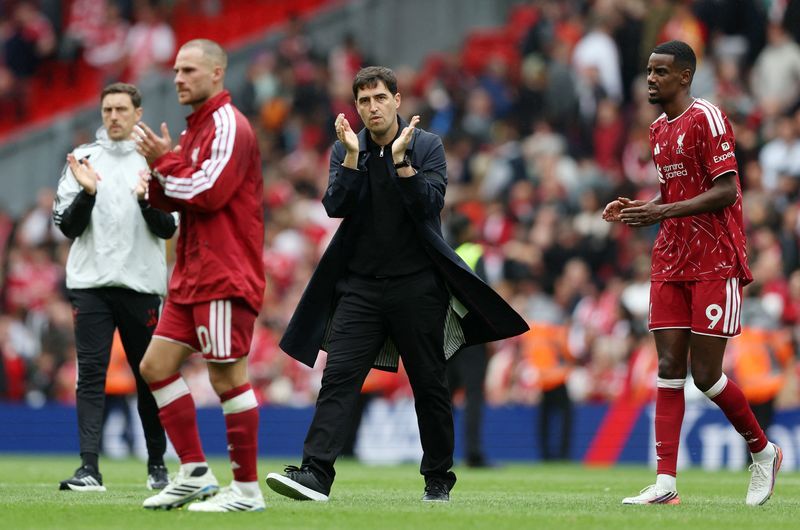
Andoni Iraola has maintained an optimistic outlook regarding Liverpool's prospects this season, even as the club remains without a victory in the Premier League under his stewardship. The Spaniard's latest assessment comes following Saturday's 2-2 stalemate against Nottingham Forest, a result that, while frustrating on the surface, contained enough positive indicators to convince him that his vision for the club is gradually materialising.
Iraola arrived at Anfield this summer with a formidable challenge before him. Liverpool endured a deeply disappointing previous campaign, sliding from champions in 2025 to fifth place despite the club's record-breaking investment of £446 million in fresh talent. The pressure to reverse this decline is substantial, and the expectations from supporters who have grown accustomed to sustained success under previous regimes remain sky-high. Yet the former Bournemouth manager has entered the role with a clear philosophical blueprint rather than panic or cautious conservatism.
At the heart of Iraola's approach lies a deliberate shift in playing style. He envisions Liverpool functioning as a pressing, attacking force that dominates possession and territory through relentless intensity. This represents something of a return to the high-energy principles that characterised Juergen Klopp's celebrated tenure, when Anfield's atmosphere and the team's aggressive pressing were genuinely feared by opposition managers across Europe. The more measured, possession-retention style of his predecessor Arne Slot, while respectable, did not produce the titles Liverpool sought, and Iraola believes a return to attacking intensity offers the path back to the summit.
However, Saturday's performance against Nottingham Forest illustrated the unfinished nature of this transformation. Forest's opening goal, scored by Dan Ndoye, exposed a fundamental weakness in Liverpool's current setup: their vulnerability to swift counterattacks during periods of disjointed play. The first half produced long stretches of sluggish football that left Iraola visibly frustrated on the sideline, as his side failed to impose the tempo and intensity he demands. These early-season struggles reflect a broader truth about tactical transitions—they cannot be implemented instantaneously, regardless of the manager's clarity of vision or the quality of the personnel involved.
The narrative shifted dramatically after the interval. Liverpool's second-half display demonstrated the potential Iraola believes exists within this squad. The tempo increased noticeably, ball movement became crisper, and the team's pressing became substantially more coordinated. Alexander Isak equalised shortly after the hour, and new signing Victor Munoz added a second goal late on to secure the draw. This capacity to recover from behind for a second consecutive match—having achieved a similar comeback against Newcastle in their season opener—suggests character and adaptability within the group, even if the end result remains a point rather than three.
Munoz, brought in recently to strengthen the wide attacking contingent, has made a tangible impression despite the team's lack of victories. Iraola offered particular praise for the winger's work rate and threat level, noting that his tireless running and willingness to engage repeatedly in attacking situations provides exactly the type of dynamic Iraola wants to cultivate. Beyond the offensive contributions, Munoz has also shouldered defensive responsibilities, adding substance to his overall impact on proceedings.
Yet Iraola's overarching concern extends beyond individual performances or momentary flashes of quality. He has identified a consistent pattern of sluggish, passive play early in matches as the underlying problem restraining Liverpool's progress. The issue, he emphasises, lies specifically in what the team does without possession. During these phases, Liverpool has been too relaxed, maintaining excessive distance between players and inadvertently creating space for opponents to exploit. When he adjusted the intensity of pressing and reduced gaps between units, the difference became immediately apparent—duels were won more frequently, and the team's attacking phases became sharper and more purposeful.
Liverpool's supporters and those following the club internationally should understand that Iraola has explicitly signalled his expectation that the tactical evolution will require patience. A fundamental shift in team culture and playing patterns, particularly one designed to increase intensity across ninety minutes, demands time for integration and refinement. Players must reprogram their instincts, midfielders must develop new pressing triggers, and defensive shape must be maintained while pursuing higher-tempo football. None of this happens within days or even weeks.
Reinforcements arriving at Anfield should accelerate this process considerably. British media has reported that Liverpool have secured an agreement to sign France international Bradley Barcola from Paris Saint-Germain, with the 23-year-old representing precisely the type of player Iraola's system requires. Barcola's exceptional pace and propensity for direct, penetrative running align seamlessly with the high-tempo, front-foot attacking approach the manager advocates. Such additions strengthen the tactical coherence of the squad and should provide meaningful improvements to results in the coming weeks.
The challenge facing Iraola and Liverpool is navigating the space between nascent promise and tangible achievement. The entertainment value and attacking intent are visibly increasing, and the second-half improvements suggest the training ground work is beginning to translate into match situations. Yet points and victories—the ultimate currency in football—have remained elusive. Iraola himself has acknowledged this frustration, noting that while comebacks demonstrate commendable character, the ultimate measure of success is winning matches and accumulating the three-point rewards. The next phase of Liverpool's season will determine whether this foundation-building period yields the results necessary to rebuild confidence and momentum, both within the dressing room and among supporters who have experienced championship-winning football within recent memory.

