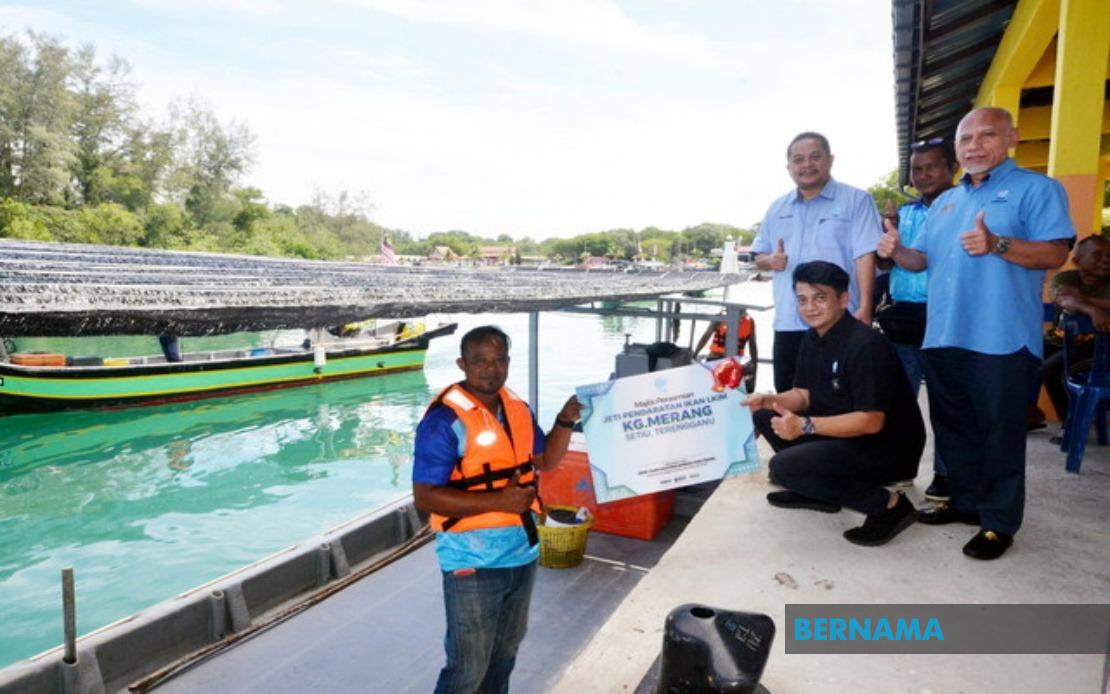
The Malaysian Fisheries Development Authority (LKIM) is stepping up its infrastructure push across the country's fishing communities, committing RM2 million to repair, upgrade and construct fish landing jetties as a key strategy for bolstering the sector's operational capacity and boosting fishermen's earnings. The investment forms part of a broader effort to modernise Malaysia's fisheries backbone, which remains vital to the rural economy and food security across the archipelago.
LKIM chairman Muhammad Faiz Fadzil disclosed the funding commitment while presiding over the handover of the Kampung Merang Fish Landing Jetty in Bandar Permaisuri on June 30. He noted that this year's achievements included the completion of the Merang facility, with additional jetty projects in Perak and Labuan currently advancing through documentation and tender stages. Yet despite these gains, Muhammad Faiz emphasised that available resources remain inadequate to meet nationwide demand, signalling the authority's desire for the government to allocate substantially more funds in future budget cycles to accelerate infrastructure expansion.
The Kampung Merang jetty, constructed at a cost of RM500,000, marks a significant upgrade for the fishing community. The concrete structure replaces an ageing wooden facility built informally by villagers that had deteriorated beyond safe operational standards for landing activities. The new facility commenced operations immediately following the handover ceremony and is projected to serve 124 registered fishermen operating 68 boats from the village. This direct beneficiary count underscores how targeted infrastructure investment translates into tangible improvements for livelihoods in fishing-dependent settlements.
The authority's portfolio of managed facilities is substantial, encompassing 372 fish landing jetties nationwide alongside 48 dedicated fisheries complexes and ports. This extensive network reflects LKIM's systematic approach to decentralising infrastructure across maritime regions, ensuring that fishing communities from Peninsular Malaysia to Sabah and Sarawak have access to modern landing and handling amenities. However, the sheer geographic spread of Malaysia's coastline and fishing populations suggests that existing infrastructure still falls short of optimal coverage, particularly in smaller communities and less economically developed regions.
For the Setiu district in Terengganu where Kampung Merang is located, the new jetty carries particular significance. Current data indicates that the area generates approximately 243 metric tonnes of fish annually, a figure that LKIM anticipates will rise substantially once fishermen fully leverage the upgraded facility's capabilities. This projection reflects confidence that improved landing conditions reduce post-catch losses and facilitate faster, more organised market transactions. Enhanced infrastructure directly addresses one of the sector's persistent challenges: the perishable nature of seafood and the time-sensitive nature of fish sales.
Muhammad Faiz articulated a clear logic linking physical infrastructure to economic outcomes. The availability of safe, modern jetties streamlines the entire landing-to-market process, eliminating inefficiencies inherent in makeshift facilities and reducing handling times that compromise product quality. For fishermen operating on thin margins and dependent entirely on catch sales for household income, such operational efficiencies translate into measurable financial gains. Better marketing conditions and reduced spoilage mean higher prices realised at point of sale and improved household cash flow.
The Kampung Merang investment exemplifies LKIM's targeted approach to infrastructure development, directing resources toward communities where demonstrated need and operational potential align. By focusing on areas with active fishing populations and established landing patterns, the authority maximises the return on public investment. The 124 fishermen and 68 boats registered to this facility represent a concentrated user base capable of generating measurable economic activity and validating the infrastructure investment.
Yet the RM2 million cumulative allocation across multiple projects nationwide reveals resource constraints facing Malaysian fisheries development. Given the country's extensive maritime boundaries and dispersed fishing communities, this funding level spreads thinly when distributed across repair, upgrade and new construction initiatives. The authority's explicit call for enhanced budget provision indicates awareness that current allocations cannot sustain the pace of infrastructure modernisation required to competitively position Malaysia's fisheries sector, particularly as regional neighbours invest more aggressively in harbour facilities and landing infrastructure.
The broader policy context matters here. Fishing communities across Southeast Asia face mounting pressures from climate variability, shifting fish stocks, rising operational costs and intensifying competition. Countries like Thailand, Vietnam and Indonesia have prioritised fisheries infrastructure investment as part of economic resilience strategies. Malaysia's allocation, while symbolically meaningful, must scale significantly to prevent the sector from falling behind regional competitors in terms of operational efficiency and market competitiveness. Infrastructure gaps risk pushing Malaysian fishermen into disadvantageous trading positions relative to better-equipped regional counterparts.
The Kampung Merang facility also highlights how infrastructure investment functions as social policy in fishing communities. Beyond purely economic metrics, modern jetties provide safer working environments, reduce occupational hazards associated with informal landing practices, and signal government recognition of fishing communities' contributions to national food systems. For rural Terengganu, the new facility represents tangible evidence of state investment in local development, strengthening social contract dimensions alongside economic gains.
Moving forward, LKIM's infrastructure agenda requires sustained policy attention and budget prioritisation. The authority's stewardship of 372 jetties and 48 complexes obligates continuous maintenance and periodic upgrades to prevent deterioration and ensure operational viability. Simultaneously, gaps in coverage across underserved coastal areas demand new facility development. The dual challenge of managing existing assets while expanding capacity necessitates multi-year funding commitments rather than annual allocations that constrain strategic planning and project continuity.
The Kampung Merang handover demonstrates that targeted infrastructure investment in fisheries yields tangible community benefits measurable in improved livelihoods and operational efficiency. However, the authority's candid acknowledgment of funding limitations and request for enhanced budget allocation reveals that current resource levels are insufficient to address the sector's infrastructure needs comprehensively. Policymakers must weigh these realities against the economic and social importance of sustaining Malaysia's fishing communities as the nation balances agricultural transformation with rural development objectives.

