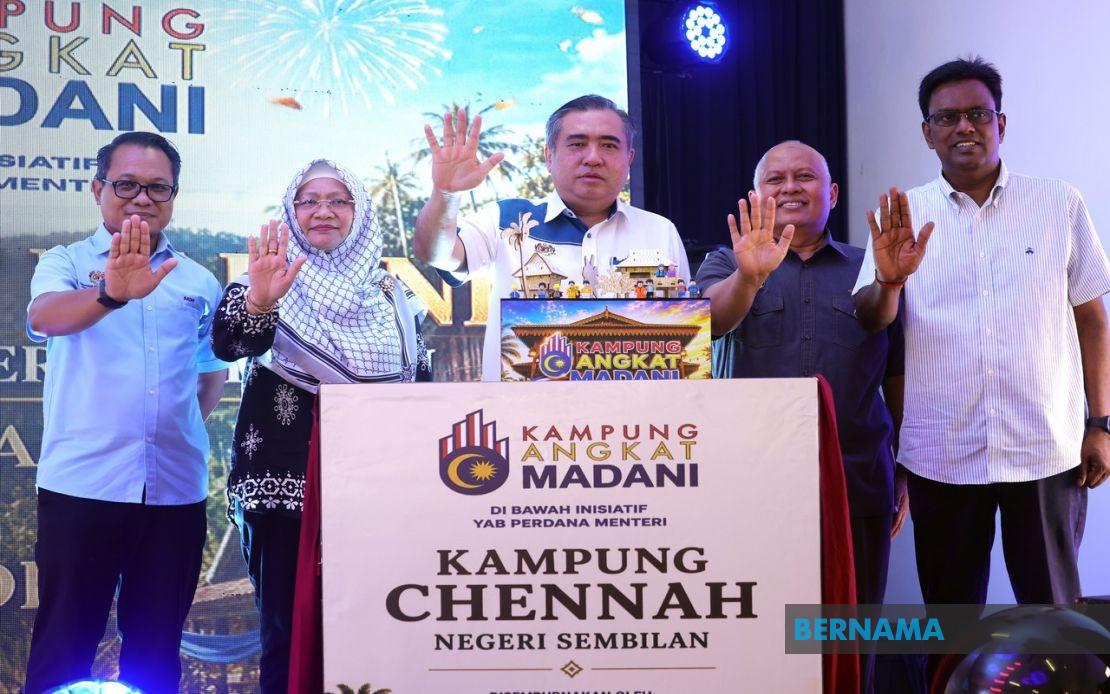
Transport Minister Anthony Loke Siew Fook has moved to dispel any perception that the rolling out of the Kampung Angkat MADANI programme in Jelebu represents a politically motivated move timed with state polling. Speaking at the launch of the Land Public Transport Agency's (APAD) initiative in Kampung Chennah on July 12, Loke clarified that this community development effort forms part of a broader government strategy conceived and initiated two years previously, and is progressing through carefully scheduled phases rather than being accelerated for electoral advantage.
The minister explained that the programme's fundamental purpose is to identify villages struggling with basic infrastructure gaps and limited socio-economic prospects, particularly those situated in geographically isolated regions far removed from city centres. By conducting detailed needs assessments, the government aims to tailor development interventions that respond to genuine community requirements rather than imposing standardised solutions. This approach reflects an understanding that rural communities, especially in peninsular Malaysia where villages like Kampung Chennah exist, often face distinct and complex challenges requiring customised policy responses.
Loke noted that the government has honoured strict electoral guidelines prohibiting official programmes during campaign periods. He stressed that he and his colleagues planned implementation activities deliberately before the nomination day threshold, ensuring compliance with administration directives established by Prime Minister Anwar Ibrahim. These protocols represent what Loke described as a new administrative culture aimed at maintaining clearer separation between government machinery and electoral competition. Once campaigns officially commence, ministers refrain from attending official government events within contested constituencies, even while discharging their regular ministerial functions elsewhere.
The selection of Kampung Chennah as APAD's flagship village for 2024 reflects the community's documented needs rather than political calculation. The minister identified the settlement's remote positioning and infrastructural deficits as key criteria driving the allocation decision. Recognising that such villages often languish without adequate public investment compared to urbanised areas, the government has committed RM500,000 toward five specific projects designed to meaningfully enhance residents' daily lives and opportunities.
These initiatives include comprehensive refurbishment of the public library facility, restoration of the futsal court to operational standards, and systematic improvements to drainage infrastructure surrounding the mosque. By investing in both social infrastructure and recreational amenities alongside essential services, the programme demonstrates recognition that rural development encompasses cultural and leisure dimensions beyond purely utilitarian considerations. For communities like Kampung Chennah, such improvements directly address isolation and inequality that characterise life in less-developed settlements.
The anticipated two to three month completion timeline reflects realistic construction scheduling, with Loke signalling that his ministry would maintain active oversight to prevent delays that often plague rural development projects. This monitoring commitment carries particular significance given historical instances where rural infrastructure initiatives have encountered implementation bottlenecks due to procurement complications, contractor capacity constraints, or logistical challenges in reaching remote areas. By explicitly committing to supervisory vigilance, Loke positioned the Transport Ministry as genuinely accountable for delivery.
Beyond the specific Jelebu interventions, Loke articulated a broader philosophical reorientation of the Transport Ministry's institutional identity. Traditionally understood as a regulatory body managing ports, airports, railways, and public transport systems, the ministry increasingly embraces social responsibility dimensions extending into community welfare and quality-of-life enhancement. This conceptual expansion reflects evolving government thinking about how individual ministries can contribute to holistic national development beyond their narrowly defined sectoral mandates.
The Kampung Angkat MADANI initiative itself represents manifestation of this expanded ministerial role. Rather than confining engagement to technical infrastructure—albeit important—the programme acknowledges that transport ministry has legitimate interests in how communities access services, economic opportunities, and essential facilities. Improved village infrastructure indirectly strengthens rural transportation dynamics and market connectivity, creating linkages between traditional ministry functions and broader development outcomes.
For Malaysian readers, particularly those in rural constituencies, Loke's clarifications address legitimate concerns about whether government resources are allocated based on genuine need assessment or electoral strategising. The emphasis on phased implementation over two years, pre-nomination day planning, and structured selection criteria aims to build public confidence that such programmes reflect developmental priorities rather than short-term political advantage-seeking. Whether such assurances sufficiently convince voters in contested areas remains an open question, particularly given historical Malaysian experiences where development projects and electoral cycles have frequently overlapped.
The Kampung Angkat MADANI programme also signals broader Southeast Asian trends wherein governments increasingly recognise that rural inequality and infrastructural gaps constitute both moral imperatives and practical governance challenges. Malaysia's experience with balancing urban-centric growth against rural development needs parallels challenges across the region, from rural Thailand to Indonesia's outer islands. Systematic programmes targeting documentation of village requirements and phased infrastructure improvement represent policy approaches gaining traction across ASEAN nations seeking to address rural marginalisation.
For transport sector specifically, Loke's positioning of the ministry as development-focused rather than purely regulatory reflects global patterns where transport agencies expand remits beyond traditional infrastructure management. This aligns with contemporary development thinking emphasising connectivity's role in reducing rural poverty and enabling economic participation. Villages with improved transport access, enhanced market facilities, and better institutional infrastructure experience measurable economic activation and demographic stabilisation.
Moving forward, the success of individual Kampung Angkat MADANI interventions will significantly influence public perception of government sincerity regarding rural development. Kampung Chennah residents' experiences with project quality, timeline adherence, and tangible benefit delivery will establish benchmarks against which future rural initiatives are evaluated. For a government navigating persistent perceptions of urban bias and developmental inequality, ensuring that such village-focused programmes deliver genuine improvements rather than symbolic gestures represents a considerable political and developmental imperative.
The minister's repeated emphasis on programme legitimacy and non-electoral timing underscores sensitivity within government circles regarding public scepticism about development-election connections. This defensive posturing, while understandable, inadvertently highlights precisely the concern that critics raise: that rural communities have historically experienced the intertwining of government resources and electoral cycles. Only sustained demonstration of genuinely programmed, needs-responsive rural investment divorced from electoral timing will ultimately rebuild trust in governmental development claims.

