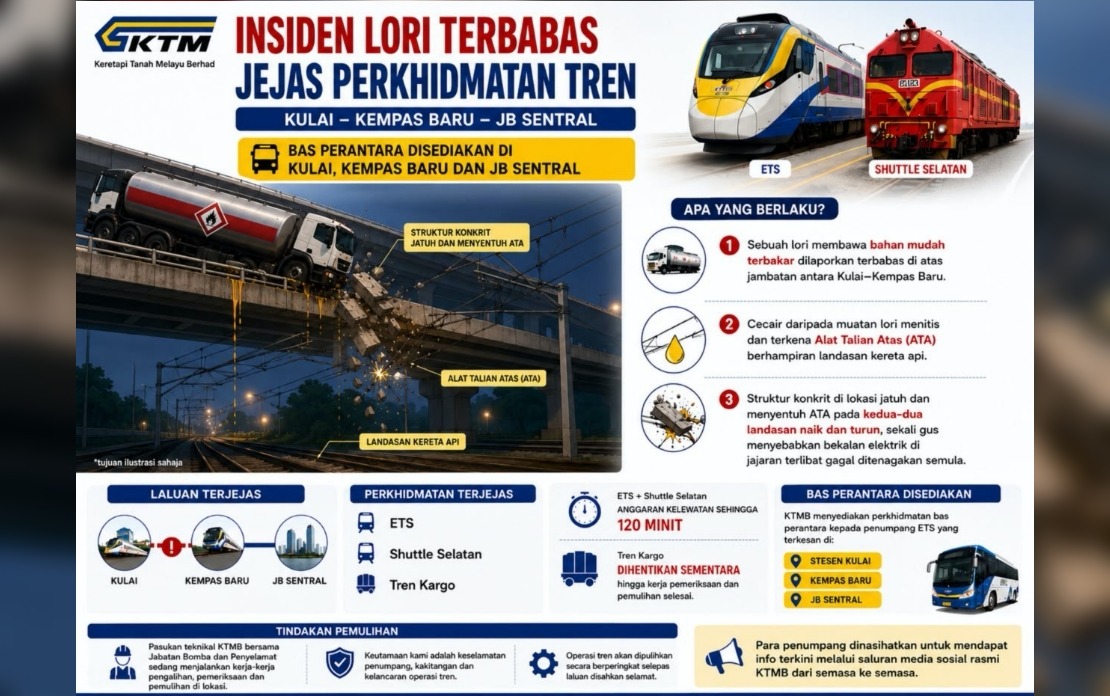
Keretapi Tanah Melayu Berhad (KTMB) announced service disruptions on the Kulai–Kempas route following a traffic incident that cut power to railway infrastructure. The accident involved a lorry transporting flammable liquid that skidded dangerously close to the electrified tracks, triggering an automatic power shutdown as a safety precaution. The incident, which occurred on August 5, immediately halted both the Electric Train Service (ETS) and Shuttle Selatan bus replacement service, leaving hundreds of commuters stranded across multiple stations in Johor Bahru.
The power supply failure proved more disruptive than the physical accident itself, as the railway's electrical systems needed to be safely restored before any trains could resume operation. KTMB responded by mobilising emergency response teams to both clean up the spillage and conduct electrical inspections to ensure track safety. The utility company worked simultaneously with hazmat specialists to contain any leaked flammable material and prevent environmental contamination. These parallel operations, while necessary for public safety, extended the overall recovery timeline beyond what a simple vehicle removal would have required.
Passengers relying on the ETS discovered that shuttle bus services had been activated at three key stations: Kulai, Kempas Baru, and JB Sentral. This arrangement allowed commuters to continue their journeys using road-based alternatives, though travel times increased substantially due to traffic congestion typical of Johor Bahru's arterial roads. KTMB indicated that compensation through fare adjustments would be automatically applied to season-ticket holders and registered passengers, though commuters making one-way journeys were encouraged to retain their tickets for refund claims at station counters.
The Shuttle Selatan service, which operates as a dedicated coach replacement network, faced a more complex situation. Unlike the ETS, which had an established shuttle contingency plan, Shuttle Selatan passengers were advised to seek alternative transportation entirely. This asymmetrical response reflected the different operational structures of the two services—the ETS operates on fixed electrified tracks requiring power restoration, while Shuttle Selatan typically runs on scheduled routes without the same redundancy infrastructure. Many commuters consequently faced longer delays and unplanned expenses in arranging private transport or ride-hailing services.
By late evening, the situation remained in flux with inconsistent service restoration. ETS9449 was running approximately 32 minutes behind schedule, while ETS9533 faced a more severe 55-minute delay. KTMB cautioned that these figures were provisional and subject to change depending on whether cleanup and electrical testing proceeded without complications. Any discovery of track damage or contamination would necessitate further investigative work before safe resumption. The railway operator's transparent communication about uncertainty, rather than promising fixed timelines, reflected the unpredictable nature of hazmat incidents on critical infrastructure.
The incident highlighted vulnerabilities in Malaysia's integrated transport network, particularly the dependency of rail services on uninterrupted electrical supply. Unlike overseas systems with underground cables or multiple redundant power sources, the Kulai–Kempas corridor relies on overhead catenary lines exposed to roadside hazards. The proximity of freight routes to railway corridors, while economically efficient, creates periodic friction between lorry operators and rail authorities. This accident exemplifies a broader Southeast Asian challenge: rapid urban expansion and congested road networks force heavy vehicles into proximity with sensitive infrastructure they were not originally designed to coexist with.
KTMB's apology and commitment to passenger assistance demonstrated adherence to regulatory standards for service disruptions, though the practical impact on thousands of daily commuters was substantial. Rush-hour disruptions particularly affect workers, students, and time-sensitive service users who cannot easily absorb delays. The Johor Bahru–Kulai corridor serves as a crucial mobility spine for the state's economic activity, so any interruption ripples across multiple sectors. The incident therefore represents not merely an operational inconvenience but a disruption to regional economic productivity.
The involvement of hazardous materials added a layer of complexity absent from routine traffic accidents. KTMB and emergency responders had to balance swift service restoration against thorough safety protocols. Incomplete cleanup or inadequate electrical verification could have invited far graver consequences—another accident, electrocution risk, or environmental damage. This conservative approach, while extending inconvenience, reflected appropriate prioritisation of safety over speed. Commuters, though frustrated, generally appreciated assurances that trains would not resume until fully safe.
Operationally, the incident underscored the importance of investing in resilient infrastructure and contingency planning for rail networks across Malaysia and the region. As urban populations grow and dependency on mass transit increases, single-point failures become progressively more consequential. Some observers noted that more robust physical barriers separating lorry routes from electrified railway sections, or redundant power supply arrangements, could mitigate future disruptions. Such infrastructure improvements require capital investment, but the cost of periodic service shutdowns arguably justifies preventive spending.
For passengers, the incident served as a reminder to maintain flexibility when using public transport, particularly in regions where integration between different modes remains evolving. Station staff availability and clear real-time information became critical during the disruption, as passenger anxiety often stems from uncertainty rather than delays themselves. KTMB's instruction to affected passengers to seek assistance from station personnel ensured that at least a communication channel remained open, even if solutions were limited.
The Kulai–Kempas route's strategic importance in connecting Johor Bahru's manufacturing belt and residential areas with central commercial zones means that disruptions cascade beyond the rail system itself. Road congestion intensifies as displaced passengers attempt alternative routes; ride-hailing services become overwhelmed; and smaller transport operators see sudden demand spikes. Understanding these multiplier effects helps explain why transport authorities invest substantially in rapid incident response and backup systems.
As infrastructure development accelerates across Southeast Asia, similar incidents will likely recur unless deliberate interventions reduce hazard exposure. The August 5 incident in Johor serves as a regional case study in the costs of insufficient separation between high-speed freight corridors and electrified public transit. Malaysian policymakers, alongside their counterparts across ASEAN, might draw lessons for future transport network planning that prioritises resilience alongside efficiency.

