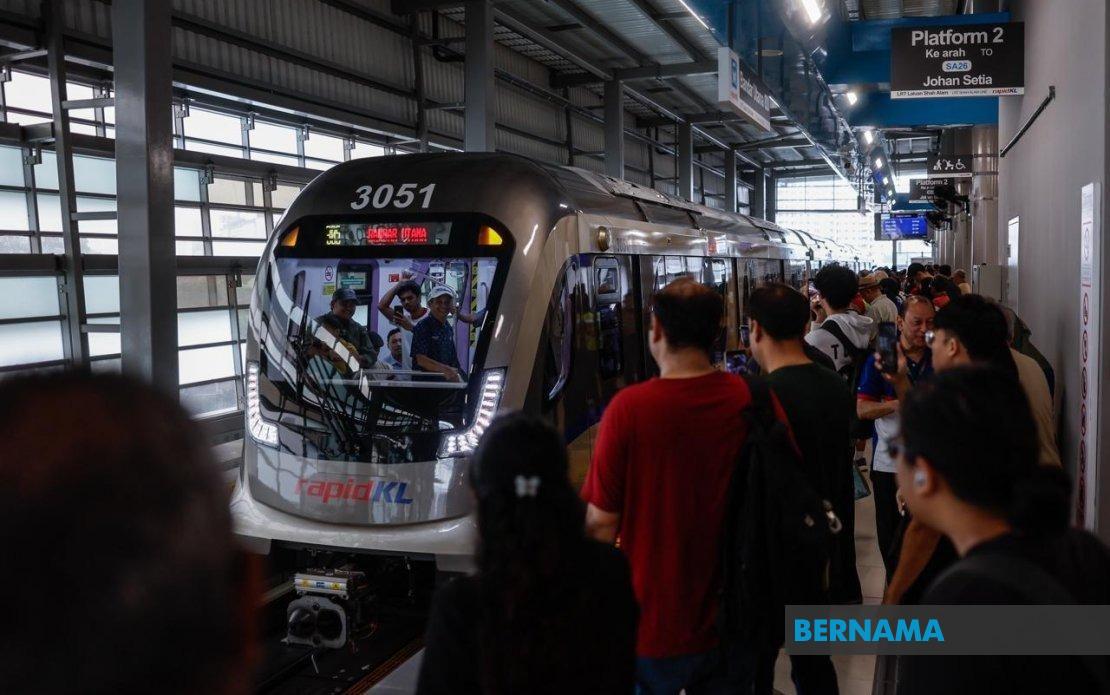
The Light Rail Transit 3 Shah Alam Line commenced commercial operations today, marking a significant milestone for public transportation in the Selangor corridor. Prasarana Malaysia Berhad projects that between 5,000 and 10,000 passengers will utilise the service on its opening day, a measured starting point that reflects the typical adoption curve for new transit infrastructure. The service began at 6 am, with commuters at various stations showing considerable enthusiasm about accessing the new rail network, according to Prasarana's management observations.
Prasarana President and Chief Executive Officer Amir Hamdan articulated an optimistic medium-term vision during his remarks at Glenmarie 2 station, indicating that daily ridership could expand to 67,000 passengers within the first operational year. This target is contingent on how swiftly the Shah Alam region's workforce and residents integrate the LRT3 into their commuting patterns. The projection suggests the operator believes genuine demand exists once the novelty wears off and the line becomes embedded in people's daily routines. Early feedback from passengers has centred on the convenience of rail commuting as an alternative to vehicular traffic, a significant draw in a metropolitan area increasingly plagued by congestion.
The launch benefits from a one-month promotional window offering completely free fares across LRT3 services and associated feeder bus routes operated by Prasarana. Prime Minister Datuk Seri Anwar Ibrahim announced this incentive yesterday, running from today through 31 July. The subsidy removes financial barriers during the critical period when commuters are evaluating whether the new line fits their travel needs, potentially inflating early-phase ridership figures and accelerating the establishment of habit-forming usage patterns. This government support underscores the political importance assigned to expanding Kuala Lumpur and Selangor's rail network.
Operational performance during the inaugural day has remained stable, with train frequencies set at approximately eight-minute intervals during morning and evening peak periods. Prasarana has maintained that all station facilities, including automated ticketing systems, electronic gates, and crowd management infrastructure, are functioning without material incident. The operator has deliberately adopted a conservative approach to capacity planning, recognising that new transit lines invariably experience an adjustment phase before settling into sustainable usage patterns. This measured strategy reflects operational experience from previous Prasarana line openings and international best practices in rail transit management.
The Shah Alam Line carries particular strategic importance because two of its stations function as interchange hubs linking to established networks. Glenmarie 2 connects commuters to the Kelana Jaya Line, while Bandar Utama provides access to the Kajang Line. These interchange points represent critical nodes in the greater Klang Valley's evolving transit ecosystem, enabling seamless journeys across multiple rail corridors. The successful integration of the new line with existing infrastructure will substantially enhance regional connectivity and potentially unlock latent demand from commuters currently dependent on private vehicles.
Prasarana's immediate operational focus centres on passenger experience rather than aggressive capacity expansion. Management has prioritised monitoring how users interact with new systems—automatic gates, ticketing machines, and station crowd flows—to identify potential friction points before they become chronic problems. This granular attention to user experience during the opening phase could prove instrumental in converting first-time riders into regular patrons. The operator has signalled flexibility regarding future infrastructure adjustments, including potential increases in train frequency and strategic positioning of standby vehicles during peak demand windows.
The operator has not yet determined whether gender-segregated coaching is necessary, preferring instead to gather empirical ridership data and passenger feedback before implementing such measures. This evidence-based approach contrasts with some transport authorities that introduce women-only facilities preemptively. For Malaysian commuters, particularly female passengers navigating crowded public transit, the eventual availability of such facilities could improve perceptions of safety and comfort, though current ridership volumes apparently do not yet justify their implementation.
The Shah Alam Line's opening occurs within a broader context of Malaysia's intensifying focus on public transport infrastructure as a counterweight to vehicular congestion and urban sprawl. Successive government administrations have committed substantial capital to expanding rail networks across the Klang Valley, recognising that sustainable metropolitan development depends on robust transit systems. The LRT3 represents incremental progress toward this objective, though the corridor's ultimate success hinges on whether projections prove accurate and whether complementary land-use policies concentrate development around transit nodes.
For the broader Southeast Asian region, the Shah Alam Line launch offers instructive lessons in transit system management and public-private coordination. As cities across Indonesia, Thailand, Vietnam, and the Philippines grapple with worsening congestion and air quality degradation, observing how Malaysian authorities execute rail expansion and market adoption strategies carries relevance. The region's increasing urbanisation creates urgent demand for integrated transit systems, yet implementation challenges remain formidable, making the documentation of successful precedents valuable.
Ridership trends over the coming weeks will significantly influence whether the 67,000 daily passenger target materialises or proves overly optimistic. The one-month free-fare period provides a natural experiment in latent demand, allowing Prasarana to understand whether congestion reduction alone drives adoption or whether additional service enhancements and land-use integration remain necessary. Careful analysis of this opening phase will inform strategic decisions about future line extensions and service optimisation across the broader network.

