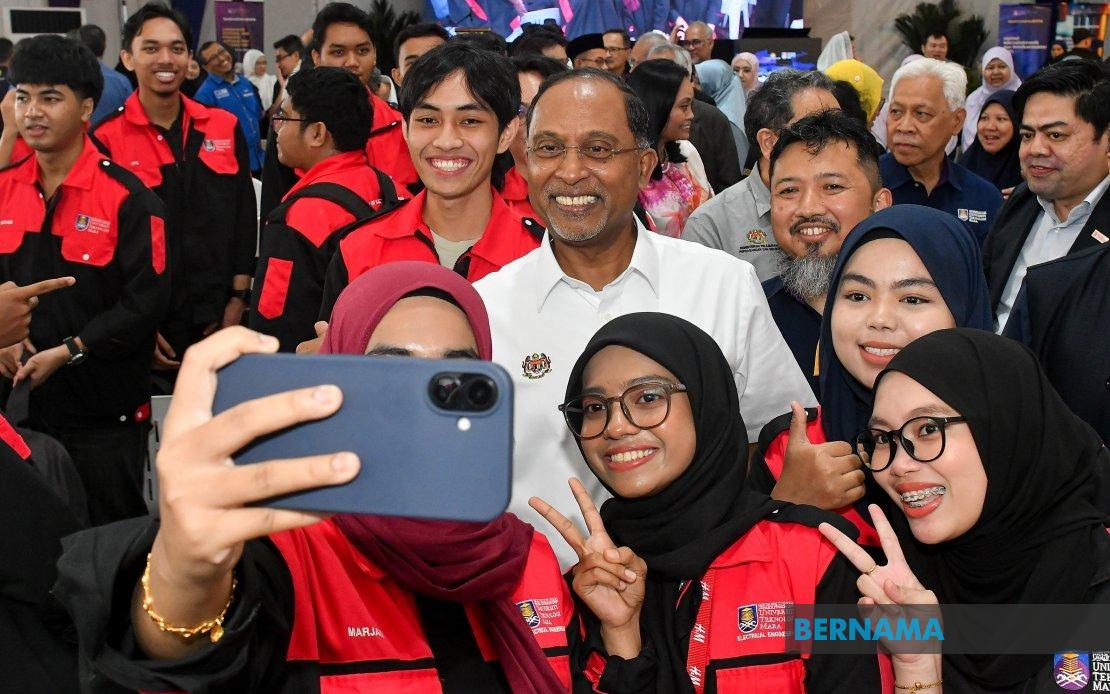
The launch of the Light Rail Transit 3 Shah Alam Line marks a turning point for campus accessibility in the Klang Valley, with immediate advantages flowing to the student population at Universiti Teknologi MARA's flagship Shah Alam campus. The transport infrastructure addresses a longstanding challenge for the university's tens of thousands of commuting students, many of whom have endured prolonged journeys through congested suburban corridors. Higher Education Minister Datuk Seri Dr Zambry Abd Kadir, speaking during a visit to the campus on June 30, emphasised how the dedicated UiTM Shah Alam Station represents more than simple convenience—it signals a strategic investment in human mobility that supports broader regional development across Selangor.
The enthusiasm among students observed during the line's inaugural period underscores genuine relief from the transportation burden that has constrained campus life and academic productivity. Zambry noted that the availability of rapid transit directly reduces commuting costs while freeing up time previously lost to traffic delays, a particularly acute problem as the Shah Alam corridor continues its rapid urbanisation. For students managing tight budgets while pursuing engineering and technical qualifications, the elimination of daily transport expenses carries substantial economic weight. The transport corridor now links 20 interconnected stations spanning from Bandar Utama through to Johan Setia, weaving together multiple residential nodes and commercial hubs that comprise the greater Klang Valley metropolitan area.
The Prime Minister Datuk Seri Anwar Ibrahim's decision to implement free fares from June 29 through July 31 represents a policy gesture that acknowledges transport accessibility as essential infrastructure for social mobility and educational opportunity. This temporary subsidy period allows students and workers to experience the service's genuine value without financial barriers, potentially embedding the habit of transit usage among younger demographic cohorts. The 20-station network—encompassing strategically positioned interchanges at Stadium Shah Alam, Bandar Baru Klang, and Pasar Klang—creates a skeletal framework for Klang Valley movement that complements rather than duplicates existing transport corridors, addressing historical gaps in the region's metropolitan connectivity.
Concurrently with celebrating transport infrastructure gains, Zambry unveiled the Semiconductor@UiTM initiative, a strategic program positioning Malaysia's premier technical university as a cornerstone institution within the country's evolving high-technology ecosystem. The initiative represents substantive translation of government policy into institutional capacity, with UiTM receiving RM20 million in government allocation directed toward infrastructure development, faculty expertise cultivation, and curriculum alignment with international semiconductor industry standards. This investment philosophy—channelling public resources into talent pipeline development rather than passive subsidies—reflects the administration's technocratic approach to sustaining Malaysia's position within global manufacturing value chains.
The semiconductor sector remains economically vital for Malaysia, currently commanding approximately 13 per cent of global market share while generating over RM300 billion in annual revenue for the national economy. This substantial contribution masks underlying vulnerabilities: as automation accelerates and competition from lower-cost jurisdictions intensifies, Malaysia must continuously upgrade its technical workforce to capture higher-value design, testing, and specialisation activities rather than competing purely on manufacturing cost. UiTM's pivot toward semiconductor-focused engineering education directly addresses this strategic imperative by ensuring the next generation of Electrical and Electronics Engineering graduates possess cutting-edge technical competency aligned with contemporary industry requirements.
The program's architecture reflects sophisticated understanding of how academic excellence translates into economic competitiveness. Beyond conventional classroom instruction, Semiconductor@UiTM emphasises structured collaboration between university researchers and industry practitioners, creating experiential pathways through which students encounter real-world technological challenges before graduation. This cross-sector learning model exposes undergraduates to global semiconductor supply chain complexities while building networks that facilitate employment transitions and entrepreneurial ventures. By positioning the university as an intermediary between academic knowledge creation and industrial application, UiTM potentially attracts multinational semiconductor corporations seeking reliable local talent pipelines and research collaboration opportunities.
The National Semiconductor Strategy that informs this university-level initiative reflects broader governmental recognition that Malaysia's comparative advantages—established semiconductor manufacturing infrastructure, skilled technical workforce, geographic positioning within Asian production networks—require continuous renewal through innovation and human capital investment. UiTM's elevated focus on semiconductor engineering education directly implements this strategic vision at the institutional level, where curriculum decisions, faculty recruitment, and research prioritisation determine whether students emerge with genuinely marketable expertise. The RM20 million allocation, while meaningful, represents relatively modest investment in infrastructure and training capacity relative to the sector's economic significance, suggesting this initiative functions as a catalyst for institutional transformation rather than a comprehensive sectoral funding mechanism.
Zambry's characterisation of UiTM's semiconductor initiative as a benchmark for other Malaysian universities acknowledges that higher education institutions competing for research funding and graduate employment outcomes must increasingly specialise around sectors offering genuine economic trajectory. The subtext here involves positioning certain universities as primary talent suppliers to priority economic sectors, a differentiation strategy that allocates limited public higher education resources toward demonstrable economic alignment. For UiTM, historical association with technical and engineering disciplines makes semiconductor focus a natural evolution, yet the initiative also signals to other institutions—particularly those with different disciplinary foundations—that sectoral alignment increasingly determines institutional prestige and resource allocation within Malaysia's higher education ecosystem.
The convergence of transport infrastructure improvements and university-level technical initiative development reflects a strategic logic often overlooked in routine policy reporting: physical accessibility to educational institutions and the quality of educational offerings must advance simultaneously for talent pipeline development to succeed. A student unable to reach campus affordably abandons educational pursuits regardless of programme quality, while conversely, excellent facilities in inaccessible locations cannot reliably attract qualified applicants. The LRT3 Shah Alam Line therefore represents an enabling precondition for UiTM's semiconductor ambitions, ensuring that talented students from across the Klang Valley can physically access the university's upgraded facilities and industry-aligned programmes without prohibitive transport costs or exhausting commutes.
For Malaysian policymakers and regional observers, the UiTM and LRT3 developments together illustrate how economic competitiveness in the semiconductor sector depends upon interconnected investments spanning physical infrastructure, institutional capacity, and human capital development. Other Southeast Asian nations pursuing semiconductor manufacturing expansion—notably Vietnam, Thailand, and Indonesia—note Malaysia's systemic approach with interest, recognising that isolated investments in factory construction or research facilities generate disappointing returns without corresponding attention to workforce development and metropolitan connectivity. The deliberate coordination evident in these concurrent announcements suggests Malaysian strategic thinking increasingly embraces this holistic perspective.
Longer-term implications warrant consideration beyond immediate student convenience or institutional prestige metrics. As Malaysia confronts manufacturing sector transitions driven by automation and global supply chain restructuring, the semiconductor industry's technological sophistication and capital intensity make it a preferred target for economic diversification efforts. UiTM's Semiconductor@UiTM initiative thus connects to fundamental questions about whether Malaysia can sustain prosperity through continuous upskilling and specialisation or whether structural factors limit long-term competitiveness regardless of educational investment. The LRT3 Shah Alam Line's success in accommodating student mobility while reducing environmental emissions and traffic congestion likewise determines whether the Klang Valley's expansion remains sustainable or becomes constrained by infrastructure inadequacy.
Minister Zambry's official inauguration of these parallel developments—personally riding the LRT3 from Stadium Shah Alam Station before launching the semiconductor initiative at the Tuanku Abdul Halim Mu'adzam Shah Engineering Complex—carried symbolic weight beyond ceremonial protocol. The journey itself embodied the accessibility improvements students would experience, while the subsequent inauguration at an engineering complex positioned technical education as the natural beneficiary and driver of transport modernisation. This carefully choreographed sequencing suggests the Higher Education Ministry recognises that public perception of infrastructure and educational initiatives shapes adoption rates and institutional support, making symbolic gestures integral to policy implementation rather than peripheral embellishments.

