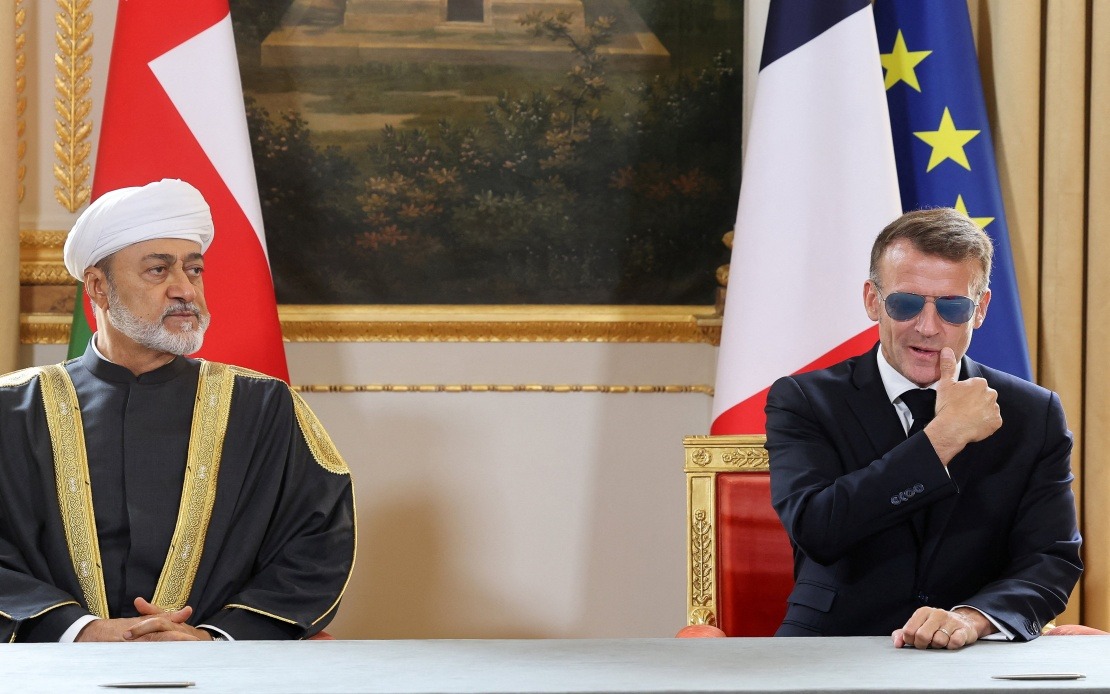
French President Emmanuel Macron arrived at the Élysée Palace on Monday sporting his distinctive aviator-style sunglasses for a state meeting with the Sultan of Oman, reigniting public curiosity about eyewear that has become unexpectedly prominent in international diplomacy. According to French media reports citing sources within the presidential entourage, Macron opted for the shades due to an eye problem rather than any fashion statement. The president maintained the sunglasses throughout his formal discussions with Sultan Haitham bin Tariq, making no attempt to remove them during the greeting or subsequent bilateral talks.
The French leader's recurring reliance on the eyewear harks back to an incident six months earlier at the World Economic Forum in Davos, where his choice of accessory sparked considerable international commentary and domestic ridicule. At that January gathering, officials attributed his eye condition to minor inflammation, a temporary medical issue they indicated would resolve within approximately two weeks. Yet the appearance in Oman suggests the problem may have resurfaced or persisted longer than initially disclosed, prompting Macron to return to the same solution.
The Davos appearance proved far more consequential than a simple medical accommodation. The sunglasses drew pointed commentary from US President Donald Trump, who used the moment for public mockery, whilst within France the imagery sparked widespread jest among observers who noted the president's resemblance to actor Tom Cruise's iconic appearance in Hollywood films. Social media and traditional media outlets alike seized upon the visual spectacle, transforming what might have been a minor health matter into a talking point that transcended the substance of Macron's diplomatic engagement.
The commercial impact of Macron's eyewear choice illuminates how presidential visibility translates into market dynamics. Henry Jullien, a French luxury eyewear manufacturer, reported a notable surge in consumer inquiries following the Davos incident, with potential buyers seeking to acquire the same model worn by the French leader. The company has capitalised on this unexpected boost in brand recognition by leveraging Macron's image in promotional materials, using photographs of him wearing the aviators to market the product.
From a diplomatic perspective, the reappearance of the sunglasses at the Oman meeting underscores how even peripheral details of presidential presentation can influence public perception. Sultan Haitham bin Tariq, who ascended to power in 2020 following the death of Sultan Qaboos bin Said, represents a strategically important partner for France in the Gulf region. Oman's positioning as a relatively neutral actor within Middle Eastern geopolitics makes bilateral relations particularly valuable for European powers seeking leverage and influence across the Arabian Peninsula.
The incident reflects broader questions about transparency and formality in contemporary diplomacy. Whether a leader should disclose medical conditions that affect their appearance remains contested terrain in modern politics. Macron's apparent comfort in proceeding with the meeting whilst visibly wearing corrective eyewear contrasts with earlier generations of political leaders who might have attempted to conceal such vulnerabilities. The French president's willingness to conduct state business whilst managing a health issue publicly demonstrates either confidence in his position or pragmatic acceptance that medical realities supersede aesthetic considerations.
For Southeast Asian observers and policymakers, the incident offers tangential insights into European diplomatic protocols and the personal vulnerabilities of major Western leaders. France maintains substantial interests across the Indo-Pacific region, including colonial territories and defence commitments, making Macron's conduct and health status matters of broader regional significance. Any indication that the French president faces ongoing health challenges, however minor, potentially influences assessments of French capacity to sustain engagement in distant theatres.
The sunglasses phenomenon also illuminates the peculiar power of visual symbolism in the social media age. A medical accessory transforms into a meme, a fashion statement, and ultimately a commercial asset within hours of public exposure. This acceleration of meaning-making reflects how international diplomacy now operates within parallel streams of official discourse and viral commentary. Macron's apparent indifference to the mockery or his strategic use of the sunglasses as a talking point—depending on one's interpretation—represents a political choice as much as a medical one.
The French luxury eyewear industry's response demonstrates how prestige goods marketing has adapted to leverage accidental celebrity endorsements. Henry Jullien's decision to capitalise on the Macron moment through deliberate promotional campaigns suggests that high-end manufacturers recognise presidential visibility as invaluable advertising, even when that visibility arises from medical necessity rather than intentional promotion. This symbiotic relationship between political leaders and luxury brands reflects the commodification of diplomatic imagery.

