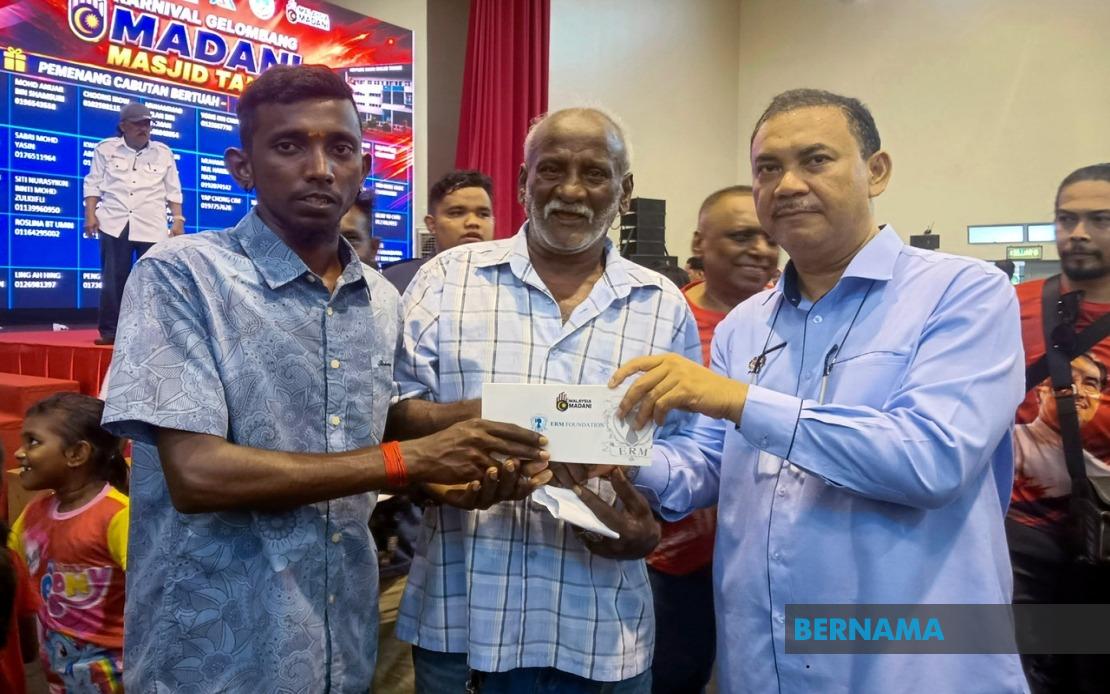
The Sentuhan MADANI Donation initiative reached approximately 2,000 residents struggling with financial hardship across the Masjid Tanah parliamentary constituency during a welfare carnival held in Alor Gajah on August 7. The programme, operating under the broader Gelombang MADANI framework, exemplifies the government's targeted approach to poverty alleviation in Melaka, extending assistance directly to vulnerable household units in one of the state's established constituencies.
Each beneficiary received RM200 in direct cash support, a measure designed to provide immediate relief to families facing monthly budget pressures. Datuk Azman Abidin, the Prime Minister's political secretary, oversaw the distribution at the Masjid Tanah Sports Complex, emphasizing the cross-constituency nature of the initiative. The programme deliberately structured itself to encompass recipients from the five state assemblies that comprise Masjid Tanah—Kuala Linggi, Lendu, Tanjung Bidara, Ayer Limau, and Taboh Naning—ensuring equitable geographic coverage and preventing concentration of aid in any single administrative boundary.
The initiative deliberately targeted Malaysia's most economically vulnerable cohorts: households in the B40 income bracket, persons living with disabilities, elderly citizens, and working families classified as low-income earners. This segmented approach reflects current policy recognition that poverty and financial stress manifest differently across demographic groups, and that assistance programmes yield greater socioeconomic impact when calibrated to address specific vulnerabilities. Senior citizens, for instance, frequently exhaust resources managing healthcare expenses and medications, while persons with disabilities often shoulder additional costs for mobility aids, therapy, and accessibility modifications that mainstream budgeting categories typically overlook.
Ramlah Othman, a 63-year-old resident from Tanjung Bidara, articulated the tangible household-level impact of such assistance. She described the RM200 grant as addressing an immediate necessity rather than representing discretionary income, enabling her to better manage routine expenses that have become increasingly strained under Malaysia's current cost-of-living environment. Her response—expressing gratitude through the Islamic phrase Alhamdulillah—reflected genuine relief rather than ceremonial acknowledgment, suggesting the assistance addressed genuine financial shortfall rather than functioning as purely symbolic gesture.
N. Mariappan, a 69-year-old stroke survivor residing in Ladang Sungai Baru, offered a complementary perspective on how such programmes affirm the government's ostensible commitment to senior welfare amid rising healthcare costs. Stroke patients and similar disability cases frequently encounter unanticipated medical expenses, accessibility modifications, and care arrangements that existing pension or assistance structures inadequately address. Mariappan's observation that the contribution had measurably reduced pressure on his daily budget indicates that targeted cash transfers, even of modest amounts, can generate meaningful psychological and practical relief when targeted populations face genuine financial constraints.
The timing of the Gelombang MADANI initiative within Malaysia's broader social assistance architecture reflects an evolution in poverty-relief strategy. Rather than exclusively depending on institutional welfare programmes with their enrollment requirements, eligibility verification protocols, and bureaucratic delays, the carnival-format distribution model creates accessible entry points for vulnerable residents while embedding assistance distribution within broader community engagement frameworks. The combination of entertainment, public ceremony, and direct cash transfer transforms what might otherwise constitute routine bureaucratic transaction into community event, potentially enhancing social cohesion and reducing stigma historically associated with receiving public assistance.
From a regional perspective, Malaysia's direct cash transfer approaches increasingly parallel models deployed across Southeast Asia, from Thailand's targeted elderly support initiatives to Indonesia's conditional cash transfer schemes. The Sentuhan MADANI framework demonstrates policymakers' recognition that while structural economic reforms generate long-term prosperity, immediate cash transfers provide necessary stabilization for households whose purchasing power has degraded relative to fixed expenses. Food costs, utilities, transportation, and healthcare represent non-discretionary budget items that compressed household incomes cannot adequately accommodate, creating poverty traps wherein families exhaust savings and accumulate debt attempting to maintain baseline living standards.
The specific inclusion of persons with disabilities within the Masjid Tanah distribution underscores evolving awareness that physical or sensory impairments frequently correlate with employment barriers and income limitation. Employers often harbor reluctance regarding workforce integration of disabled workers, whilst accessibility improvements in workplace and transportation infrastructure remain inconsistently implemented. Disabled individuals therefore experience higher unemployment rates, lower wage trajectories, and elevated expenses managing medical and accessibility requirements—dynamics that general anti-poverty programmes may inadequately address without explicit inclusion.
The carnival approach employed here also serves practical administrative functions beyond symbolic community engagement. Public distribution events create opportunities for social workers and programme administrators to identify additional cases requiring escalation to longer-term assistance programmes, whilst simultaneously reaching beneficiaries who might navigate standard bureaucratic enrollment processes with difficulty. For elderly residents of limited digital literacy or those requiring mobility assistance, the on-site ceremony eliminates transportation barriers and procedural complexity that might otherwise prevent assistance access.
Looking forward, the scale and geographic reach of Sentuhan MADANI distributions across multiple parliamentary constituencies suggest sustained commitment to periodic cash assistance programmes targeting vulnerable households. Such initiatives require fiscal sustainability, however, particularly if global economic volatility continues constraining Malaysian government revenues. Policymakers must balance expanding assistance coverage against maintaining fiscal discipline and ensuring that temporary relief programmes genuinely support transitions toward economic self-sufficiency rather than creating dependency patterns that undermine long-term individual and household resilience.
The convergence of direct cash transfers, targeted demographic inclusion, and community-based distribution reflects international best practice in poverty alleviation programming, validated through decades of research establishing that unconditional cash transfers generate positive downstream effects on health, education, and economic participation. Malaysia's continued investment in such programmes, particularly extending to constituencies with persistent poverty concentrations, indicates growing recognition that sustained development requires systematic attention to household economic vulnerability alongside aggregate growth metrics.

