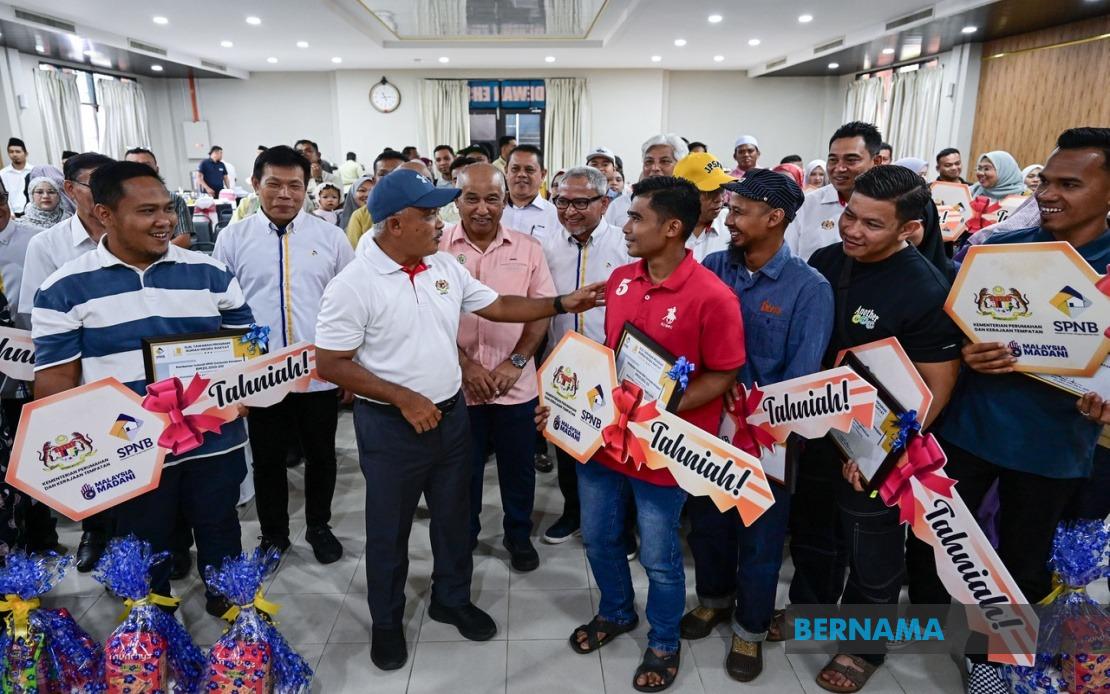
The MADANI Government took another step forward in its affordable housing mission on June 28 when 50 families in Terengganu received direct assistance through the Rumah Mesra Rakyat (RMR) programme. The ceremony, held at Dewan Ehsan in Felda Wilayah Timur, Kuala Nerus, saw the distribution of 30 completed homes and 20 offer letters for new construction, marking a tangible advancement in the government's broader strategy to address the housing deficit affecting lower-income Malaysians.
The initiative reflects a deliberate policy framework designed to serve citizens who own land but lack the financial resources to construct adequate housing. Rather than viewing homeownership as a luxury reserved for the wealthy, the MADANI Government positions the RMR programme as a fundamental tool for social mobility and community stabilization. By bridging the gap between land ownership and housing construction, the scheme addresses a persistent challenge in Malaysian society where informal settlements and substandard housing persist despite available land resources. The programme recognises that many lower-income families possess the foundational asset of land but cannot navigate the substantial capital and technical requirements of building quality homes.
Datak Dr M. Noor Azman Taib, secretary-general of the Housing and Local Government Ministry (KPKT), emphasized during the presentation that the programme extends far beyond simple shelter provision. His statement underscored how homeownership functions as a catalyst for broader quality-of-life improvements, enabling families to build long-term wealth, strengthen community ties, and establish stable foundations for future generations. This perspective aligns with international development research indicating that secure homeownership correlates with improved educational outcomes for children, better health outcomes, and enhanced economic resilience at the household level.
Terengganu's allocation represents a significant investment in the state's housing infrastructure. With 680 RMR units implemented across the state using a total budget of RM46.67 million, the programme has already resulted in 246 completed units being handed over to recipients as of May 2024, while another 154 units remain under construction. Within the two constituencies receiving assistance on June 28, Kuala Terengganu has seen 34 units implemented with 18 completed and 16 under construction, while Kuala Nerus features 32 implemented units comprising 25 completed properties and seven still in development. These figures demonstrate how the programme systematically expands housing availability in constituencies with significant demand.
The broader national context underscores the scale of the government's housing ambitions. Under Budget 2026, the administration targets the construction of 6,545 RMR units nationwide, representing a substantial acceleration of the programme. To date, 3,900 units have been activated nationally, with 2,478 already completed and transferred to beneficiaries, while 1,422 units remain under construction. This pipeline suggests that housing delivery will continue accelerating through 2025 and into 2026, creating momentum that could potentially relieve pressure on the country's affordable housing shortage.
The RMR programme's historical trajectory provides important context for understanding its significance. Since its introduction in 2002, the scheme has benefited more than 80,000 families nationwide, fundamentally transforming the housing circumstances of low-income households across Malaysia. Over two decades, the programme has demonstrated resilience and adaptability, evolving to meet changing economic conditions and housing standards. The sustained government commitment, even across different administrations, suggests recognition of the programme's importance to social stability and economic equity.
For Malaysian policymakers and analysts, the Terengganu distribution highlights how housing policy intersects with broader development objectives. By targeting families in parliamentary constituencies, the government ensures geographically distributed benefits while maintaining political accountability for programme outcomes. The emphasis on completed homes alongside new construction offers immediate shelter to some families while supporting construction employment and stimulating local economic activity through ongoing building projects. This dual approach creates both immediate social benefits and sustained economic stimulus.
The programme's significance extends to regional Southeast Asian contexts where affordable housing remains a critical challenge. Malaysia's structured approach to subsidized homeownership for lower-income groups offers a model that neighbouring countries grapple with implementing effectively. The integration of government financing, construction standards, and recipient selection criteria demonstrates institutional capacity that many developing economies struggle to maintain consistently. As migration pressures and urbanization accelerate across the region, Malaysia's experience with scale-appropriate housing delivery becomes increasingly relevant to regional development discussions.
Looking forward, the trajectory of the RMR programme depends on sustained budgetary allocation and administrative effectiveness in construction delivery. The current pipeline of 1,422 units under construction represents approximately 15 months of work at current completion rates, suggesting that the 6,545-unit target for 2026 requires continued momentum and possibly accelerated construction timelines. Maintenance of programme quality remains critical, as poorly constructed or inadequately designed homes would undermine the long-term wealth-building objectives that justify government investment. Government authorities will need to balance speed of delivery with durability and functionality standards that ensure beneficiary satisfaction and programme credibility.
The Terengganu ceremony ultimately exemplifies how targeted housing interventions address fundamental needs while advancing broader national development goals. By converting land ownership into secure, quality housing, the programme enables lower-income families to participate more fully in economic and social life. As the MADANI Government pursues expanded housing delivery through 2026, the programme's success in states like Terengganu will likely shape public perception of government capacity and commitment to equitable development, reinforcing or testing the administration's broader developmental legitimacy.

