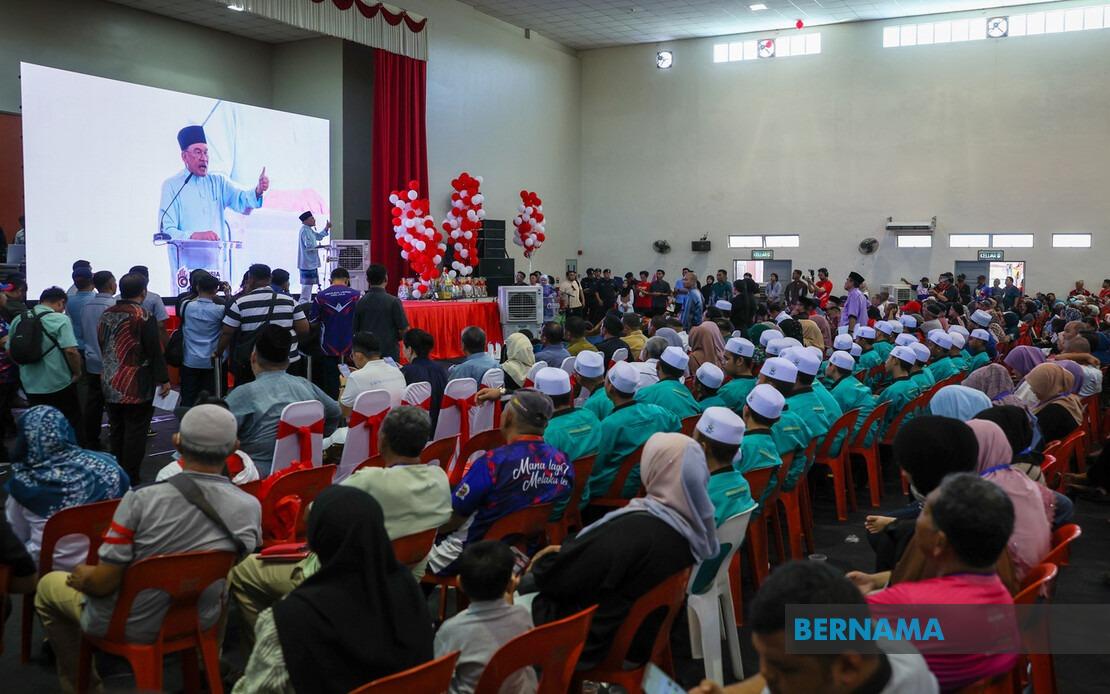
Prime Minister Datuk Seri Anwar Ibrahim has moved to reassure Malaysia's diverse education sector that the government remains committed to supporting all schools fairly, rejecting any suggestion that enhanced funding for Islamic educational institutions represents neglect of other communities. Speaking at the Gelombang MADANI Carnival in Alor Gajah, Melaka, on August 7, Anwar underscored that the MADANI Government's approach to education financing reflects a broader philosophy of inclusive governance that respects Malaysia's multicultural character.
The Prime Minister's remarks address longstanding sensitivities around education funding in Malaysia, where concerns about resource allocation between vernacular and religious schools have occasionally flared into political contention. Anwar clarified that assistance programmes for Chinese and Tamil schools have already been finalised and would be unveiled in Kuala Lumpur within approximately two weeks, indicating that the government has prepared substantive allocations for these institutions independently of its Islamic school initiatives. This staged announcement strategy suggests deliberate efforts to demonstrate parity in the government's commitment across all education streams rather than presenting funding decisions as zero-sum allocations.
The government's emphasis on strengthening Islamic educational institutions, including pondok schools and tahfiz institutions, stems from acknowledgment that these establishments had faced years of inadequate support. Since assuming office in 2022 and establishing the Unity Government, Anwar explained that restoration of assistance to religious schools began in 2023, with allocations substantially increased in 2024. This financial rehabilitation reflects recognition that historically marginalised institutions require targeted intervention to prevent educational inequities from widening. The government's modernisation efforts, including the introduction of artificial intelligence and computer training in pondok schools, demonstrate an intention to upgrade these institutions to contemporary educational standards rather than maintain them as parallel systems operating outside mainstream development initiatives.
Anwar's articulation of Malaysia's success as a plural society carries particular weight given regional tensions over religious and communal identity in Southeast Asia. The Prime Minister presented Malaysia's peaceful coexistence of Chinese, Indian, and Malay communities, alongside religious schools and secular institutions, as evidence that multiconfessional societies can function harmoniously when mutual respect underpins social relations. He contrasted this stability with instability elsewhere driven by suspicion, hatred, and distrust, framing Malaysia's educational pluralism not as a problem requiring management but as a strength requiring protection through equitable investment. This rhetorical positioning elevates education funding debates beyond technical budgetary questions into foundational matters of national cohesion.
The Prime Minister grounded his vision of equitable education in Islamic theological concepts, specifically referencing the principle of 'ummatan wasatan' from Surah Al-Baqarah, verse 143. This theological framework calls for Muslims to embody balance in faith, knowledge, character, and relationships with others and the environment. Anwar argued that adherence to this principle demands that Malaysia demonstrate integrity, efficient governance, and absence of corruption such that other nations view Malaysian society as a model worthy of emulation. This theological-political argument positions inclusive education policy not merely as pragmatic governance but as religious obligation, potentially resonating with Islamic constituencies while articulating universal values of integrity and environmental stewardship that transcend communal boundaries.
The financial commitments announced at the Melaka event underscore the government's concrete investments in this philosophy. A total allocation of RM1.29 million directed toward upgrading infrastructure at thirteen Islamic educational institutions across Melaka included substantial grants to major institutions such as Madrasah Tahfiz Al-Quran Wal Qiraat Kota Melaka, which received RM250,000, and Sekolah Menengah Arab JAIM Al-Ahmadiah Al-Syafi'iyah Sayyidina Khadijah in Jasin, which received RM160,000. These tangible allocations lend credibility to government rhetoric regarding commitment to Islamic education, providing evidence of financial follow-through rather than rhetorical commitment alone. The distribution across multiple institutions rather than concentration in flagship facilities suggests an intention to upgrade the broader ecosystem of Islamic education throughout the state.
The presence of senior government figures, including the Prime Minister's wife Datuk Seri Dr Wan Azizah Wan Ismail, Melaka Chief Minister Datuk Seri Ab Rauf Yusoh, and Deputy Higher Education Minister Adam Adli Abdul Halim, indicated that education equity constitutes a priority across multiple levels of government rather than a discrete initiative. The attendance of the Chief Minister particularly underscores that education funding represents state-level concern in a federal system where education responsibilities are shared between federal and state authorities. This multilevel governmental engagement suggests coordination across administrative tiers to ensure consistent messaging regarding commitment to educational pluralism.
Anwar's emphasis on preventing pondok schools from falling behind relative to well-managed Chinese and Tamil schools reflects growing recognition that educational inequality, particularly when stratified along communal lines, poses risks to social cohesion and individual opportunity. The government's modernisation initiatives targeting Islamic schools acknowledge that contemporary employment markets increasingly demand digital literacy and technological competence, skills that students in underresourced institutions may struggle to acquire. By introducing artificial intelligence and computer training into pondok curricula, the government positions Islamic education not as separate from technological modernity but as integral to it, potentially addressing concerns among religious school constituencies that modernisation represents cultural or religious threat.
The government's sequential announcement approach regarding different education streams suggests political sophistication regarding the sensitivities surrounding education funding in Malaysian society. Rather than presenting comprehensive education budgets that invite comparative analysis and potential grievances, the government parcels announcements temporally and geographically, maintaining the narrative initiative and controlling media coverage. This strategy allows government claims regarding equitable treatment to remain relatively uncontested during announcement phases, with promised allocations for Chinese and Tamil schools anchoring claims of fairness even as those allocations remain unspecified. For Malaysian readers concerned about their respective education communities, this announcement strategy requires attention to forthcoming details regarding actual funding levels, which will ultimately determine whether rhetoric of equity translates into substantive parity.
The theological and philosophical framing of education equity through concepts of 'ummatan wasatan' and balanced community represents an attempt to transcend narrow communal interest and appeal to universal principles of good governance. Anwar's argument that integrity, efficiency, and environmental stewardship should characterise Malaysia such that other nations emulate Malaysian standards elevates education beyond sectarian concern into a matter of national reputation and competitiveness in the global economy. This universalising rhetoric may appeal to business communities and international observers while potentially generating cynicism among those who perceive gaps between governmental rhetoric and implementation. The substantive test of this philosophy lies not in ceremonial announcements but in consistent resource allocation over time and actual improvements in educational outcomes across all streams.
For Malaysian society broadly, the government's education philosophy articulated through Anwar's remarks represents commitment to what scholars describe as deliberative pluralism—the recognition that deeply diverse societies require institutional and financial structures that actively ensure no community experiences systematic marginalisation. This approach acknowledges that formal equality of treatment proves insufficient in contexts where historical inequities have accumulated; rather, equity may require differential investment to bring disadvantaged institutions to comparable standards. The success of this approach depends upon sustained political will to maintain such commitments through subsequent budget cycles and electoral transitions, circumstances that will ultimately determine whether the MADANI Government's education equity philosophy becomes institutionalised or remains contingent upon particular leadership personalities.

