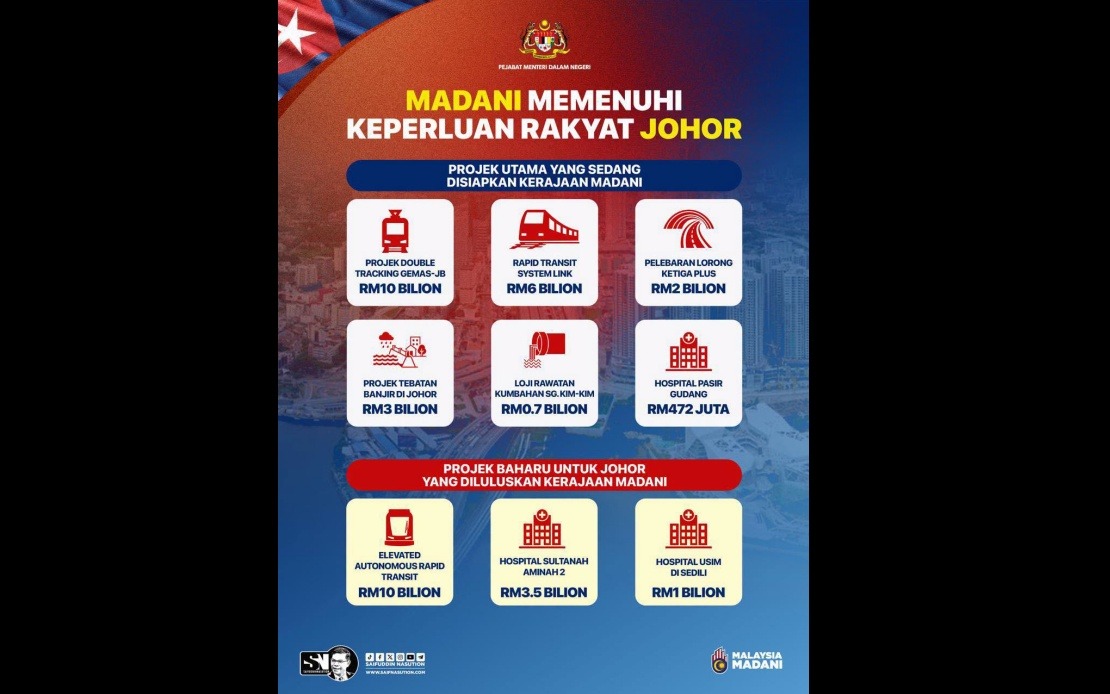
The MADANI Government has reaffirmed its dedication to fostering sustainable and equitable development throughout Malaysia, with Pakatan Harapan (PH) secretary-general Datuk Seri Saifuddin Nasution Ismail emphasising that no state will be left behind under the administration's development agenda. Speaking in Johor Bahru on June 29, the Home Minister outlined how Prime Minister Datuk Seri Anwar Ibrahim's leadership has positioned infrastructure investment, public transportation enhancement, healthcare expansion, and flood resilience as central pillars of the government's approach to improving living standards for all Malaysians.
Johor has emerged as a key focus area within this broader development framework, serving as a practical demonstration of how the MADANI agenda translates into tangible improvements for ordinary citizens. The state's strategic location as Malaysia's southern gateway, combined with its significant economic contributions, has made it a natural priority for large-scale investment. Saifuddin Nasution highlighted that Johor is now positioned on a trajectory of sustained growth through the systematic rollout of transformative initiatives designed to address infrastructure deficits, mobility challenges, and essential service provision that have accumulated over previous years.
The government's project pipeline in Johor showcases the breadth of the development vision. The Gemas-Johor Bahru Electrified Double Tracking Project represents a critical modernisation of rail infrastructure that will enhance freight and passenger capacity along a vital economic corridor. Simultaneously, the Rapid Transit System (RTS) Link addresses urban mobility needs in the Johor Bahru metropolitan area, reducing congestion and improving connectivity between the city and Singapore. The expansion of the PLUS Highway through third-lane widening responds to rising traffic volumes, while the dedicated Johor flood mitigation project acknowledges the recurring challenges that have disrupted economic activity and displaced residents during monsoon seasons.
Healthcare infrastructure constitutes another dimension of the development push. The government has green-lit the construction of Sultanah Aminah Hospital 2 and USIM Hospital in Sedili, projects that will decentralise specialist medical services and reduce pressure on existing facilities. Complementing these hospital developments, the Sungai Kim Kim Sewage Treatment Plant addresses environmental and public health concerns that have periodically affected Pasir Gudang's industrial zone and surrounding communities. The approval of the Elevated Autonomous Rapid Transit (E-ART) system signals the government's embrace of innovative transport technology as a future-oriented solution to urban mobility.
Saifuddin Nasution's emphasis on development's true meaning reveals an understanding that infrastructure investments must ultimately enhance ordinary citizens' lived experiences rather than merely accumulate as statistical achievements. The distinction he drew between development measured purely through investment figures and development assessed through its tangible impact on people's daily lives reflects a more nuanced governance philosophy. This framing acknowledges widespread public frustration in previous years when large-scale announcements failed to translate into visible improvements in transportation efficiency, healthcare access, or flood prevention at the ground level.
The employment dimension of development holds particular significance for Johor's working population. These infrastructure projects generate direct construction jobs, ongoing maintenance positions, and indirect economic opportunities through increased business activity in serviced communities. The Pasir Gudang Hospital expansion exemplifies how health infrastructure investment creates skilled employment while simultaneously improving service capacity. Similarly, the RTS Link and E-ART projects will require specialised technical staff for operations and maintenance, adding to Johor's capability in high-value service sectors.
Transportation efficiency improvements carry economic implications extending beyond personal convenience. Businesses relying on logistics and supply chains benefit from reduced travel times and improved connectivity. The double-tracking of the Gemas-Johor Bahru rail line increases freight capacity, potentially lowering transport costs for manufacturers and traders. Enhanced public transit options may also reduce household transportation expenditure, freeing resources for consumption and investment elsewhere in the economy. These multiplier effects suggest that infrastructure development functions as an economic stimulus with lasting structural benefits.
Healthcare accessibility improvements address long-standing inequities in service distribution. Johor's reliance on centralised hospital facilities in Johor Bahru has historically disadvantaged residents in peripheral districts and smaller towns. Distributing specialist capacity through new hospitals in areas like Sedili democratises access to advanced medical services, reducing travel burdens on patients and families while improving health outcomes through earlier intervention. The Sewage Treatment Plant similarly tackles a public health challenge that has periodically threatened environmental quality and investor confidence in Pasir Gudang's industrial sustainability.
Flood mitigation represents perhaps the most visible policy response to a recurring crisis affecting thousands of residents and significant economic infrastructure. Johor's monsoon-driven flooding has periodically paralysed commerce, damaged housing, and exposed vulnerability to climate-related shocks. A dedicated flood mitigation project signals government recognition that infrastructure development must incorporate climate resilience and disaster risk reduction as core objectives rather than secondary considerations. This approach aligns with broader global trends acknowledging that sustainable development now demands explicit attention to environmental and climate challenges.
The portfolio of initiatives also reflects federal-state coordination mechanisms that have strengthened under the MADANI framework. Securing approval for multiple large-scale projects simultaneously suggests improved alignment between federal priorities and state-level needs, a contrast to previous tensions that sometimes delayed critical infrastructure development. This collaborative approach potentially accelerates project implementation while ensuring that investments genuinely address state-identified priorities rather than imposing top-down solutions misaligned with local requirements.
For Southeast Asian observers, Johor's development trajectory holds instructive relevance. The state's experience demonstrates how a regional government within a federal system can leverage national development frameworks to secure investment for locally-prioritised initiatives. The combination of traditional infrastructure (rail, highways) with emerging technologies (autonomous transit) reflects integration into global development trends while maintaining focus on immediate accessibility challenges affecting current populations. The emphasis on inclusive access—transportation efficiency, healthcare proximity, environmental protection—suggests a development model prioritising broad-based benefit distribution over concentrated gains.

