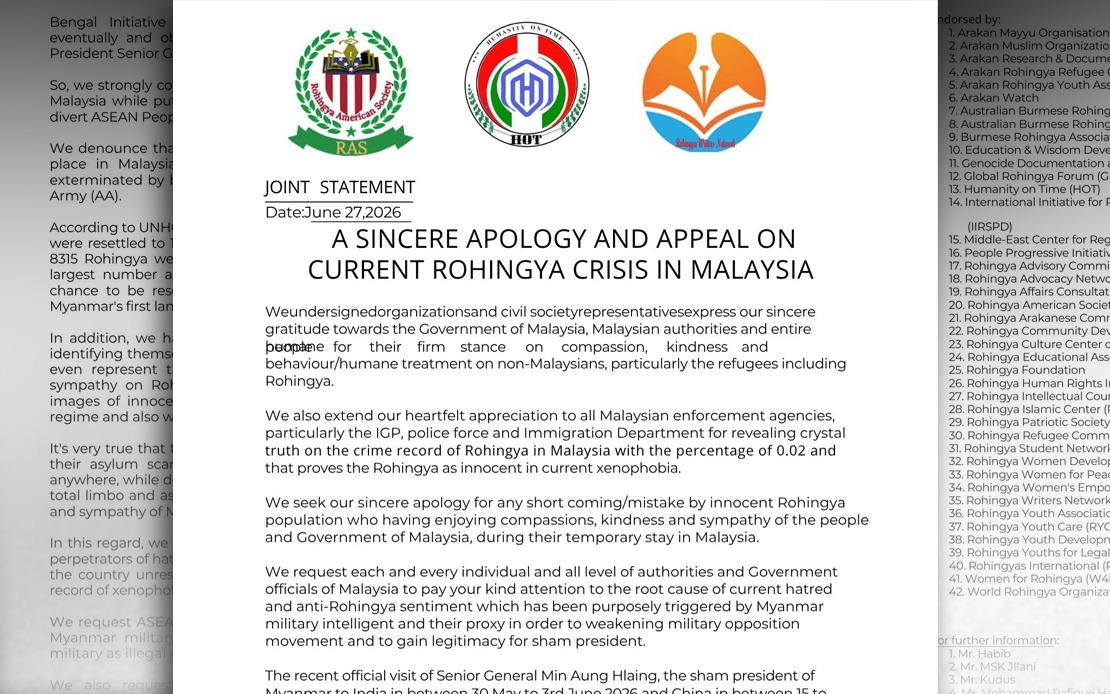
Malaysian Humanitarian Aid and Relief (MAHAR) has publicly acknowledged an apology extended by 40 Rohingya non-governmental organisations, framing the gesture as evidence of institutional accountability within the refugee support sector. The organisation's positive reception of this statement underscores a broader push to strengthen the relationship between refugee-focused groups and Malaysia's governance structures, signalling that goodwill gestures from humanitarian actors are being recognised and rewarded with constructive engagement rather than dismissal.
While commending the NGOs for their contrition, MAHAR has articulated a vision of humanitarian action that extends considerably beyond the conventional relief paradigm of distributing food packages and emergency shelter. The organisation contends that meaningful support requires addressing the complex social dynamics that emerge when displaced populations integrate into host societies, particularly the need to equip refugees with knowledge of their civic obligations while residing in Malaysia. This perspective reflects growing recognition among humanitarian practitioners that sustainable solutions depend not merely on meeting immediate survival needs but on facilitating successful coexistence.
Central to MAHAR's argument is the proposition that Rohingya NGOs shoulder a responsibility to cultivate deeper respect for Malaysian legal frameworks, cultural practices, and community norms. By positioning this as part of the humanitarian mandate rather than a separate government function, MAHAR suggests that refugee-serving organisations occupy a unique position to model and transmit Malaysian values. Such an approach acknowledges that local communities perceive integration partly through the lens of whether newcomers demonstrate genuine commitment to observing established social rules and showing deference to host-country traditions.
The organisation has also redirected focus toward the international dimension of the crisis, urging these NGOs to intensify advocacy campaigns targeting Myanmar's persecution of the Rohingya population. MAHAR's emphasis here reflects a sophisticated understanding that humanitarian relief without concurrent efforts to address root causes amounts to symptom management rather than systemic resolution. By encouraging international advocacy alongside domestic community engagement, the organisation articulates a theory of change that recognises both immediate shelter provision and long-term political solutions as essential components of genuine humanitarian work.
Jismi Johari, MAHAR's president, has brought additional nuance to the discussion by centering the safety concerns of both refugee and Malaysian populations. Rather than dismissing local worries about crime or social cohesion as xenophobia, Johari has validated the legitimacy of these anxieties, particularly when they stem from direct personal experience with incidents. This validation represents an important shift in how humanitarian organisations frame public concerns, moving away from narratives that position safety criticism as inherently discriminatory and instead treating such concerns as legitimate topics for serious policy discussion.
Johor has simultaneously warned against the dangers of collective blame, articulating the principle that an entire community should not be stigmatised based on misconduct by individual members. This position occupies challenging middle ground: acknowledging that specific incidents involving some refugees have created genuine public concern while insisting that demographic generalisation remains both unjust and counterproductive. His observation that misconduct exists across all societies functions as a reminder that antisocial behaviour among refugee populations does not represent a unique phenomenon but rather a universal feature of any large human group.
The pathway forward, according to MAHAR leadership, requires the active participation of multiple stakeholders working in concert toward shared objectives. Johor emphasises that resolving tensions between refugee populations and local communities demands empathy from host-society members, reciprocal respect from displaced persons, and constructive willingness from all parties to engage across difference. This framing moves beyond zero-sum approaches where security and humanitarian principles appear opposed, instead suggesting that both can be served through deliberate institutional design and genuine dialogue.
MAHAR's reaffirmation of its commitment to humanitarian work grounded in justice, safety, and human dignity represents an attempt to resolve the apparent tension between refugee protection and host-community reassurance. The organisation proposes that these objectives need not conflict; rather, they can be integrated into a more holistic framework that treats the welfare of both populations as interdependent. This approach carries particular significance for Malaysia, which hosts one of Southeast Asia's largest Rohingya populations and faces ongoing pressure to balance international humanitarian obligations with domestic social stability.
The broader context here involves Malaysia's complex position as both a Muslim-majority nation with historical responsibility toward persecuted Rohingya and a country grappling with real integration challenges. The MAHAR statement implicitly acknowledges that previous refugee assistance frameworks may have underestimated the importance of community integration and local buy-in. By calling on Rohingya NGOs to take on what amounts to civic education and cultural orientation functions, MAHAR suggests that sustainability of refugee presence in Malaysia depends partly on whether support organisations actively cultivate positive relationships with host communities. This represents a significant evolution from purely needs-based humanitarian models toward what might be termed integration-oriented assistance.

