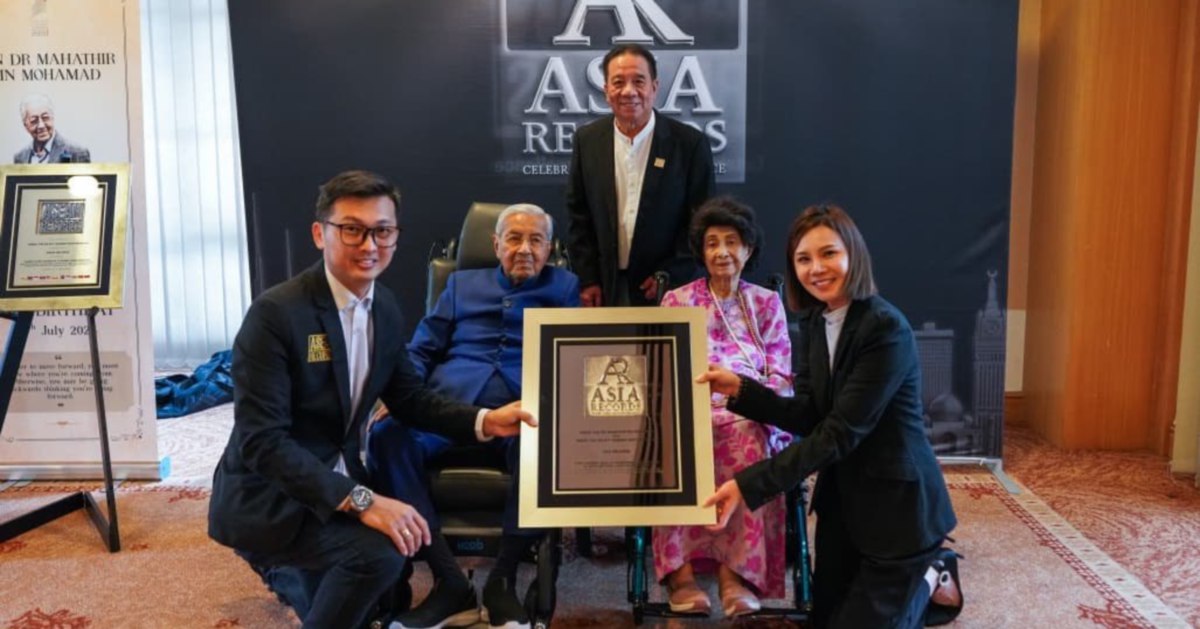
Tun Dr Mahathir Mohamad and his wife, Tun Dr Siti Hasmah Mohd Ali, have entered the annals of Malaysian history by becoming the nation's most celebrated centenarian couple, having received three official records documenting their remarkable longevity and unprecedented shared accomplishments. The recognition underscores not merely the statistical improbability of both spouses reaching and surpassing one hundred years of age, but equally the distinctive prominence they hold as figures whose lives have intersected with modern Malaysia's most transformative decades.
The significance of this milestone extends beyond simple demographic achievement. In Malaysia's context, where life expectancy has risen steadily over recent decades—now hovering around 75 years—the attainment of triple-digit ages by both members of a couple remains extraordinarily uncommon. The official records serve as testimony to advances in healthcare, nutrition, and living standards across the nation, while simultaneously highlighting the particular circumstances and choices that have enabled this couple to transcend ordinary longevity benchmarks. For a society that increasingly grapples with the implications of an ageing population, the Mahathir-Siti Hasmah example provides both inspiration and practical evidence that extended healthy lifespans are achievable.
The recognition carries particular resonance given the couple's public prominence. Tun Dr Mahathir's tenure as prime minister for 22 years, followed by his return to the office in 2018 at an advanced age, challenged conventional assumptions about the relationship between age and capacity for high-stakes governance. His longevity in public life spanned from Malaysia's immediate postcolonial era through to the 21st century, witnessing and shaping the nation's economic transformation, industrialisation, and international positioning. Siti Hasmah, meanwhile, earned distinction in her own right as a physician and advocate for healthcare advancement, bringing professional credentials and independent achievement to her public role.
The three official records presumably encompass multiple dimensions of their accomplishment—possibly recognising them as the longest-married couple both reaching centenarian status, the longest-living couple with a former head of government, or similar permutations that capture different aspects of their historical position. Such granular categorisation in record-keeping reflects how significance in human achievement can be measured through varied lenses, each revealing different facets of an extraordinary life narrative.
From a Southeast Asian perspective, the Mahathir-Siti Hasmah recognition holds broader implications. The region has seen its own demographic transition accelerate over the past three decades, with countries including Singapore, Thailand, and Vietnam witnessing substantial increases in elderly populations. Malaysia's experience in supporting extended lifespans for prominent citizens offers lessons—both medical and societal—that may inform policy discussions across the association of nations. The couple's public health engagement, particularly Siti Hasmah's medical background, has contributed to elevating awareness about healthcare accessibility and preventive medicine across generations.
The achievement also reflects evolving cultural and social structures that have enabled such longevity. Malaysia's extended family systems, though transforming amid urbanisation, continue providing networks of support for elderly relatives. The economic security afforded to figures of Tun Dr Mahathir's stature certainly facilitates access to healthcare and living conditions conducive to extended life. Yet the recognition implicitly raises questions about equity in longevity—whether the healthcare systems and social support structures that enabled this couple's centenarian status are equally accessible across socioeconomic strata in Malaysia and the region.
International record-keeping bodies increasingly document such achievements as part of broader research into longevity patterns and the factors contributing to extended lifespans. The Mahathir-Siti Hasmah recognition, whether officially verified through Malaysian record authorities or international bodies, contributes to the growing body of evidence about human longevity in contemporary Asia. Researchers studying gerontology and lifespan determinants can examine this particular case as a data point within larger patterns examining nutrition, healthcare access, genetic factors, and lifestyle choices.
The symbolic importance of this recognition for Malaysian society warrants particular consideration. National figures who achieve remarkable longevity become embodiments of broader aspirations and possibilities. The message implicit in honouring the Mahathir-Siti Hasmah couple resonates across generations—that productive, engaged lives can extend well beyond traditional retirement frameworks, that intellectual and professional contributions need not cease at arbitrary chronological thresholds, and that partnership and family relationships can sustain meaning and vitality across a century-spanning timeframe.
Looking forward, this recognition will likely feature prominently in discussions about demographic planning, healthcare resource allocation, and social policies addressing ageing populations across Malaysia and the wider region. As governments confront the economic and social implications of increasingly elderly demographics, successful examples of centenarians who have maintained engagement and vitality become reference points for reimagining what extended lifespans might mean for individuals and communities. The Mahathir-Siti Hasmah example, precisely because of their public visibility and the documented achievements spanning their long lives, offers a template—imperfect though it may be—for how societies might adapt institutional and cultural frameworks to accommodate and valorise extended human lifespans in their midst.

