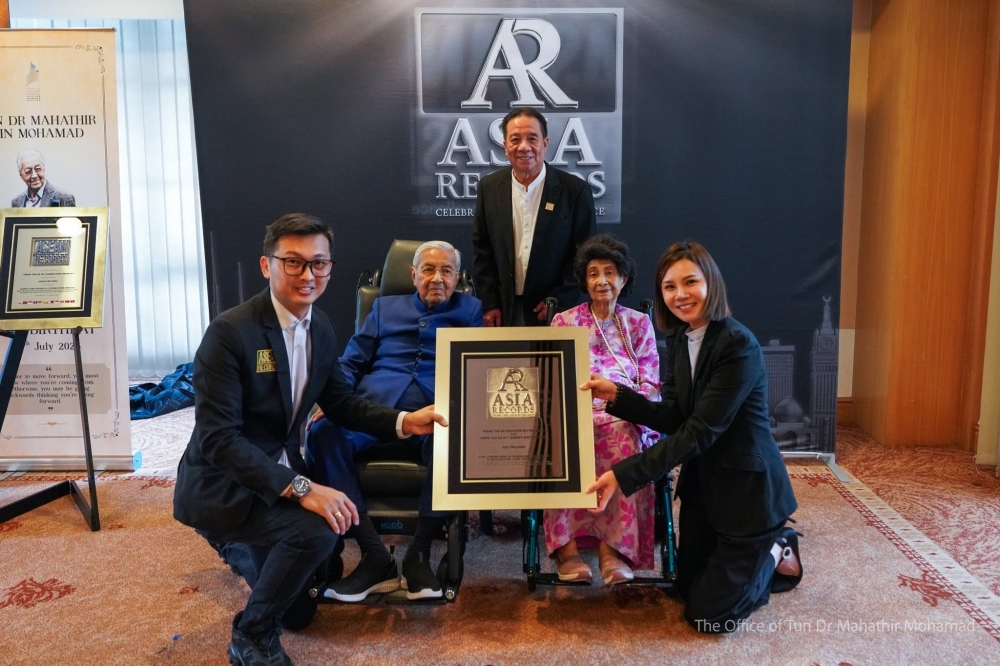
Tun Dr Mahathir Mohamad and his wife Tun Dr Siti Hasmah Mohd Ali have been officially recognised by Guinness World Records for three separate achievements following their entry into the centenarian club, marking a remarkable milestone in Malaysia's contemporary history. The dual recognition underscores the exceptional longevity of the couple, whose combined presence has spanned a century of Malaysia's political, medical, and social landscape. Both reaching the age of 100 represents an increasingly rare occurrence globally, though the pair's records extend beyond mere age to encompass their roles and relationships.
The three Guinness World Records now attributed to the couple reflect their distinctive positions in Malaysian public life. These accolades recognise not only their advanced age but also their sustained relevance and contributions across multiple decades. The recognition by the international record-keeping authority provides official validation of their place in global history, distinguishing them among world figures who have achieved comparable longevity. For Malaysia, the records represent a national achievement, positioning the country alongside other nations with notable centenarian figures in public service and prominence.
Dr Mahathir's tenure as Prime Minister between 1981 and 2003, followed by his return to the position in 2018, established him as one of the world's longest-serving and oldest serving heads of government. His continued political engagement and public commentary well into his second century demonstrates an intellectual vigour that defies typical expectations of advanced age. The longevity of his career, spanning from Malaysia's transformation into a modern industrialised nation through several subsequent decades of development and reform, provides continuity with the country's foundational post-independence era.
Dr Siti Hasmah's career as a medical doctor and her decades of contribution to public health in Malaysia have been similarly substantial, though her work has received less international prominence than her husband's political role. Her professional achievements in medicine, combined with her extensive work in community health and welfare, established her as a respected figure in Malaysia's healthcare sector. The recognition of her individual status as a centenarian in her own right acknowledges her independent accomplishments and contributions beyond her role as a former First Lady.
The significance of both individuals reaching 100 simultaneously carries particular weight in Malaysian culture, where respect for elders and longevity is traditionally valued. The couple's achievement resonates beyond statistical significance, representing a symbol of endurance and continued relevance in a society experiencing rapid modernisation and generational change. Their visibility as active, engaged centenarians challenges prevailing stereotypes about aging and retirement, particularly in societies where the average lifespan continues to increase.
Guinness World Records' acknowledgement reflects a growing global interest in documenting exceptional human longevity and achievement. The three specific records attributed to Dr Mahathir and Dr Siti Hasmah place them within an elite international cohort of individuals whose lives have extended across multiple centuries. This recognition carries implications for gerontological research and understanding of factors contributing to exceptional longevity, including healthcare access, mental engagement, and sustained purposefulness in later life.
For Malaysia's healthcare system, the couple's longevity offers an implicit testament to the quality of medical care available within the country, particularly for individuals with access to premium healthcare services. Dr Siti Hasmah's background in medicine may have conferred additional advantages in health management and preventive care. Their ability to maintain active engagement with public affairs and continued relevance to national discourse demonstrates that advanced age need not preclude meaningful contribution to society.
The records also carry political significance in the Malaysian context, where Dr Mahathir remains a polarising but undeniably influential figure. His continued prominence at age 100 ensures that historical narratives concerning Malaysia's development and governance remain contested and subject to his ongoing reinterpretation. His accessibility to media and the public through digital platforms means his influence extends beyond traditional channels, allowing his perspective on contemporary Malaysian issues to reach audiences across generational divides.
The formal recognition through Guinness World Records provides an institutional framework for documenting and preserving the couple's place in history. Such records serve archival and educational functions, ensuring that subsequent generations of Malaysians will have verified documentation of this achievement. The records also contribute to Malaysia's cultural heritage and national narrative, providing internationally recognised markers of achievement that can be referenced in educational and commemorative contexts.
Looking forward, the couple's centenarian status raises questions about leadership succession, intellectual continuity, and the evolution of Malaysia's political and social institutions. Dr Mahathir's continued influence on political discourse, despite formal retirement from office, illustrates how individual figures can transcend official positions. The recognition of both individuals' achievements reflects broader recognition that meaningful contribution to society extends well beyond conventional retirement ages and formal office holding.

