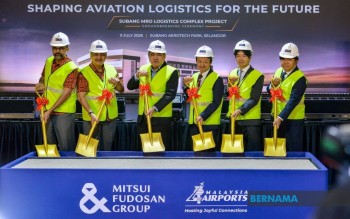
Malaysia Airports Holdings Bhd (MAHB) and Tokyo-based logistics developer Mitsui Fudosan Group have broken ground on a RM80 million air cargo and maintenance complex at Subang Airport, establishing a joint venture that pairs Malaysia's airport infrastructure assets with Japanese operational expertise. The partnership allocates a 30 per cent stake to MAHB with Mitsui Fudosan retaining 70 per cent ownership, positioning the Japanese firm as the primary operator while MAHB contributes its valuable land holdings and airport authority status.
Transport Minister Anthony Loke Siew Fook characterised the arrangement as emblematic of MAHB's broader strategy to unlock value from its substantial airport property portfolio by forging alliances with internationally experienced development partners. Rather than managing such projects independently, MAHB has opted to share both financial burden and operational responsibility with a proven player in the logistics sector, a risk-mitigation approach that reflects the complexities of modern airport-adjacent industrial development.
Mitsui Fudosan's credentials in aviation logistics stem from their extensive involvement with Japan's Haneda Airport, one of Asia's busiest aviation hubs. The Tokyo conglomerate has designed, constructed, and operated multiple logistics facilities within Haneda's ecosystem, giving them sophisticated knowledge of how to integrate cargo handling, maintenance operations, and supply chain management within airport precincts. This experience directly transfers to Subang's competitive landscape, where similar expertise could enhance operational efficiency and attract regional freight operators.
The new facility, formally termed the Subang Maintenance, Repair and Overhaul (MRO) Logistics Complex Project, will anchor a specialist industrial zone within the existing Subang Aerotech Park. The development vehicle, MFMA Industrial Sdn Bhd, unites Mitsui Fudosan (Asia) Malaysia Sdn Bhd with Malaysia Airports (Subang) Sdn Bhd as co-investors, creating a structure where both partners retain vested interests in the complex's performance.
Subang Airport's strategic location within the Klang Valley makes it uniquely positioned to serve regional aviation and aerospace enterprises, many of which have clustered around the facility over decades. The new complex targets this ecosystem directly, offering dedicated infrastructure for aircraft maintenance, repair and overhaul services alongside air cargo logistics—complementary operations that typically generate demand for one another. Airlines conducting scheduled maintenance require nearby warehousing for parts and supplies, while cargo handlers benefit from proximity to MRO facilities that generate time-sensitive shipments.
Malaysia's aviation sector has faced intensifying regional competition as Singapore's Changi Airport and Bangkok's Suvarnabhumi Airport have aggressively expanded their cargo and MRO capabilities. Subang's historical dominance in Malaysian aviation maintenance has eroded as airlines increasingly route major overhauls to regional hubs offering integrated facilities, lower labour costs, or proximity to major flight routes. This RM80 million investment represents MAHB's acknowledgment that standalone airport operations no longer suffice—competing airports now function as logistics ecosystems requiring sophisticated industrial partnerships.
The timing of this development reflects Malaysia's broader efforts to position itself as a Southeast Asian aviation services hub, a role that demands not merely runway capacity but comprehensive aerospace infrastructure. The government has explicitly encouraged such ventures through its airport privatisation framework and various aviation industry incentives, viewing aviation maintenance and logistics as high-value activities that generate skilled employment and attract international operators.
Mitsui Fudosan's expansion into Malaysia's aviation logistics sector signals broader Japanese investor confidence in Malaysia's economic fundamentals and regulatory environment. The conglomerate's willingness to commit substantial capital to Subang indicates that Tokyo-based analysts view Malaysia's aviation sector as offering acceptable risk-adjusted returns relative to alternative regional investments, particularly given the company's established presence across Asia-Pacific.
For Malaysian readers, this partnership embodies a pragmatic approach to infrastructure development: rather than attempting to build world-class logistics facilities through government institutions alone, authorities have created market conditions where international operators identify profitable opportunities and invest accordingly. MAHB's 30 per cent stake ensures the national interest remains represented in governance decisions while allowing operational expertise to reside with experienced practitioners.
The project's success will ultimately depend on its ability to attract and retain Malaysia-based aerospace enterprises seeking efficient MRO and logistics solutions. Regional aviation growth projections suggest rising demand for such services across the next decade, particularly as low-cost carriers expand maintenance networks and cargo operations intensify through Southeast Asian corridors. Subang's historical advantages—established aerospace clusters, urban accessibility, and now, purpose-built modern facilities—position it competitively for this expanding market.
Beyond immediate commercial considerations, the Subang complex represents Malaysia's evolutionary approach to airport asset utilisation. Rather than viewing airport land as fixed infrastructure dedicated solely to passenger and cargo flights, authorities increasingly recognise these precincts as strategic locations for broader aviation-dependent industries. Success here could encourage similar partnerships at other Malaysian airports, particularly Kuala Lumpur International Airport, where comparable land assets remain underutilised for industrial development purposes.

