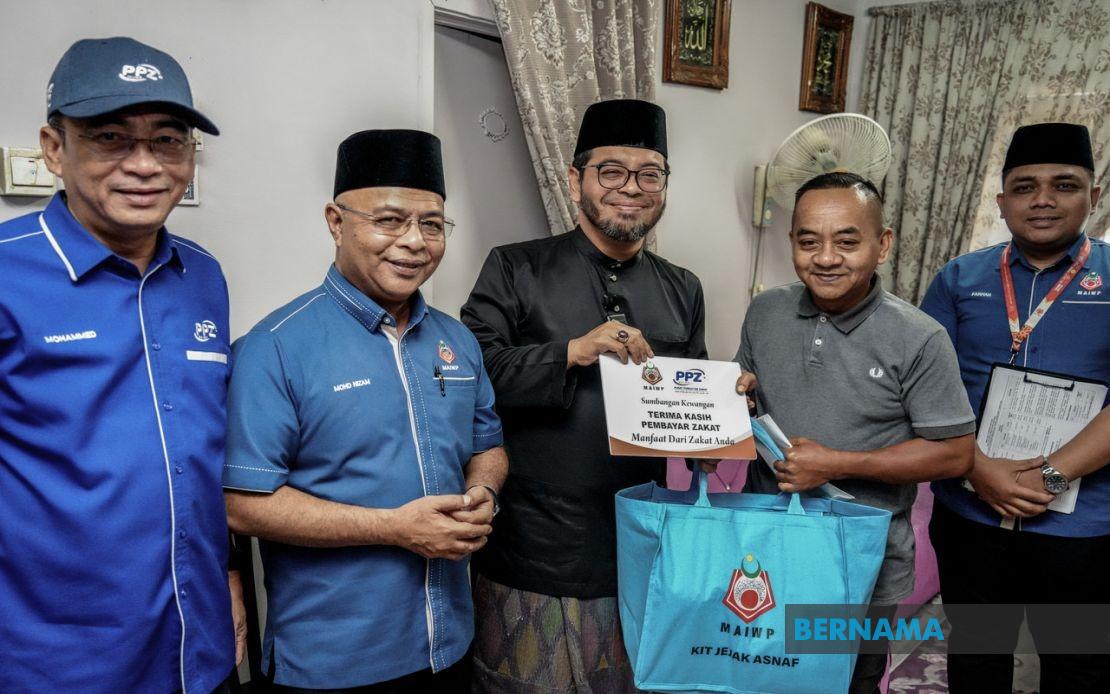
The Federal Territories Islamic Religious Council, known locally as MAIWP, has extended a comprehensive aid package to a widow who recently lost her husband and is now solely responsible for five children ranging from six to fifteen years old. This intervention demonstrates an evolving approach by Malaysia's religious administrative bodies to provide tailored welfare support that addresses the specific circumstances of each household, rather than applying a one-size-fits-all methodology.
Datak Dr Zulkifli Hasan, the Minister in the Prime Minister's Department overseeing Religious Affairs, highlighted the significance of direct community engagement in delivering effective assistance. During a recent visit to the affected families, he underscored that field-based assessments enable MAIWP to grasp the genuine challenges facing recipients and calibrate their aid programmes accordingly. This on-ground methodology represents a strategic shift toward more personalised welfare distribution, a model increasingly adopted across Malaysian religious and social agencies seeking to maximise the impact of limited resources.
The widow's family has become a focal point of MAIWP's expanded intervention strategy. Having previously received General Schooling Aid, the family now qualifies for additional monthly living expense allocations, rental assistance, and enhanced educational support. This multifaceted approach addresses the interconnected vulnerabilities that typically emerge when a single parent assumes the financial burden of raising school-age children, particularly in an urban centre like Kuala Lumpur where housing and education costs place substantial pressure on low-income households.
Beyond this individual case, MAIWP's outreach encompasses diverse family structures and circumstances. One household comprises a married couple with eight school-going children where the father works as a Kuala Lumpur City Hall driver whilst the mother manages domestic responsibilities full-time. This family receives monthly General Medical Assistance covering essential items such as diapers and diabetic supplies, alongside support for wheelchair provision and educational expenses. The combination of employment instability common in municipal work and the substantial burden of supporting eight children illustrates the economic fragility affecting even employed households in Malaysia.
Another beneficiary family features a divorced mother who has managed alone since 2018, raising three school-age children independently. She receives regular cost-of-living stipends, basic necessities support, and educational assistance. The case of divorced or never-married mothers raising children represents a growing demographic challenge across Southeast Asia, where traditional family support structures have weakened amid urban migration and economic pressures. MAIWP's inclusion of such families signals a pragmatic recognition that welfare provision must extend beyond widow-focused categories to encompass broader family fragmentation patterns.
Minister Zulkifli's statement that these interventions represent core components of the government's community support strategy reflects broader policy directions within Malaysia's Islamic affairs apparatus. The phrase "Insya-Allah, these are among the measures we are implementing to assist the community and the people as effectively as possible" encapsulates the framing of such programmes as both religious obligation and governance responsibility. This dual legitimacy—rooted simultaneously in Islamic principles of social welfare and secular administrative capacity—underpins MAIWP's institutional authority in the Federal Territories.
The scale of MAIWP's operations becomes apparent when considering that as of mid-August 2026, the council had already distributed RM699.57 million in cumulative assistance. This substantial allocation demonstrates that religious councils in Malaysia have evolved into major welfare providers, managing resources comparable to those of dedicated government agencies. The magnitude of distribution underscores how Islamic institutional structures have become embedded within Malaysia's broader social safety net, handling welfare provision with financial capacity typically associated with ministerial portfolios.
The targeting mechanisms employed by MAIWP merit examination within the context of Malaysian welfare provision more broadly. Rather than means-testing alone, the council appears to employ categorical eligibility focused on life circumstances—widowhood, disability, large family size, single parenthood—that create structural vulnerability. This categorical approach differs from some alternative models that prioritise income thresholds exclusively, potentially capturing families who face acute hardship despite modest declared earnings.
For Malaysian readers and regional observers, the MAIWP assistance framework illustrates how religious governance structures in Malaysia fulfil functions typically associated with secular welfare ministries in other nations. The Federal Territories, comprising Kuala Lumpur, Labuan, and Putrajaya, fall outside the jurisdiction of any particular state government, making MAIWP's role especially critical. This administrative arrangement has positioned the Islamic council as the primary social welfare institution in Malaysia's capital region, providing services ranging from education support to medical assistance to housing subsidies.
The implications extend beyond immediate poverty relief. By addressing educational expenses for children in vulnerable households, MAIWP's programmes seek to interrupt intergenerational poverty cycles. School-related assistance ensures that economic hardship does not force premature work or educational withdrawal, theoretically enabling upward mobility for the next generation. This preventive welfare orientation contrasts with purely remedial approaches that address immediate destitution without addressing underlying structural disadvantage.
Looking forward, the expansion of MAIWP's assistance frameworks may reflect demographic and economic pressures increasingly visible across Malaysian urban centres. Rising housing costs, stagnant real wages for manual workers, and family instability have generated expanding populations requiring formal welfare support. As traditional extended family networks weaken through urbanisation and emigration, institutional providers like MAIWP must scale operations correspondingly. The current intervention patterns suggest that Malaysia's Islamic religious institutions are adapting their historical charitable functions to address twenty-first-century urban vulnerability effectively.

