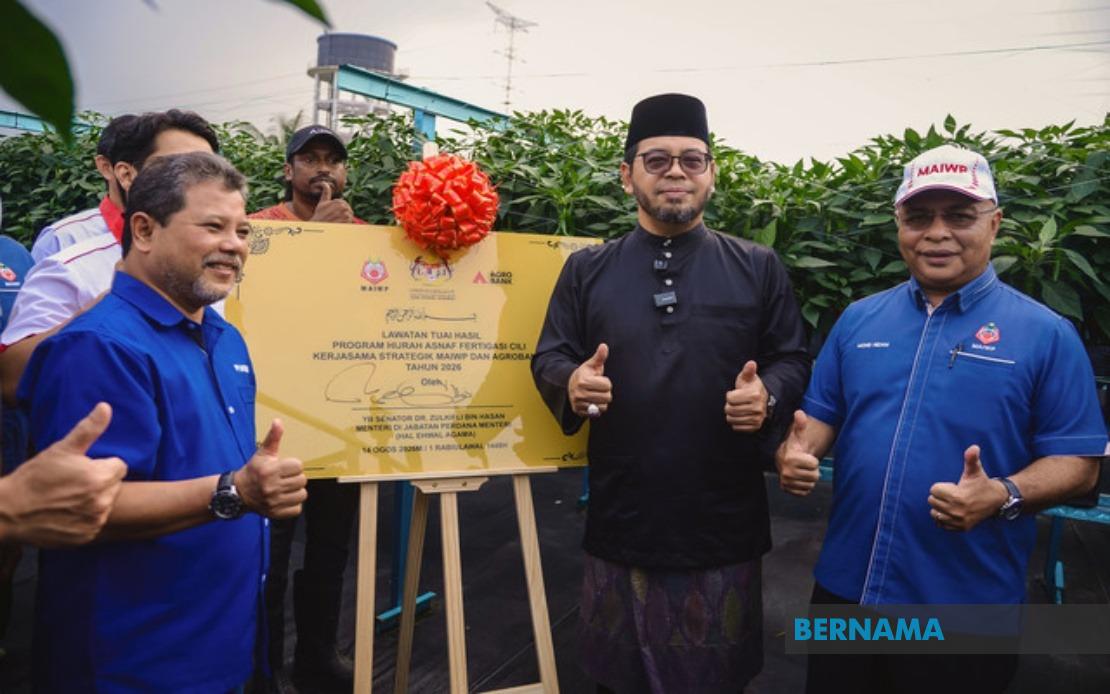
The Majlis Agama Islam Wilayah Persekutuan (MAIWP) is broadening its fertigation-based chilli farming scheme for asnaf communities following strong economic returns from an initial pilot phase. The expansion to five acres represents growing confidence in the project's viability as an income-generating enterprise for underprivileged Malaysians, particularly those who have struggled with conventional employment pathways.
Dr Zulkifli Hasan, the Minister in the Prime Minister's Department (Religious Affairs), highlighted the project's impressive inaugural results when speaking about the initiative's scaling prospects. The first harvest alone produced more than 16.7 tonnes of chillies, translating into returns exceeding RM207,000 for participating asnaf members. These figures underscore the economic potential of modern agricultural techniques when combined with targeted support for vulnerable populations, offering a promising model for zakat distribution beyond traditional welfare assistance.
The fertigation methodology deployed in the project represents a significant technological upgrade for many participants unfamiliar with contemporary farming practices. By automating irrigation and nutrient delivery systems, the approach maximises crop yields while reducing labour requirements and water consumption—critical advantages in Malaysia's tropical climate where weather volatility can devastate traditional farming operations. This technical foundation has proven accessible enough for participants with limited agricultural background to master and deploy successfully.
Beyond primary production, MAIWP is actively encouraging participants to explore downstream processing and value-added manufacturing opportunities. By producing chilli-based products such as pastes, sauces, and dried preparations, farmers can capture higher profit margins and access broader retail and export markets. This integrated approach transforms participants from commodity producers into small entrepreneurs controlling greater portions of their supply chains, substantially improving long-term income sustainability and business resilience.
Alinda Rosely, a 49-year-old programme participant, exemplifies the transformative potential of the initiative. As a single mother who had struggled with economic security, she leveraged the fertigation training and project support to rebuild her household finances. During a particularly favourable market period last year, she generated RM40,000 within six months—an income trajectory that would have been virtually impossible through conventional unskilled employment. Her experience highlights how targeted skills training, access to productive assets, and market linkages can fundamentally alter economic prospects for marginalised community members.
The MAIWP programme aligns with broader policy objectives around developing self-reliant and economically competitive asnaf populations. Rather than perpetuating dependency relationships through cash transfers alone, the initiative equips beneficiaries with productive skills, business acumen, and market access necessary for sustainable livelihoods. This represents a philosophical shift within zakat distribution frameworks—moving from pure poverty alleviation toward human capital development and economic empowerment.
The scale of MAIWP's overall zakat operations underscores the substantial resources available for such developmental initiatives. As of August 12, 2026, the organisation had distributed RM699.57 million in zakat through 38 distinct welfare assistance schemes, alongside funding mechanisms supporting various community development projects. This substantial capital base, drawn from religious obligations across MAIWP's jurisdiction, creates opportunities for experimentation with innovative poverty-reduction models that combine immediate relief with medium and long-term economic opportunity creation.
For Malaysian policymakers and zakat authorities across other states, the MAIWP chilli project offers instructive lessons about programme design and implementation. The combination of technical training, access to modern productive assets, market linkages, and income support creates a comprehensive ecosystem for sustainable livelihood development. Replicating this model across different agricultural commodities and geographic contexts could substantially expand the reach and impact of zakat-funded development initiatives throughout the country.
The expansion to five acres also signals potential commercialisation pathways. As the operation scales, opportunities emerge for cooperative structures, quality certification, supply chain partnerships with major retailers or processors, and potential export development. These commercial dimensions could eventually reduce reliance on zakat subsidies while generating broader employment for surrounding communities, creating spillover economic benefits beyond direct programme participants.
Regionally, Malaysia's experience with income-generating zakat projects carries relevance for other predominantly Muslim Southeast Asian economies grappling with rural poverty and unequal development. The demonstrated success of technology-enhanced agricultural development targeted at disadvantaged populations could inform policy discussions in neighbouring countries about optimising religious taxation systems for sustainable development objectives.
The human dimension remains central to understanding the project's significance. Beyond aggregate statistics, initiatives like the MAIWP chilli scheme restore dignity and agency to economically marginalised individuals by positioning them as productive economic actors rather than passive welfare recipients. This psychological and social dimension—complementing purely financial returns—contributes meaningfully to community wellbeing and social cohesion outcomes.

