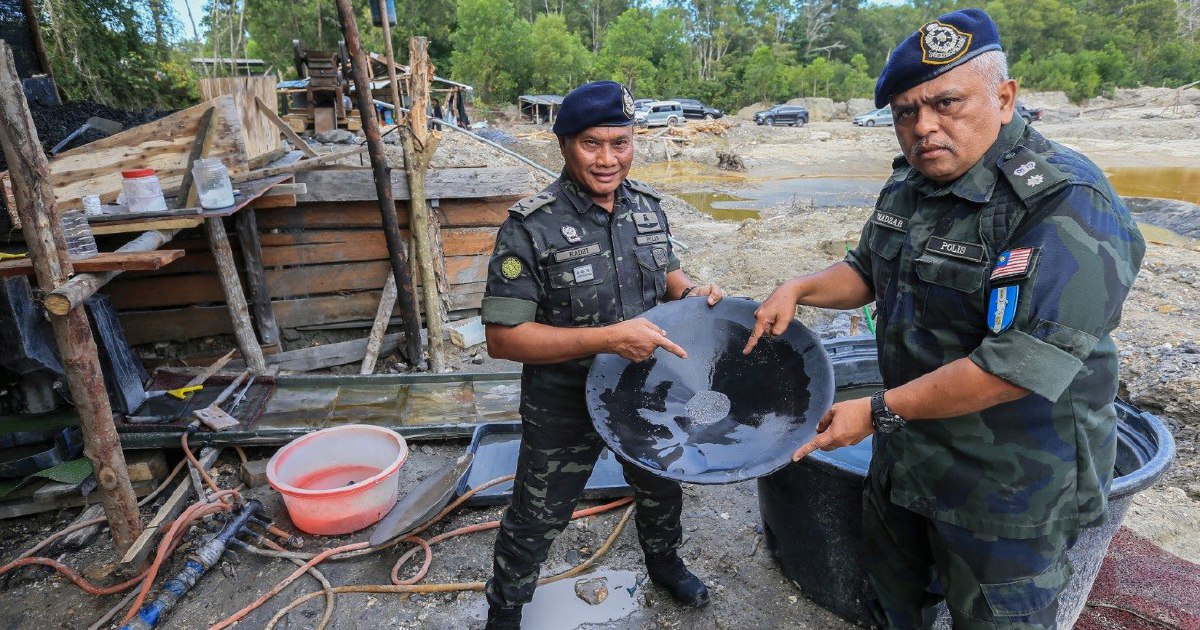
Law enforcement authorities in Terengganu have successfully dismantled a large-scale illegal gold mining operation following a major raid in the Marang district. Officers arrested 15 individuals implicated in running the syndicate, which operated under the moniker 'Mak Siti' and was reportedly generating substantial daily profits of up to RM13,000 through unlicensed extraction activities in the Bukit Kor area.
The discovery and subsequent enforcement action represent a significant success in combating organised mining-related crime in Malaysia's east coast region. Illegal gold mining operations have become increasingly sophisticated in recent years, employing modern extraction techniques and layered management structures designed to evade regulatory oversight. The scale of daily earnings attributed to this particular syndicate underscores the financial incentives driving criminal participation in the sector and the substantial resources invested by organisers to maintain operational secrecy.
Bukit Kor, the location where the raid was executed, falls within a mineral-rich zone in Terengganu. The geological characteristics of this area have made it attractive to both legitimate prospectors and criminal operators. The region's accessibility and relatively sparse population in certain zones create conditions that enable clandestine mining activities to flourish with reduced risk of immediate detection. The choice of this location by the syndicate reflects careful site selection based on geological viability and operational risk assessment.
The detention of 15 individuals suggests a sizeable organisational structure rather than a small-scale opportunistic venture. Such networks typically involve multiple layers of responsibility, from extraction teams operating on-site to logistical personnel managing equipment and supplies, along with intermediaries responsible for processing and selling extracted materials. This hierarchical arrangement enables operators to compartmentalise knowledge and insulate senior figures from direct involvement in extraction activities, a strategy that complicates law enforcement investigations.
Daily revenues of RM13,000 translate into annual gross income exceeding RM4.7 million from this single operation alone. This financial scale places the syndicate among the more substantial criminal mining enterprises, though the actual profit margin remains unclear given the operational costs associated with equipment maintenance, site security, and distribution networks. The profitability levels help explain the willingness of participants to accept legal risks, particularly given inconsistent enforcement resources across Malaysia's vast geographical territories.
The existence of established syndicates with operational names such as 'Mak Siti' indicates these are not spontaneous ad hoc activities but rather organised criminal ventures with recognised identities and established reputations. Named syndicates typically have developed supplier relationships, trusted customer bases, and established protocols for money movement and product distribution. This level of formalisation suggests previous periods of undetected operation before eventual law enforcement interdiction.
Illegal mining operations carry significant environmental and public health consequences alongside their criminal status. Unregulated extraction disrupts soil structure, contaminates groundwater, and destroys vegetation across affected areas. The absence of proper safety protocols on unmonitored sites creates hazard risks including unstable pit structures, chemical exposure, and absence of emergency response capabilities. Terengganu's environmental integrity depends partially on effective suppression of such operations.
The raid's success likely depended on accumulated intelligence gathered through community reporting, observation, or financial investigation. Malaysian authorities have progressively improved inter-agency coordination and intelligence-sharing capabilities concerning organised crime networks. The coordination required to simultaneously apprehend 15 suspects across a distributed operation requires detailed planning and comprehensive knowledge of syndicate structure and personnel deployment.
Malaysia's mineral extraction sector remains economically important, generating government revenue and employment through properly licensed and regulated operations. Illegal mining directly undermines legitimate operators' market position, as unlicensed production avoids tax obligations, environmental compliance costs, and licensing fees that licensed entities must bear. This competitive disadvantage pressures legitimate businesses while enriching criminal syndicates, creating distortions throughout the mineral commodities supply chain.
The enforcement action in Marang contributes to broader anti-organised crime initiatives across Southeast Asia, where cross-border criminal networks frequently operate. Gold mining syndicates in one jurisdiction often coordinate with buyers and processing facilities in neighbouring regions. Disrupting large operations like 'Mak Siti' creates supply disruptions and generates intelligence potentially useful for identifying connected networks in adjacent territories.
Sustained suppression of illegal mining requires continued resource allocation to investigations, raids, and prosecutions over extended periods. Individual enforcement actions, while valuable symbolically and operationally, must be complemented by longer-term strategies including community engagement, economic alternatives for marginal populations vulnerable to recruitment into illegal mining, and technology-enhanced monitoring of known mineral extraction zones. The Marang operation's scope suggests Malaysian authorities recognise the seriousness of this criminal category and remain committed to active intervention.

