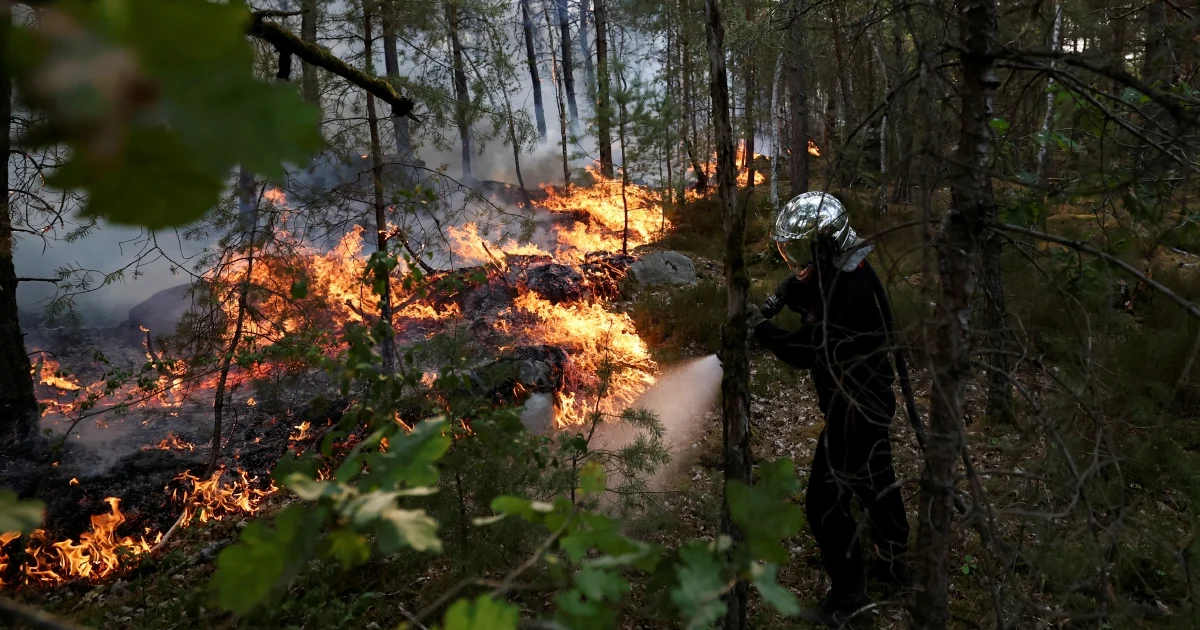
France faced a critical wildfire emergency on Monday as two major blazes swept through forests south of Paris, consuming over 1,300 hectares of woodland in what authorities suspect was a deliberate act. The fires, which broke out in the Arbonne-la-Foret region, prompted a swift police response alongside firefighting operations, resulting in the detention of two individuals on suspicion of arson.
The scale of destruction represents a significant threat to France's forest resources and underscores the vulnerability of the country's natural areas to both environmental pressures and criminal activity. The timing of the blazes during what would typically be considered fire season in continental Europe highlights ongoing challenges facing European nations in safeguarding their ecosystems against escalating wildfire risks.
French emergency services mobilized considerable resources to combat the twin fires, deploying firefighting teams and aerial support to contain the rapidly spreading blazes. The scale of the incident demanded a coordinated response across multiple agencies, reflecting the seriousness with which authorities treated the unfolding crisis. The operational challenges of tackling fires across such a vast forested area, particularly near populated regions, required precision and sustained effort from emergency personnel.
The suspected arson angle introduces a troubling dimension to the environmental disaster. Deliberate firebombing represents not merely environmental vandalism but a serious criminal offense with far-reaching consequences for communities, ecosystems, and national resources. French law enforcement's rapid apprehension of two suspects suggests either swift detective work or intelligence from witnesses at the scene, though investigations into the circumstances and motivations behind the alleged arson would continue.
For Malaysian readers, the Arbonne-la-Foret incident carries particular resonance given Southeast Asia's persistent struggles with uncontrolled wildfires, particularly during dry seasons when agricultural burning spirals into devastating conflagrations. Indonesia and Malaysia have repeatedly confronted transnational haze crises triggered by both intentional and unintentional fires across vast plantation and natural forest areas. The French experience, despite occurring in a developed nation with advanced firefighting capabilities, demonstrates that no country is entirely insulated from wildfire catastrophe when conditions align dangerously.
The historic significance of forests near Paris compounds the loss. These woodlands hold ecological value as carbon sinks, biodiversity repositories, and recreational spaces for surrounding communities. The destruction of such areas, whether through accident or criminal intent, represents a permanent alteration of the landscape that restoration efforts can only partially remedy across timescales measured in decades.
Climate change has emerged as a force multiplier for wildfire incidence across Europe. Rising temperatures, extended drought periods, and shifting precipitation patterns create ideal conditions for fires to ignite and spread rapidly through drier vegetation. The Arbonne-la-Foret fires, whether deliberately set or not, occurred within this context of a warming continent where extreme fire weather events are becoming increasingly commonplace. France and other European nations have witnessed record-breaking fire seasons in recent years, particularly in 2022 and 2023, establishing a troubling trajectory.
Arson investigations into large-scale forest fires typically examine forensic evidence from the ignition points, witness testimony, and behavioural patterns of the accused. The fact that authorities moved quickly to arrest two suspects suggests they identified either direct evidence or strong circumstantial indicators linking the individuals to the blazes. The legal proceedings that follow will illuminate whether the fires were related to personal grievances, environmental extremism, insurance fraud, or other motivations entirely.
The incident underscores vulnerabilities in France's forest management and fire prevention infrastructure despite the nation's considerable resources and technological sophistication. Balancing recreational access to forests with security measures that deter arson remains an ongoing challenge. Enhanced monitoring systems, increased ranger patrols, and stricter penalties for arson continue to evolve as European countries grapple with protecting their woodlands.
Regional implications extend beyond France's borders. The European Union has been strengthening wildfire response mechanisms through the EU Civil Protection Mechanism, recognizing that cross-border support becomes essential when blazes exceed individual nations' firefighting capacities. The Arbonne-la-Foret fires, while serious, remained manageable within French emergency resources, but they exemplify the scale of incidents that can overwhelm response systems without adequate preparation.
For Southeast Asian policymakers watching the French situation, the lesson is sobering: wealthy, developed nations with modern firefighting infrastructure still struggle to contain large-scale wildfires efficiently, particularly when human negligence or deliberate action sets them in motion. This reality has profound implications for countries across ASEAN, where socioeconomic constraints limit firefighting investment even as climate change amplifies fire risk. The Paris forest fires serve as a cautionary reminder that wildfire management demands not only advanced technology but also sustained commitment to prevention, rapid response capabilities, and inter-agency coordination that even prosperous nations find challenging to maintain consistently.

