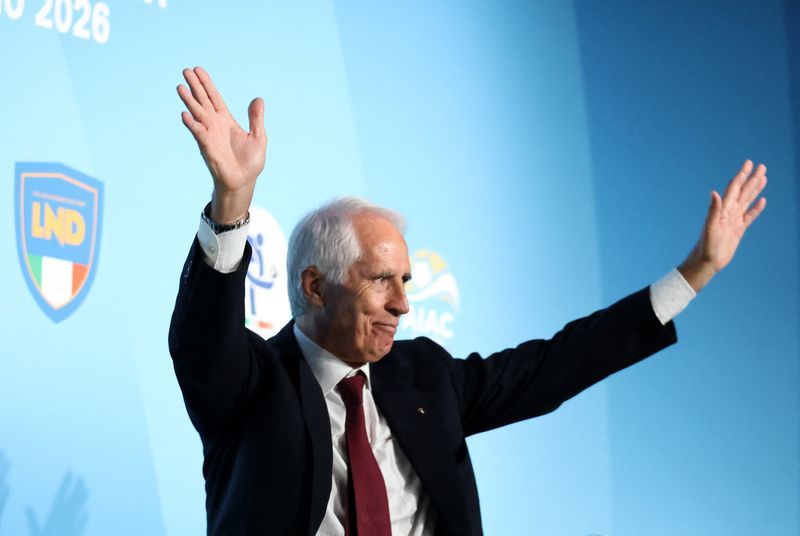
Giovanni Malago has taken the helm of Italian football following a decisive mandate that reflects both the urgency of the federation's predicament and confidence in his ability to navigate crisis. The 67-year-old businessman secured 68.58 percent of votes at the federation assembly in Rome on Monday, defeating rival Giancarlo Abete to become president of one of the sport's most storied yet currently troubled national associations. Malago's appointment marks a watershed moment for a country that has won four World Cup titles but now finds itself in the deepest institutional malaise in generations.
The vacancy Malago fills emerged from widespread public fury following Italy's playoff elimination by Bosnia & Herzegovina in April, a result that meant the Azzurri would miss the World Cup for the third consecutive tournament. The shock reverberated across Italian society, drawing condemnation from supporters and politicians alike. Gabriele Gravina, his predecessor, resigned in the aftermath, unable to withstand the pressure and recrimination. That resignation itself underscored the magnitude of the challenge: leading Italian football requires not merely administrative competence but the ability to restore national pride in an institution deeply woven into the country's cultural identity.
Malago arrives with a recent credential that appeals to Italy's establishment: he chaired the Milano Cortina Winter Olympics organising committee, which successfully delivered the February games in well-regarded fashion. His background also includes a lengthy tenure heading the Italian National Olympic Committee, marking him as someone accustomed to managing large, politically sensitive sporting bodies. He was also a futsal player during his competitive years. Yet even these accomplishments pale beside the scale of reconstruction required within Italian football, which faces not a single catastrophic failure but a systematic breakdown spanning multiple levels of the sport.
The depth of Italian football's crisis extends well beyond the men's national team's World Cup misadventure. Italian clubs have simultaneously collapsed in continental competitions, creating a perfect storm that has left the nation's football infrastructure weakened as it has not been since the early 1980s. This convergence of failures at both domestic and international levels suggests structural rather than superficial problems. Youth development systems that once reliably produced world-class talent have deteriorated, prompting warnings from prominent figures including retired striker Roberto Baggio, who publicly questioned whether Italy's academies and training programmes remained fit for contemporary football's demands.
Malago has wasted little time identifying his immediate tasks. Chief among his priorities is recruiting a new men's national team coach following Gennaro Gattuso's resignation in the wake of the World Cup qualification exit. Equally pressing is a comprehensive rethinking of how Italy identifies, develops, and nurtures young footballers through the ranks. The federation must also accelerate preparations for hosting the 2032 European Championship alongside Turkey, an obligation that offers both opportunity and deadline pressure.
In his remarks after election, Malago signalled his understanding that Italian football requires not incremental tinkering but fundamental reimagining of its role within society. He argued that the Italian Football Federation must transcend its administrative function and instead serve as an inspirational force, leveraging its position as the largest sporting institution in the country. This framing acknowledges that football's influence extends beyond the pitch into broader questions of national morale and social cohesion, particularly salient given Italy's current struggles.
Malago's invocation of historical legacy as inspiration rather than burden reveals shrewd psychological positioning. Italy's four World Cup victories and its tradition of tactical sophistication and technical excellence represent both proud heritage and psychological weight. Rather than allowing former glories to become a source of nostalgia or excuse for mediocrity, he positioned them as a foundation for future ambition. This rhetorical move matters because Italian football has in recent years sometimes seemed caught between clinging to past achievements and acknowledging present inadequacy. Malago's framing potentially unblocks that psychological stalemate.
The challenge before him encompasses the philosophical as well as the practical. Italian football must reconcile its traditions with modern developments in player development, tactical evolution, and competition intensity. Many European nations have successfully modernised their youth systems in recent years; Italy's relative decline suggests its academies have not kept pace. Whether Malago can mobilise the federation's considerable resources and institutional knowledge toward systematic modernisation while maintaining connection to authentic Italian footballing values will likely determine his success.
Previous federation leader Gravina acknowledged in remarks to reporters that he should have stepped aside sooner, a candid admission that highlights how rapidly credibility erodes when sporting institutions fail at their core mission. Malago inherits a federation significantly damaged in public trust and internal morale. The task of reconstruction extends beyond tactical and strategic adjustments to encompassing restoration of confidence that Italian football possesses both the vision and competence to reclaim its former standing.
For Malaysian readers following European football, Italy's travails carry relevance beyond mere sporting interest. The Azzurri's crisis demonstrates how quickly even historically dominant football nations can lose competitive edge when institutional structures prove insufficiently responsive to changing conditions. It also illustrates the intersection of football with broader national narratives, particularly in a country where sport carries profound cultural significance. Italy's recovery or continued struggle will reshape European football's competitive landscape for years ahead.
Malago's election provides Italian football with fresh leadership at a moment of profound need, yet the federation remains in genuinely precarious condition. Three consecutive World Cup absences represent unprecedented modern failure for an Italian team. The road to recovery will demand sustained commitment, difficult institutional decisions, and successful navigation of both technical footballing challenges and the complex politics governing Italian sport. Whether Malago possesses the strategic vision and organisational acumen to accomplish this remains the critical question facing Italian football as it attempts to rebuild from its lowest ebb in four decades.