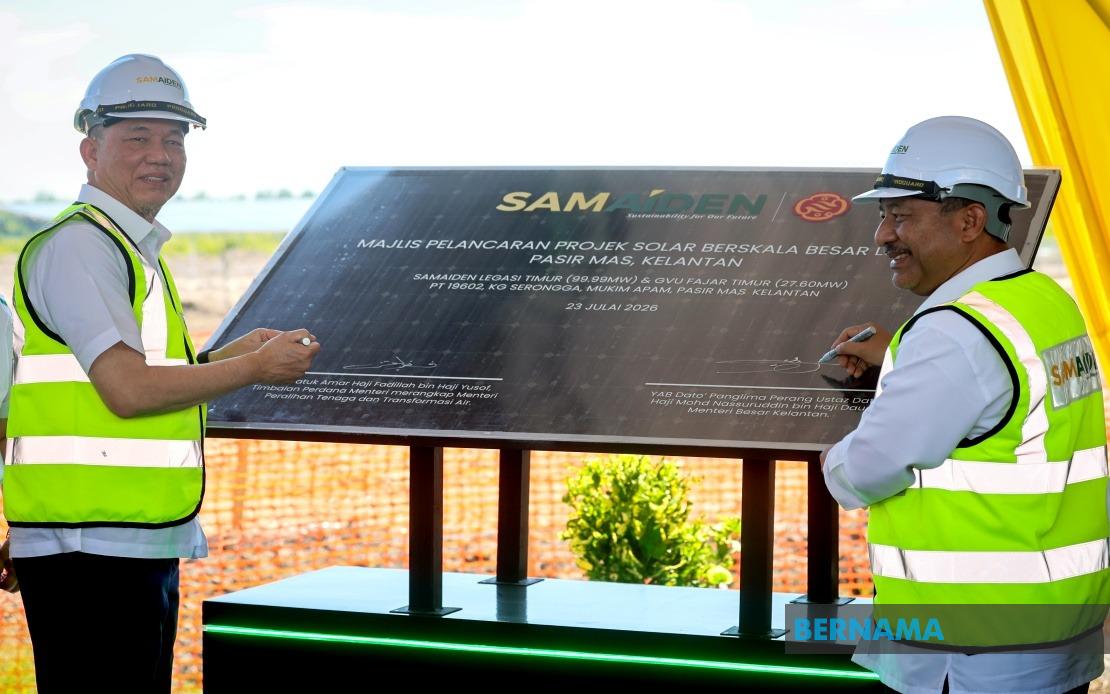
Malaysia's renewable energy landscape is gathering momentum, with installed capacity reaching nearly 32 per cent as of June, signalling that the country remains firmly positioned to exceed its 2030 renewable energy target of 35 per cent. The milestone, announced by Deputy Prime Minister Datuk Seri Fadillah Yusof at the launch of the Large-Scale Solar Project (LSS5) in Pasir Mas, Kelantan, underscores the tangible results emerging from the government's National Energy Transition Roadmap (NETR)—a comprehensive blueprint that outlines Malaysia's trajectory toward a cleaner, more resilient energy future.
The NETR represents a strategic pivot for Malaysia's energy sector, moving beyond incremental adjustments to embrace a systematic transformation centred on long-term sustainability. Fadillah, who also serves as Minister of Energy Transition and Water Transformation (PETRA), emphasised that energy transition is neither a policy preference nor an optional upgrade to Malaysia's infrastructure. Rather, it constitutes a strategic imperative shaped by three converging pressures: the need to fortify energy security in an increasingly volatile global market, the imperative to strengthen Malaysia's economic resilience in a world pivoting toward green economies, and the obligation to honour international climate commitments while maintaining the nation's standing on the global stage.
What distinguishes Malaysia's renewable energy progress is its deliberate balancing act. The government has explicitly committed to pursuing energy transition without sacrificing affordability or imposing undue strain on households and businesses. This approach recognises a fundamental reality facing developing economies: the energy transition cannot succeed if it renders electricity unaffordable for ordinary Malaysians or undermines industrial competitiveness. By anchoring the transition in principles of cost affordability alongside security and sustainability, the government signals that decarbonisation must coexist with economic pragmatism—a nuanced position that differentiates Malaysia's strategy from more doctrinaire approaches adopted elsewhere.
The trajectory toward Malaysia's renewable targets reveals accelerating momentum. The nation had achieved 31 per cent renewable energy installed capacity by December 2025, already meeting the intermediate goal set for that period. The current reading of nearly 32 per cent, recorded only months later in June, demonstrates that installations are not merely on schedule but potentially ahead of pace. Beyond 2030, the roadmap extends ambition further, targeting 70 per cent renewable energy penetration by 2050—a goal that would fundamentally restructure Malaysia's energy mix within a generation and require sustained investment and innovation across two decades.
The launch of LSS5 in Kampung Serongga, Kelantan, embodies the practical manifestation of this policy framework. Large-scale solar installations of this magnitude serve multiple functions simultaneously: they expand the renewable energy supply into the national grid, create employment across construction, operations, and maintenance phases, stimulate local economies through procurement of materials and services, and catalyse the growth of supporting industries that supply and service solar infrastructure. For Kelantan specifically, the project carries particular significance as a proof-of-concept that northern Malaysian states can attract and successfully execute major renewable energy investments, positioning the state as a credible destination for sustainable development projects.
Kelantan's renewable energy potential extends far beyond what LSS5 alone can capture. The state possesses substantial tracts of suitable land for solar deployment, enjoys active backing from its state government, and increasingly attracts private sector participation driven by both policy certainty and commercial opportunity. Recognising this untapped capacity, Fadillah encouraged widespread adoption of rooftop solar systems through PETRA's Solar ATAP Programme, a distributed generation initiative that shifts renewable energy generation away from utility-scale projects toward residential, institutional, and commercial properties. This two-pronged strategy—combining large-scale utility projects with distributed rooftop systems—maximises the utilisation of available solar resources while building renewable energy capacity at multiple scales throughout the state.
The economic implications for Kelantan are substantial. Kelantan Menteri Besar Datuk Mohd Nassuruddin Daud positioned LSS5 as a benchmark project that signals to investors that the state possesses both the physical infrastructure and governance frameworks necessary to execute complex energy projects successfully. In Malaysia's competitive landscape where multiple states vie for investment, successful execution of flagship projects carries outsized importance in shaping investor perceptions and generating follow-on interest. The project's success would reinforce Kelantan's emerging identity as a state capable of driving investment in sustainable technology and innovation—sectors increasingly prioritised by multinational corporations and regional investors evaluating expansion or relocation decisions.
Beyond immediate economic returns, the LSS5 project exemplifies how energy transition and economic development can reinforce each other rather than compete. The construction and operational phases will generate employment for local workers, stimulate demand for supporting services and goods, and demonstrate viable pathways for sustainable economic activity. For communities in Pasir Mas and surrounding areas, the project's benefits extend to improved electricity access, lower energy costs over time as renewables reduce dependence on imported fossil fuels, and enhanced environmental quality through reduced air pollution and associated public health impacts.
The investor confidence reflected in projects like LSS5 carries strategic implications for Malaysia's broader development agenda. Private sector participation in renewable energy expansion indicates that investors perceive Malaysia's regulatory environment and energy policies as sufficiently stable and attractive to justify capital deployment. This confidence, in turn, validates the government's policy approach and creates a virtuous cycle: successful projects attract additional investment, which accelerates capacity additions and lowers costs, which attracts further investment. Maintaining this momentum requires continued policy consistency, transparent regulatory frameworks, and demonstrated commitment from both federal and state governments—factors that Fadillah and Mohd Nassuruddin both emphasised in their statements.
The confluence of federal and state government coordination, private sector initiative, and community engagement illustrated by LSS5 reflects an evolved understanding of how energy transition must be executed in Malaysia's federal context. Unlike centralised systems where energy policy flows unidirectionally from the capital, Malaysia's approach requires alignment across multiple tiers of government, collaboration with private investors who bear execution and financial risk, and consideration of local impacts on communities hosting renewable projects. This multilayered coordination adds complexity but also distributes responsibility and risk, making large-scale transitions more politically sustainable and economically efficient.
For Malaysian households and businesses, the progress toward renewable energy targets carries direct implications for energy affordability and supply security. As renewable energy capacity expands, the grid becomes less dependent on imported fossil fuels—primarily liquefied natural gas and coal—whose prices fluctuate with global market conditions often beyond Malaysia's control. Renewable energy, once installations are built, generates electricity at minimal operating cost, providing a hedge against future price volatility and offering potential pathways to more stable, predictable energy costs. However, realising these benefits requires investments in grid modernisation, energy storage systems, and demand management technologies that must proceed in parallel with capacity expansion.
Looking ahead, Malaysia's renewable energy trajectory will be tested by challenges as deployment scales beyond demonstration projects and pilot programmes toward system-wide transformation. Grid integration of variable renewable sources will require sophisticated forecasting and balancing mechanisms; supply chains for solar equipment and components must remain resilient despite global trade uncertainties; workforce development must keep pace with rising demand for technicians, engineers, and project managers; and manufacturing capabilities for renewable equipment should be developed domestically to reduce import dependence and create high-value employment. These challenges are neither unique to Malaysia nor insurmountable, but they require sustained attention and investment alongside the megawatt-scale project launches that dominate public announcements.
The achievement of nearly 32 per cent renewable energy capacity places Malaysia in a competitive position within Southeast Asia, where renewable energy deployment varies significantly across the region. The clarity of Malaysia's targets, the institutional framework provided by the NETR, and the demonstrated ability to mobilise both public and private resources position the country as a regional leader in managed energy transition. For neighbouring countries facing similar pressures to decarbonise while managing energy security and affordability concerns, Malaysia's experience offers valuable lessons in balancing competing priorities and maintaining policy coherence across government levels. As the nation advances toward 2030 and beyond, the integration of renewable energy into Malaysia's energy mix will reshape not only electricity supply but the broader competitive advantages available to Malaysian industries and the quality of life for Malaysian citizens.

