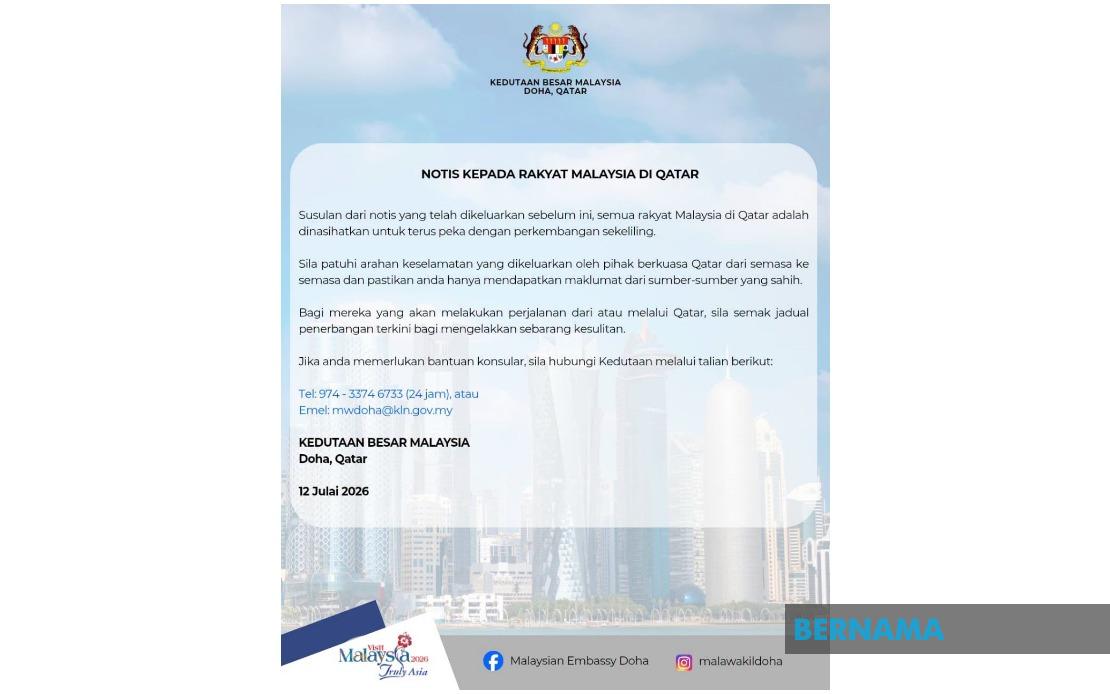
The Malaysian Embassy in Doha has issued a formal security advisory to Malaysian citizens residing in or transiting through Qatar, directing them to remain vigilant and strictly adhere to guidance from local Qatari authorities. The embassy's warning comes as military tensions in the Middle East have intensified dramatically, with both Washington and Tehran conducting fresh attacks this week despite having agreed to a ceasefire mechanism just weeks earlier. Malaysians in the Gulf nation are urged to obtain news and updates exclusively from verified and reliable sources, while those planning travel are instructed to monitor airline schedules carefully to mitigate potential disruptions to their itineraries.
The escalation marks a significant deterioration in the regional security environment. On Sunday, American military forces executed their third round of airstrikes against Iranian targets within a single week, triggering a sharp spike in hostilities that contradicts diplomatic progress achieved in June. The trigger for this renewed violence centres on control of the Strait of Hormuz, one of the world's most critical maritime chokepoints through which roughly one-fifth of global petroleum trade passes daily. Iran's Islamic Revolutionary Guard Corps navy announced the unilateral closure of the waterway, declaring that it would remain sealed indefinitely until the United States ceases all military intervention in the region.
The timing of this escalation is particularly alarming given that Tehran and Washington had only recently taken a significant step toward de-escalation. In June, both nations signed a Pakistan-brokered memorandum of understanding that was designed to terminate the conflict that commenced in late February and establish the foundations for a comprehensive peace settlement. That agreement explicitly stipulated an immediate cessation of all military operations across all theatres, the complete removal of American naval blockades imposed on Iran, and the reopening of the Strait of Hormuz to commercial maritime traffic. The memorandum represented a rare diplomatic breakthrough in an intensely fraught relationship marked by decades of mutual antagonism and proxy conflicts across the Middle East.
Yet despite this binding agreement, the underlying tensions have proven more intractable than the diplomatic language suggested. This week's tit-for-tat military exchanges originated from disputes over commercial shipping passage through the Strait of Hormuz, demonstrating that even ostensibly settled agreements between the two adversaries remain vulnerable to sudden collapse when operational disputes emerge. The Iranian military's decision to fire upon a commercial vessel transiting the strait, coupled with the announcement of its closure, represents a provocative assertion of regional power that directly contravenes the June memorandum both nations had signed.
For Malaysia and other Southeast Asian nations with significant economic interests in the Middle East, this escalation carries tangible consequences. Malaysian companies involved in shipping, petroleum trade, and regional commerce depend heavily on unfettered access to the Strait of Hormuz. Any sustained closure of this waterway would drive up transportation costs, create supply chain disruptions, and inflate energy prices across the region. Malaysian nationals working in Qatar's thriving petrochemical, finance, and construction sectors could face security risks if violence spreads, while the broader business environment would suffer from heightened uncertainty and operational challenges.
The Malaysian Embassy's advisory reflects the standard precautionary posture adopted by diplomatic missions when security conditions deteriorate. By instructing citizens to comply with Qatari security protocols and rely only on authenticated information, the embassy is attempting to insulate Malaysian nationals from the misinformation and rumour that typically circulate during periods of regional instability. Qatar itself, as a small but strategically significant nation hosting major American military installations alongside serving as a mediator between Iran and Western powers, occupies a delicate position in these geopolitical calculations. The country's role as a regional hub for finance, energy, and diplomatic engagement means that any sustained escalation could undermine Qatar's broader economic and political objectives.
The Malaysian Embassy has also activated its consular support infrastructure to assist citizens who require assistance during this period of heightened tension. A dedicated 24-hour hotline has been publicised through the embassy's official social media channels, enabling Malaysians to report emergencies, seek shelter, or obtain evacuation assistance should circumstances deteriorate significantly. This institutional readiness reflects standard diplomatic protocols, yet the establishment of such elevated alert status underscores official assessment that risks to Malaysian nationals in Qatar have genuinely increased beyond baseline levels.
The broader context of this escalation reveals fundamental disagreements between the United States and Iran that remain unresolved despite the June memorandum. Washington's insistence on maintaining strategic dominance in the Persian Gulf, coupled with its naval presence and military capabilities in the region, directly conflicts with Tehran's assertion of sovereignty and its determination to establish itself as the preponderant regional power. The Strait of Hormuz has become the physical manifestation of this struggle for geopolitical supremacy, making it an inevitable flashpoint for renewed conflict whenever diplomatic channels weaken or political calculations shift.
For Malaysian policymakers and business leaders, the current episode underscores the vulnerability of Southeast Asian economic interests to Middle Eastern instability. Malaysia's substantial overseas workforce, significant petroleum imports, and growing regional investments all depend on predictable security conditions and stable governance in Gulf states. The apparent fragility of the June agreement, tested within mere weeks of its signature, suggests that lasting peace in the region will require far deeper institutional mechanisms and more fundamental shifts in the strategic calculations of the principal actors than recent diplomatic initiatives have yet achieved. Until such structural changes occur, Malaysian authorities will likely maintain heightened vigilance and continue issuing periodic security advisories to their citizens in the region.

