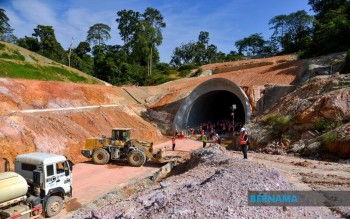
The Malaysian government has committed RM207.2 million to develop the Pasir Puteh parliamentary constituency in Kelantan through a package of 46 approved projects scheduled for implementation in 2026 and beyond. The initiative represents a significant push to transform the region's economic landscape by capitalizing on the East Coast Rail Link's strategic infrastructure, Deputy Economy Minister Datuk Mohd Shahar Abdullah announced during a parliamentary question-and-answer session in Kuala Lumpur on July 13.
At the heart of this development strategy lies the establishment of a downstream industrial area adjacent to the Pasir Puteh ECRL cargo station. Rather than viewing the rail link as simply a transport corridor, Malaysian policymakers are treating it as an economic anchor that can reshape local economic activity. The planned infrastructure encompasses site preparation, land development, and facility construction designed to facilitate logistics and manufacturing operations. This approach acknowledges a fundamental shift in how the country intends to leverage major transport infrastructure—not merely for moving goods and passengers, but as catalysts for concentrated industrial development in strategically selected zones.
The geographic positioning of Pasir Puteh offers particular advantages that planners believe justify the substantial public investment. The constituency's proximity to the Tok Bali Supply Base creates potential synergies between maritime and rail transport networks. Deputy Minister Mohd Shahar emphasized that this convergence of logistics infrastructure could position the area as a major hub for regional commerce, potentially attracting both domestic and foreign investors seeking efficient supply chain solutions. The thinking reflects broader recognition within Malaysian development circles that successful regional growth increasingly depends on multi-modal connectivity rather than single transport modes.
The government's framework for this development operates under the ECRL Integrated Land Use Master Plan, referred to locally as PGTA-ECRL. This comprehensive planning document identifies the Pasir Puteh station specifically as a dual-purpose facility serving both passenger and cargo functions. Rather than creating isolated industrial zones disconnected from other economic activities, planners envision an integrated ecosystem where rail infrastructure, port facilities, warehousing, manufacturing, and service sectors operate in coordination. This integrated approach represents a maturation of Malaysian regional development philosophy, moving beyond disparate projects toward holistic spatial planning.
The timeline for implementation extends across the 13th Malaysia Plan period, beginning this year and continuing through 2030. This seven-year implementation horizon acknowledges that substantial infrastructure transformation requires sustained investment and sequential project delivery. The staged rollout also provides flexibility for course corrections based on market response and changing economic conditions. Progress will be tracked through the MyRMK system, a digital monitoring mechanism that enables real-time oversight and accountability reporting to Parliament.
Deputy Minister Mohd Shahar articulated the broader strategic rationale behind the investment, emphasizing that development spending should narrow regional disparities while building on each locality's inherent competitive advantages. His comments reflect official thinking that fiscal allocation should follow economic logic rather than purely political distribution formulas. By concentrating resources in Pasir Puteh around logistics and industrial capacity, the government is signaling that this constituency possesses genuine structural advantages worth developing intensively, rather than spreading funds thinly across numerous modest initiatives.
For Malaysia's northeast region, the Pasir Puteh initiative carries implications extending beyond the single constituency. The East Coast Rail Link itself represents one of Southeast Asia's most significant infrastructure projects, with broader economic impacts across Kelantan, Terengganu, and Pahang. By actively developing the cargo station at Pasir Puteh as a functional logistics hub rather than leaving it as merely a transit point, the government seeks to distribute ECRL's economic benefits more equitably. This approach attempts to prevent scenarios where major infrastructure projects primarily benefit major metropolitan centers while peripheral areas gain minimal advantage.
The investment also reflects federal government confidence in Kelantan's economic potential despite the state's historical position as Malaysia's least developed peninsula state. Rather than treating Pasir Puteh as a recipient of poverty-alleviation aid, officials are positioning it as an emerging logistics and industrial opportunity. This framing carries important political and economic messaging—that development is achievable through strategic infrastructure rather than permanent subsidy arrangements.
The initiative will be closely watched by other Malaysian constituencies seeking comparable investment. The 46-project package covering RM207.2 million establishes a substantial baseline for parliamentary resource allocation. If the Pasir Puteh model generates measurable economic returns—job creation, investment inflow, tax revenue—other constituencies may successfully argue for similar integrated development frameworks rather than fragmented project lists.
For regional investors and logistics operators, the Pasir Puteh development signals Malaysian government commitment to operationalizing the ECRL as more than a vanity infrastructure project. Companies evaluating supply chain locations across Southeast Asia increasingly consider not just transport connectivity but surrounding industrial ecosystems. A fully developed cargo hub at Pasir Puteh could position the area within regional logistics networks connecting southern Thailand, Brunei, Sarawak, and Sabah.
The parliamentary commitment also underscores that Kelantan's development trajectory remains central to national planning despite the state's different political leadership. Fiscal transfers and major infrastructure projects continue flowing to the state regardless of partisan considerations, suggesting institutional continuity transcending electoral cycles. This consistency provides stability for private sector investment planning and local government strategy formulation.
Looking forward, success will depend on complementary investments from Kelantan state government and private sector participation. The federal RM207.2 million covers infrastructure foundation, but attracting manufacturing and logistics companies requires competitive operational costs, skilled workforce development, and regulatory frameworks that private operators find commercially viable. The next phase involves moving beyond planning and infrastructure to actual business establishment and employment generation within the Pasir Puteh industrial zone.

