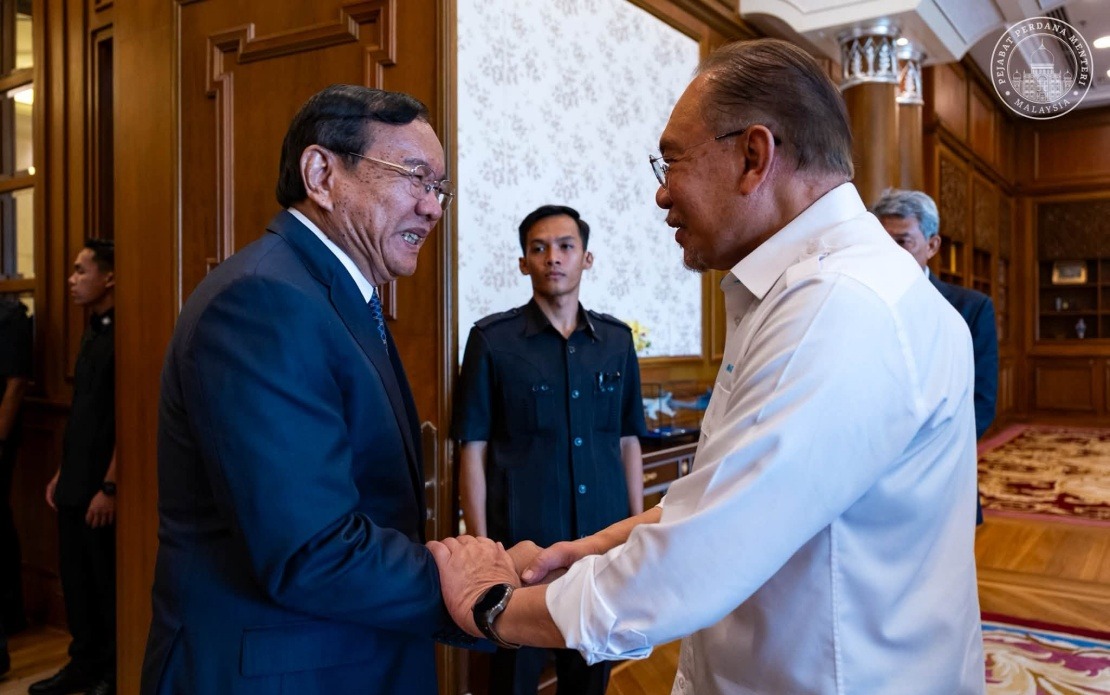
Prime Minister Datuk Seri Anwar Ibrahim has outlined an ambitious agenda for strengthening Malaysia-Cambodia relations, signalling that both Southeast Asian nations are moving beyond traditional cooperation frameworks to embrace emerging technologies and contemporary economic challenges. The commitment, articulated during a high-level diplomatic engagement, underscores the growing importance of bilateral ties between Kuala Lumpur and Phnom Penh at a time when regional geopolitics and economic interdependence are reshaping intra-ASEAN dynamics.
The announcement came during a courtesy visit by Cambodian Deputy Prime Minister and Minister of Foreign Affairs and International Cooperation Prak Sokhonn, who arrived in Malaysia for a two-day official engagement beginning on August 3. The timing of the visit carries particular significance as it precedes the Third Malaysia-Cambodia Joint Commission for Bilateral Cooperation (JCBC) meeting scheduled for August 4, a formal mechanism designed to review progress and chart new directions for the bilateral relationship.
Among the priority areas identified for enhanced cooperation are the digital economy and artificial intelligence—sectors that reflect both nations' recognition that technological advancement is central to future competitiveness. Malaysia, with its established position as a regional technology hub, and Cambodia, increasingly positioning itself as a digital frontier market, stand to benefit considerably from coordinated efforts in these fields. Expertise transfer, joint research initiatives, and regulatory harmonisation could accelerate Cambodia's digital transformation whilst creating new commercial opportunities for Malaysian technology firms and investors.
The halal industry represents another pillar of the expanded partnership, an area where Malaysia's decades-long expertise and global market leadership creates natural complementarity with Cambodia's growing interest in this sector. As Muslim-majority nations with significant economic stakes in halal products and services, Malaysia and Cambodia can leverage combined capabilities to develop supply chains, certification standards, and market access strategies that serve not only their domestic needs but also position them as competitive suppliers to major halal markets across Asia and the Middle East.
Food security emerged as a critical focus area during discussions between the two leaders, reflecting broader regional anxieties about agricultural resilience, climate change impacts, and supply chain vulnerabilities exposed during recent international disruptions. Collaboration on agricultural research, crop diversification, water management, and food production technologies could bolster the resilience of both nations whilst generating mutual economic benefits through trade and investment in agribusiness sectors.
Human capital development—encompassing education, skills training, and professional exchange programmes—forms another strategic component of the partnership. As both nations navigate demographic transitions and labour market demands, initiatives to develop shared standards, facilitate cross-border professional mobility, and build technical expertise across key sectors can create a more integrated regional workforce and deepen people-to-people connections that strengthen diplomatic bonds.
The commitment to combating cross-border crime addresses a persistent challenge that spans narcotics trafficking, human smuggling, cybercrime, and transnational organised crime networks that exploit the porous borders and limited enforcement coordination characteristic of the region. Enhanced intelligence-sharing, joint law enforcement operations, capacity-building programmes, and technological collaboration can meaningfully reduce criminal activities that destabilise both nations and undermine regional security.
The bilateral engagement also carries broader implications for ASEAN cohesion and strategic direction. As member states of the regional bloc, Malaysia and Cambodia share responsibility for preserving peace, maintaining regional stability, and advancing the ASEAN Community Vision 2045, an ambitious framework aimed at creating a people-oriented, people-centred community underpinned by common values and shared interests. Strengthened bilateral relations between these two nations can serve as a building block for more integrated regional cooperation.
Looking ahead to 2027, when Malaysia and Cambodia will commemorate the 70th anniversary of their diplomatic relations, both countries are positioning this milestone as an opportunity to reflect on their enduring friendship and strategic partnership. This seven-decade relationship, rooted in shared ASEAN membership and geographic proximity, provides a foundation upon which increasingly sophisticated cooperation architectures can be constructed. The JCBC mechanism, meeting for its third iteration, demonstrates the institutionalisation of bilateral engagement at the highest political levels.
The announcement by Prime Minister Anwar Ibrahim reflects Malaysia's broader strategic orientation towards deepening engagement across Southeast Asia, moving away from purely bilateral transactions towards integrated partnerships addressing contemporary regional challenges. For Cambodia, the enhanced cooperation signals recognition from a more economically advanced neighbour and underscores opportunities for accelerated development and integration into regional value chains across emerging sectors.
The practical implementation of these commitments will require sustained political will, institutional capacity, and adequate resource allocation from both governments. Success will depend not only on high-level declarations but on the ability of technical agencies, business sectors, and civil society organisations to translate diplomatic intentions into concrete collaborative projects that generate tangible benefits for both populations. As regional geopolitical dynamics continue evolving, such partnership consolidation becomes increasingly vital for maintaining ASEAN's stability and prosperity.

