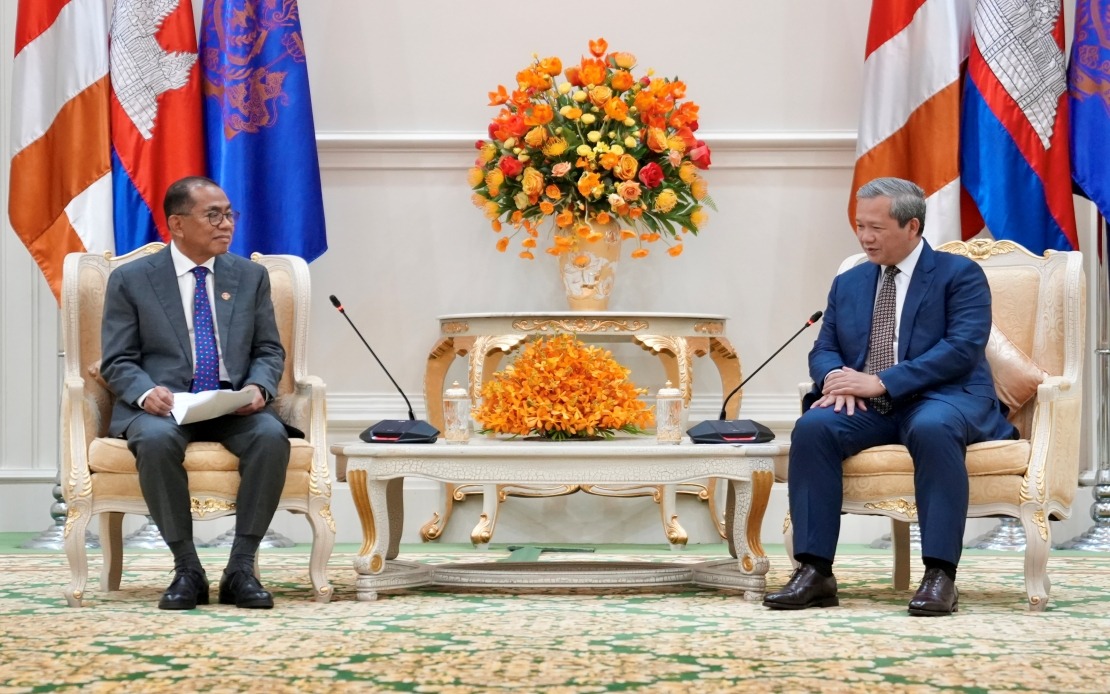
Malaysia and Cambodia are moving forward with concrete steps to expand their defence partnership, with both nations committed to resolving shared regional security concerns through dialogue and institutional cooperation. During a recent courtesy call in Phnom Penh, Defence Minister Datuk Seri Mohamed Khaled Nordin met with Cambodian Prime Minister Samdech Thipadei Hun Manet and Defence Deputy Prime Minister General Tea Seiha to chart a new course for military-to-military relations that extends beyond traditional cooperation frameworks.
The centrepiece of these discussions involves the Malaysia-Cambodia Defence Cooperation Memorandum of Understanding, which remains in its final negotiation stages. This MoU represents far more than bureaucratic formality; it will establish the foundational architecture through which both countries can coordinate on an expanding agenda of security matters. The document's completion signals mutual recognition that bilateral defence ties merit sustained institutional attention, particularly as Southeast Asia confronts increasingly complex security dynamics at multiple levels.
Regional stability concerns featured prominently in the bilateral conversations. Both Malaysia and Cambodia emphasised the importance of ASEAN centrality in addressing transnational security challenges, with particular focus on the Cambodia-Thailand border situation. Malaysia reiterated its continued support for the ASEAN Observer Team mechanism and advocated for peaceful resolutions grounded in dialogue rather than military escalation. This posture reflects Kuala Lumpur's preference for multilateral solutions over bilateral or unilateral approaches to regional conflicts, a consistent thread in Malaysian foreign policy.
The South China Sea maritime disputes also occupied significant space in the talks. Both nations highlighted the urgency of finalising the Code of Conduct in the South China Sea, viewing it as essential for maintaining a rules-based order that protects smaller nations' interests and prevents major power competition from destabilising the region. For Malaysia, which maintains territorial claims in the disputed waters and depends heavily on freedom of navigation through those routes, such frameworks carry strategic weight beyond symbolic gestures.
Crucially, Malaysia and Cambodia are broadening their defence cooperation into emerging domains that reflect 21st-century security realities. Jungle warfare training represents a practical skill-sharing endeavour suited to both nations' geographic and strategic circumstances. More significantly, collaboration in defence industry development, artificial intelligence applications, and drone technology signals recognition that military capability increasingly depends on technological sophistication and industrial capacity rather than traditional hardware alone. These areas allow both countries to develop asymmetric advantages while remaining within their economic and technical capabilities.
Mohamed Khaled's diplomatic mission encompassed sequential visits to Vietnam immediately beforehand, where he engaged Vietnam's Defence Minister General Phan Van Giang and met Prime Minister Le Minh Hung. This two-country swing demonstrates Malaysia's systematic approach to defence diplomacy, treating engagement with major ASEAN partners as interconnected rather than isolated encounters. The visits collectively illustrate Malaysia's intention to position itself as a reliable security partner across Southeast Asia despite no longer holding the ASEAN Chair.
The timing of this defence diplomacy carries additional significance given the approaching 70th anniversary of Malaysia-Cambodia diplomatic relations in 2027. Mohamed Khaled explicitly linked current cooperation initiatives to this milestone, suggesting that both governments envision strengthened defence ties as contributing to a broader relationship maturation. The Defence Minister expressed confidence that the bilateral MoU could be signed during the ASEAN Defence Ministers' Meeting scheduled for the Philippines, providing a multilateral platform for a bilateral achievement.
Malaysia's sustained commitment to ASEAN stability despite vacating the chair reflects institutional thinking within Kuala Lumpur's defence establishment. The Defence Ministry explicitly framed these working visits as implementing the Third Pillar of Malaysia's National Defence Strategy, designated as Credible Partnerships. This classification situates defence diplomacy not as optional relationship-building but as core strategic doctrine. The accompanying delegation—including Chief of the Royal Malaysian Navy Admiral Tan Sri Zulhelmy Ithnain and Deputy Secretary-General of the Defence Ministry Datuk Mohd Yani Daud—indicated institutional-level seriousness, with navy leadership's presence suggesting maritime security dimensions beyond land-based concerns.
The emphasis on ceasefire maintenance along the Cambodia-Thailand border warrants deeper consideration within Malaysia's broader regional strategy. Border conflicts create instability that reverberates across ASEAN, potentially drawing in third-party interests or escalating through miscalculation. By explicitly supporting peaceful resolution mechanisms and expressing hope for ceasefire durability, Malaysia positions itself as a stabilising force concerned with preventing localized conflicts from metastasising into regional crises. This approach protects Malaysian interests by preventing security vacuums that hostile powers might exploit.
The focus on dialogue, negotiation, and institutional mechanisms reflects a particular strategic philosophy grounded in Malaysia's experience as a middle power in a region contested by great power interests. Rather than acquiring overwhelming military capability—an impossible task for any ASEAN member—Malaysia pursues influence through demonstrable commitment to rules-based approaches, multilateral institutions, and inclusive security frameworks. Success in this strategy depends partly on convincing partners that Malaysia itself constitutes a reliable participant in such systems, which these defence visits help accomplish.
For Malaysian readers, these developments warrant attention as indicators of evolving regional security architecture. The willingness of Cambodia and Malaysia to finalise binding defence agreements suggests confidence in ASEAN's collective approach to security challenges, even as bilateral relationships deepen. The emergence of new cooperation domains—particularly artificial intelligence and drone technology—previews how Southeast Asian defence establishments anticipate 21st-century security competition. Malaysia's systematic engagement with Vietnam and Cambodia in rapid succession demonstrates proactive rather than reactive diplomacy, positioning the country to influence emerging regional arrangements rather than merely responding to external pressures.
The Defence White Paper underpinning these initiatives provides strategic context for Malaysian defence policy makers and civilian leadership. By anchoring defence diplomacy in established policy documents, the government signals consistency and long-term commitment rather than ad-hoc relationship management. This institutional approach, combined with concrete cooperation proposals in areas like artificial intelligence and defence industry development, suggests Malaysia aims for substantive rather than ceremonial partnerships with ASEAN counterparts. Such substance becomes increasingly important as major powers intensify competition for influence across Southeast Asia, making reliable regional partnerships valuable beyond their intrinsic worth.

