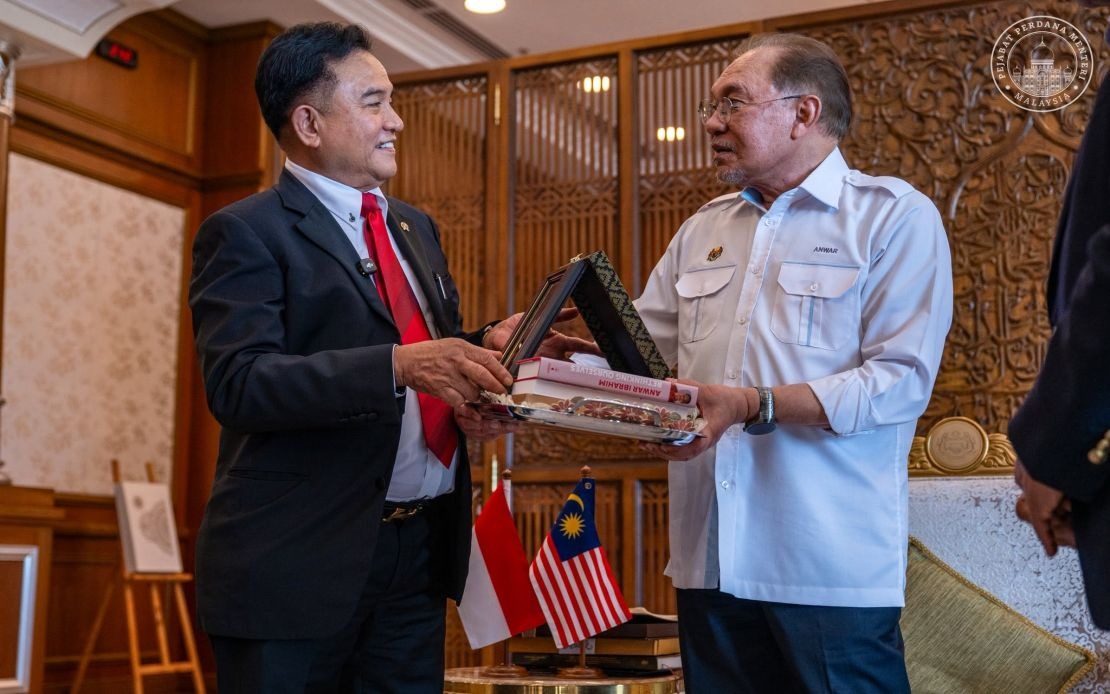
Malaysia and Indonesia have reaffirmed their commitment to expanding bilateral cooperation across legislative frameworks, governance structures, and other strategically significant areas, according to Prime Minister Datuk Seri Anwar Ibrahim. The pledge emerged from a high-level meeting in Kuala Lumpur between Anwar and Indonesia's Coordinating Minister for Legal, Human Rights, Immigration and Correction, Prof Dr Yusril Ihza Mahendra, who visited the Prime Minister's Office in Putrajaya on June 29.
The encounter represents a continuation of sustained engagement between the two Southeast Asian neighbours on institutional and administrative matters that affect their respective populations. Anwar, who concurrently holds the Finance Ministry portfolio, indicated that both delegations used the occasion to examine concrete pathways for deepening collaborative initiatives. The breadth of discussion encompassed not only immediate legislative priorities but also the broader framework within which the nations manage shared challenges and opportunities.
Given Malaysia's status as a key regional economy and Indonesia's position as the largest nation in Southeast Asia by population and GDP, cooperation on governance and legal harmonisation carries implications that extend beyond bilateral relations. The meeting touched on mechanisms through which the two countries might align regulatory approaches, harmonise standards where beneficial, and facilitate smoother cross-border administrative processes. Such alignment becomes increasingly important as the region progresses towards greater economic integration and people-to-people mobility through frameworks such as the ASEAN Economic Community.
The Indonesian minister's visit also signalled Jakarta's readiness to engage substantively on institutional matters that have historically formed the foundation of the Malaysia-Indonesia relationship. Areas such as human rights protections, immigration procedures, and correctional practices represent domains where transparency, consistent standards, and mutual learning can yield tangible benefits for citizens on both sides of the border. Anwar's emphasis on the "close fraternal relations" between the two countries underscores the cultural and historical bonds that undergird official diplomatic engagement.
From a Malaysian perspective, deepening legislative and governance cooperation with Indonesia presents several practical advantages. First, it offers opportunities to benchmark best practices in public administration, judicial reform, and legislative drafting against a major regional partner. Second, it facilitates more efficient handling of transnational issues ranging from labour migration to environmental management, areas where coordinated responses prove more effective than isolated national efforts. Third, such institutional cooperation can help establish regional standards that Malaysian policymakers might subsequently champion within broader ASEAN forums.
The emphasis on governance cooperation also reflects contemporary regional preoccupations with institutional integrity and rule of law. Both nations have undertaken various reform initiatives in recent years aimed at strengthening transparency, accountability, and the independence of key institutions. By exchanging insights and experiences through formal bilateral channels, Malaysia and Indonesia can accelerate the pace of these reforms and avoid duplicating unsuccessful approaches. This peer learning dynamic has proven valuable in other regional partnerships and represents a mature approach to development cooperation.
Indonesia's coordination ministry, which oversees legal affairs, human rights, immigration, and corrections, touches on some of the most sensitive and consequential areas of state function. The fact that Prof Dr Yusril Ihza Mahendra chose to engage directly with Malaysia's Prime Minister indicates that Jakarta views the bilateral relationship as sufficiently important to warrant ministerial-level attention on these matters. This signals both the seriousness with which Indonesia approaches the partnership and the recognition that progress in these domains requires high-level political commitment.
For Malaysia, the engagement carries domestic relevance beyond foreign policy considerations. Governance reforms, legislative modernisation, and the strengthening of institutional frameworks rank among the government's stated priorities as it seeks to restore public confidence in state institutions and enhance the nation's competitive position. Learning from Indonesia's experiences—and potentially sharing Malaysia's own institutional innovations—can contribute to achieving these domestic objectives while simultaneously fortifying the bilateral relationship.
The discussions also implicitly address concerns about ensuring that rapid globalisation, economic integration, and technological change do not outpace institutional development. By consciously designing cooperative mechanisms in legislation and governance, Malaysia and Indonesia position themselves to manage the disruptive potential of these forces more effectively than they would in isolation. This proactive approach to institutional cooperation distinguishes serious regional partnerships from merely ceremonial diplomatic exchanges.
Looking forward, the challenge lies in translating these high-level commitments into concrete institutional outcomes. Follow-up mechanisms, working groups, and implementation timelines will determine whether the June 29 meeting represents merely symbolic solidarity or a genuine acceleration of cooperation. Malaysian observers should monitor whether tangible initiatives—such as joint legislative committees, administrative exchange programmes, or harmonised standards in specific sectors—materialise in the coming months. Such concrete advances would validate the government's vision of Malaysia as an active architect of a more integrated and institutionally robust Southeast Asia.

