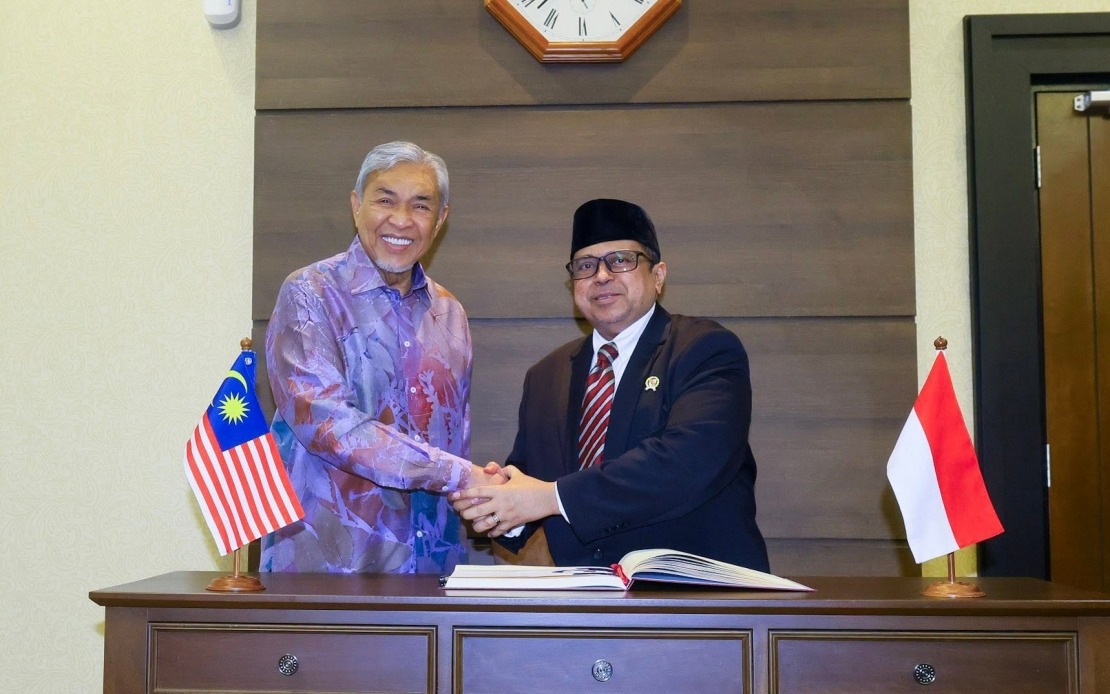
Malaysia and Indonesia are poised to deepen their bilateral engagement across the halal sector, with Deputy Prime Minister Datuk Seri Dr Ahmad Zahid Hamidi confirming plans for enhanced collaboration during discussions with Indonesian officials at Parliament House. The conversations centred on broadening partnership frameworks beyond the traditional bounds of trade, extending into human capital development, rural advancement, and the institutional architecture needed to support a thriving halal economy across both nations and beyond.
The dialogue involved Indonesia's Ambassador to Malaysia, Raden Datuk Mohammad Iman Hascarya Kusumo, and Dr Ahmad Haikal Hassan, who leads Indonesia's Halal Product Assurance Organising Body (BPJPH). Their presence underscores Jakarta's commitment to formalising and structuring the halal relationship at the highest levels, moving beyond ad hoc cooperation toward systematic integration. This institutional engagement signals that the halal economy—increasingly recognised as a cornerstone of economic diversification in both Muslim-majority nations—deserves dedicated political and bureaucratic focus.
Central to the proposed partnership framework is the establishment of three tiers of governance structures. The Malaysia-Indonesia Halal Council (MIHC) would operate as the bilateral foundation, creating direct channels for coordinating standards, certifications, and trade protocols. Beyond this bilateral arrangement, officials discussed launching the ASEAN Halal Council, which would extend cooperation across the entire regional bloc and amplify Southeast Asia's collective voice in shaping global halal commerce. At the apex, a World Halal Development Council would position the region as a standard-setter rather than merely a participant in international halal markets, a shift with profound implications for supply chains, certification regimes, and investment flows.
The emphasis on harmonising halal standards reflects a critical challenge in contemporary Islamic commerce. Currently, varying certification requirements across nations create friction in trade flows, raise compliance costs for businesses operating across borders, and potentially fragment what could otherwise be a seamless regional supply chain. By establishing coordinated standards through these councils, Malaysia and Indonesia can reduce bureaucratic redundancy while maintaining the integrity and credibility of halal designations that consumers and retailers demand. This standardisation agenda becomes particularly relevant as global interest in halal products expands beyond traditional Muslim markets into health-conscious and ethically minded consumers worldwide.
Ahmad Zahid, speaking in his capacity as chair of the Malaysia Halal Industry Development Council, positioned the initiative within a broader context of Malaysia-Indonesia strategic alignment. The two nations' historical ties, shared Islamic heritage, and complementary economic capabilities create natural synergies that, if properly leveraged, could establish Southeast Asia as the global epicentre of halal product innovation and trade. Malaysian expertise in halal certification and standards-setting combines with Indonesia's massive consumer base and production capacity, creating a partnership that addresses both supply-side and demand-side dynamics of the halal sector.
The trade dimension of this cooperation deserves particular attention for Malaysian stakeholders. Indonesia remains one of Malaysia's largest trading partners, with bilateral commerce valued at over US$30 billion annually. However, halal trade between the two nations represents a relatively untapped opportunity, with significant room for expansion in food processing, pharmaceuticals, cosmetics, and logistics services. By removing technical barriers and creating trusted institutional mechanisms, the proposed councils could unlock billions in additional trade by simplifying cross-border transactions and reducing certification delays that currently hamper commerce.
Investment flows constitute another critical benefit. Companies seeking to establish halal manufacturing or distribution operations increasingly prefer regulatory environments with clear, internationally recognised standards. The existence of a unified Malaysia-Indonesia halal framework would make the region more attractive for foreign direct investment from global corporations—whether multinational food producers or Islamic finance institutions—seeking reliable halal certification without navigating fragmented national regimes. This competitive advantage against other emerging markets underscores the economic logic behind the proposed institutional architecture.
The human capital dimension mentioned in the discussions carries long-term strategic importance often overlooked in trade-focused analysis. Developing halal expertise—whether in certification auditing, product development, or supply chain management—requires investment in education and professional training. Bilateral cooperation in sharing knowledge, accrediting professionals, and establishing regional centres of excellence would create a skilled workforce capable of managing increasingly sophisticated halal operations. For Malaysia, with its established reputation in this domain, this represents an opportunity to position itself as a training hub for Southeast Asian halal professionals, generating service revenue while strengthening regional integration.
Rural development, the fourth pillar of cooperation mentioned, connects halal industry growth to agricultural communities in both nations. Much halal production depends on primary agricultural inputs—meat, dairy, crops—that originate in rural areas. By linking rural development initiatives with halal value chains, Malaysia and Indonesia can ensure that farming communities benefit directly from halal sector expansion. This might include financing for farm upgrades to meet halal standards, training in sustainable practices, and preferential market access for halal-compliant agricultural products, thereby addressing development equity alongside economic growth.
The global dimensions of these proposed frameworks reflect sophisticated strategic thinking. Rather than remaining confined to bilateral or regional cooperation, the vision articulated encompasses the World Halal Development Council, positioning Malaysia and Indonesia as architects of international norms. This approach transforms the two nations from norm-takers following Western-dominated international standards bodies into norm-setters shaping the future of global commerce in ways that reflect their values and interests. For Southeast Asia broadly, this represents an assertion of economic agency and soft power in an increasingly multipolar world.
For Malaysian businesses, the implications are substantial. Companies operating in halal-sensitive sectors gain clarity and consistency in their compliance obligations across major markets. The reduction in certification redundancy and the streamlining of approval processes lower operational costs, making Malaysian halal products more price-competitive internationally. Simultaneously, the institutional architecture signals to global investors that Southeast Asia is serious about halal sector development, attracting capital and technology transfer that could elevate the region's position in high-value segments of the Islamic economy.
The timing of this enhanced cooperation aligns with broader trends in global consumer behaviour and Islamic economics. The global halal market, valued at over US$1.8 trillion, is expanding faster than conventional markets, driven by growing Muslim populations, increasing consumer consciousness, and mainstream adoption across diverse consumer segments. By strengthening bilateral and regional frameworks now, Malaysia and Indonesia position themselves to capture disproportionate growth in this expanding sector during the coming decades, transforming halal from a niche market into a defining feature of their economic profiles.
The announced cooperation framework represents a maturation of Malaysia-Indonesia relations, moving beyond general statements of intent toward concrete institutional mechanisms. Success in executing this agenda will depend on political commitment, bureaucratic coordination, and genuine harmonisation rather than superficial alignment. If realised effectively, however, these councils could redefine how two large Southeast Asian economies coordinate economic development, establishing a model potentially applicable to other sectors and other bilateral relationships within the region.

