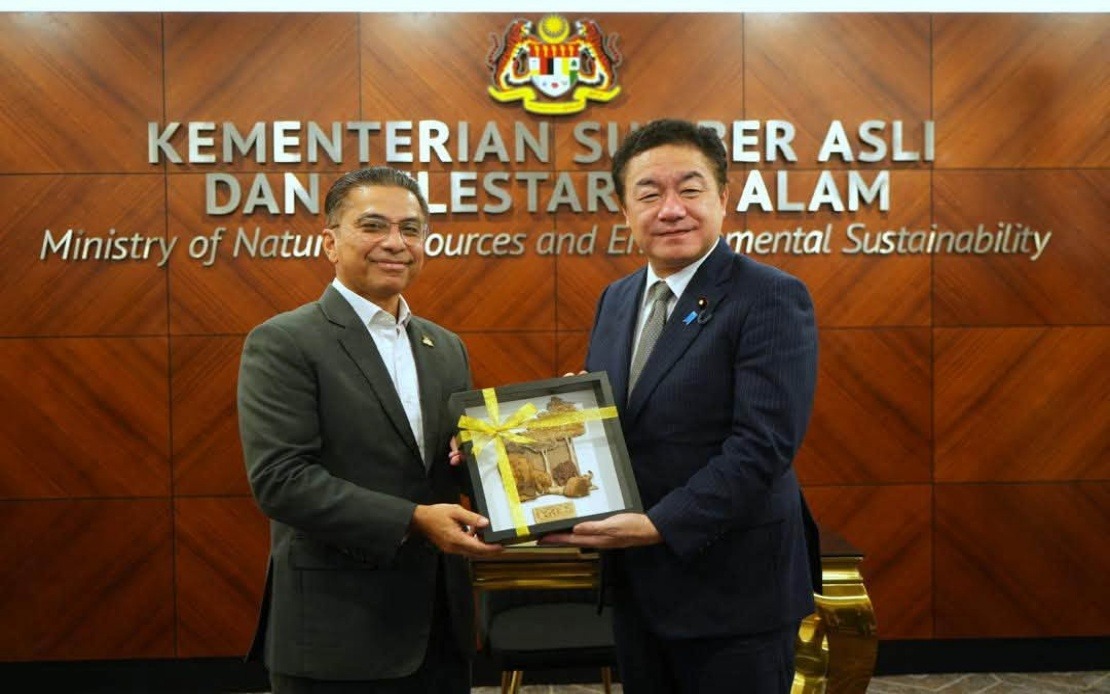
Malaysia and Japan are intensifying their strategic partnership across critical minerals and environmental sustainability, reflecting deepening economic and technological ties between the two nations. During a recent visit to Putrajaya by Japan's Parliamentary Vice-Minister of Economy, Trade and Industry Komori Takuo, officials from both countries discussed concrete follow-up measures stemming from a bilateral summit held in June under the Malaysia-Japan Comprehensive Strategic Partnership framework.
The meeting, hosted by Deputy Natural Resources and Environmental Sustainability Minister Syed Ibrahim Syed Noh at the Ministry of Natural Resources and Environmental Sustainability (NRES), underscores growing recognition of Malaysia's strategic importance in Japan's resource security strategy. This engagement carries significant implications for Southeast Asia, as it demonstrates how developed economies are repositioning themselves to secure supplies of rare earth elements and other critical minerals essential for the green energy transition. Japan's interest in deepening ties with Malaysia reflects broader concerns about supply chain resilience in key technology sectors, particularly as geopolitical tensions continue to reshape global trade patterns.
Central to the discussions was Malaysia's reaffirmation of its moratorium on exporting raw rare earth elements, a policy designed to capture greater value through domestic processing and advanced manufacturing. By restricting raw material exports, Malaysia aims to build a competitive advantage in high-value refining and production activities, transforming itself from a commodity supplier into a technology-driven manufacturer. This approach aligns with Malaysia's broader industrial policy objectives and has parallels with strategies adopted by other resource-rich nations seeking to move up the value chain. For Japan, securing reliable access to processed rare earth materials supports its manufacturing base and reduces vulnerability to supply disruptions from other sources.
Japan's contributions to this partnership extend through established development channels, particularly the Japan International Cooperation Agency (JICA) and the Japan Organisation for Metals and Energy Security (JOGMEC). These institutions have long played crucial roles in technical cooperation across Asia, facilitating knowledge transfer and infrastructure development. Malaysia's acknowledgment of this support reflects the practical benefits of longstanding institutional relationships, which often prove more durable than project-based aid. Through JICA and JOGMEC, Japan has been able to influence standards, build capacity, and establish frameworks that benefit Japanese companies operating in the region while simultaneously supporting development objectives.
Beyond minerals, the meeting marked significant progress on climate cooperation, with both nations moving toward finalising a Memorandum of Cooperation for the Joint Crediting Mechanism (JCM). This framework, based on Article 6.2 of the Paris Agreement, creates a market-based approach to carbon reduction that benefits both countries. Under this mechanism, Japan can claim credit for emissions reductions achieved through investments in green technology projects in Malaysia, while Malaysia gains access to advanced environmental technologies and capital for transition initiatives. The expected completion of negotiations by year-end signals momentum in implementing the bilateral carbon market framework.
Malaysia's energy transition and its Nationally Determined Contribution (NDC) under the Paris Agreement form the strategic context for these climate initiatives. As Malaysia commits to reducing emissions intensity and expanding renewable energy capacity, collaboration with technology leaders like Japan becomes increasingly valuable. Japanese expertise in areas such as renewable energy systems, energy efficiency, and carbon capture aligns well with Malaysia's development needs. This partnership thus creates mutual benefits: Japan secures investment opportunities for its green industries while Malaysia accelerates its climate action ambitions with proven technologies and financial support.
The broader strategic dimension involves combining Japan's technological sophistication with Malaysia's abundant natural resources and manufacturing capacity to build what officials describe as a competitive green economy. This framing suggests an aspiration toward creating an integrated regional ecosystem where Japanese innovation drives the development of Malaysian resources in environmentally sustainable ways. Such cooperation models are increasingly prevalent in Southeast Asia as countries recognise that development and climate action need not be contradictory goals. The partnership demonstrates how bilateral engagement can address multiple priorities simultaneously: economic competitiveness, resource security, technological advancement, and environmental responsibility.
The composition of delegations underscores the government-level seriousness accorded to these discussions. Malaysia's team included NRES deputy secretary-general Datuk Khalid Mohamed and representatives from the Foreign Ministry, signalling whole-of-government coordination. Japan's representation through Parliamentary Vice-Minister Komori Takuo, Ambassador Shikata Noriyuki, and senior METI officials reflected appropriate diplomatic weight. Such high-level engagement typically translates into prioritised implementation and sustained follow-up, suggesting these are not merely aspirational statements but commitments backed by institutional resources and political attention.
For Malaysian policymakers, this partnership offers practical benefits in multiple domains. Access to Japanese technical expertise can accelerate the development of domestic rare earth processing capabilities, creating higher-value manufacturing jobs. Climate cooperation provides access to concessional financing and technology for Malaysia's energy transition, reducing the fiscal burden of renewable energy expansion. Additionally, strengthening ties with Japan, a major developed economy and technology leader, reinforces Malaysia's positioning as a reliable partner in global supply chains, potentially attracting further investment from Japanese and other regional companies seeking to diversify away from geopolitical risk zones.
The emphasis on technology transfer and joint investment in low-carbon initiatives also addresses a persistent challenge facing developing economies: achieving growth objectives while meeting climate commitments. By tapping into Japanese expertise and capital, Malaysia can pursue emissions reductions more efficiently than attempting to develop these capabilities independently. This represents a sophisticated approach to managing the often-competing demands of economic development and environmental stewardship that many Southeast Asian nations struggle to balance.
Looking ahead, the trajectory of Malaysia-Japan cooperation in rare earths and climate action will likely influence how other countries in the region approach their own resource and sustainability strategies. If the JCM framework proves effective in generating investment and emissions reductions, it may become a template for expanded climate finance mechanisms across Southeast Asia. Similarly, Malaysia's success in building domestic rare earth processing capacity while maintaining quality partnerships with technology leaders could offer lessons for other resource-rich nations seeking to develop more sophisticated industrial bases.

