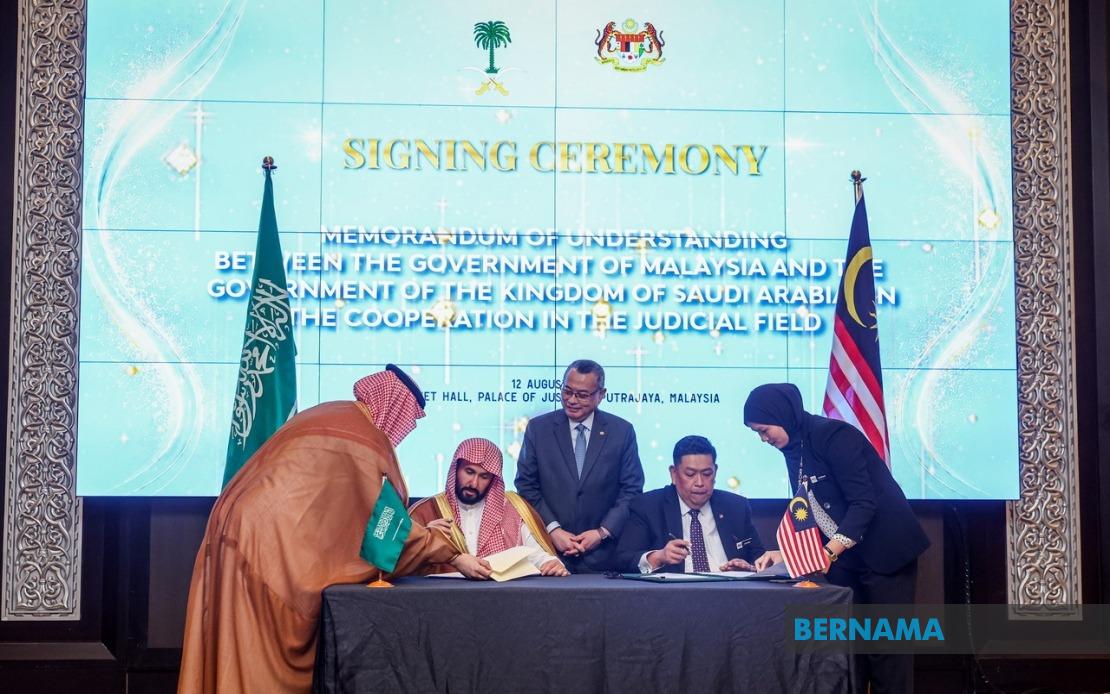
Malaysia and Saudi Arabia have taken a significant step in their bilateral relations by formalising a comprehensive judicial partnership. The two nations signed a memorandum of understanding at the Palace of Justice in Putrajaya on August 12, with Chief Registrar of the Federal Court Azhaniz Teh Azman Teh and Saudi Arabian Minister of Justice Sheikh Dr Waleed Mohammed Alsmani affixing their signatures to the agreement. Chief Justice Tun Wan Ahmad Farid Wan Salleh witnessed the signing, underscoring the importance both countries place on this institutional arrangement.
The agreement represents more than ceremonial diplomacy; it establishes a structured institutional framework designed to facilitate meaningful exchanges between the Malaysian and Saudi Arabian judiciaries. By codifying cooperation in specific areas, the memorandum moves both nations beyond informal dialogue toward systematic collaboration that can yield tangible improvements in how their respective court systems operate. The timing of the signing during Sheikh Dr Waleed's official visit to Malaysia reflects a deliberate effort to elevate judicial relations to a higher plane of formal engagement.
At the heart of the arrangement lies a commitment to modernising judicial administration through technology transfer and best-practice sharing. The framework specifically addresses civil case management protocols, where Malaysia's experiences may prove instructive for Saudi Arabia's ongoing judicial reforms. More significantly, both nations have identified judicial digitalisation as a priority area for collaboration, with Malaysia's e-Court system positioned as a model for knowledge exchange. This focus on technological advancement speaks to broader regional trends in Southeast Asia and the Middle East, where courts are increasingly turning to digital platforms to enhance efficiency and accessibility.
One particularly noteworthy dimension of the partnership concerns how each nation handles sensitive criminal matters. The memorandum explicitly contemplates collaborative learning regarding judicial approaches to sexual offences against children, a area where Malaysia has developed specialised frameworks and institutional expertise. This component suggests recognition that expertise in child protection transcends borders and that judicial systems benefit from examining international approaches to managing these complex cases. For Malaysia, such exchanges position the country as a source of knowledge rather than merely a recipient, enhancing its standing within regional and international judicial networks.
The agreement contemplates regular institutional visits and personnel exchanges that will deepen personal relationships between judges, court administrators, and legal professionals from both countries. These direct interactions often prove more valuable than written guidelines or formal protocols, as they allow judicial officials to understand the philosophical underpinnings and practical constraints influencing their counterparts' decision-making. Malaysia's longstanding experience managing a diverse, multicultural society may offer insights relevant to Saudi Arabia's own evolving judicial landscape.
For Malaysian stakeholders, this partnership carries implications extending beyond ceremonial cooperation. Judicial collaboration with Saudi Arabia, a major investor and trading partner, can help clarify legal frameworks affecting commercial disputes and cross-border transactions. Malaysian businesses operating in the Gulf region benefit when local courts maintain professional relationships with regional judicial systems and when there is mutual understanding of procedural expectations. Similarly, Malaysians working or residing in Saudi Arabia gain security from institutional channels through which their rights can be advocated.
The framework also acknowledges that modern judiciaries operate within global contexts requiring standardised information exchange and mutual recognition of professional standards. By committing to exchange publicly available judicial information, Malaysia and Saudi Arabia position themselves within an emerging ecosystem of transparent, internationally-oriented court systems. This contrasts with more opaque judicial cultures and signals both nations' intent to participate in global conversations about judicial reform and best practices.
The Malaysian Judiciary's formal statement emphasising that the arrangement strengthens "longstanding ties" reflects the reality that informal cooperation between the two countries' courts predates this memorandum. What changes now is the institutionalisation of these relationships through formal mechanisms, regular scheduled exchanges, and documented frameworks. This formalisation allows institutions to plan strategically around judicial cooperation rather than relying on ad-hoc arrangements dependent on individual relationships.
The selection of specific substantive areas for collaboration reveals priorities shaping both judiciaries' development trajectories. Beyond child protection and technology, the emphasis on civil case management suggests both countries confront similar challenges in managing court dockets efficiently and ensuring timely resolution of disputes. The practical reality that civil litigation often determines commercial confidence makes this focus particularly relevant for bilateral investment and trade relationships.
From a broader Southeast Asian perspective, Malaysia's deepening judicial ties with Saudi Arabia position the region as increasingly integrated with Middle Eastern institutional networks. This mirrors similar judicial cooperation agreements Malaysia has developed with other nations, creating a web of bilateral judicial relationships that collectively strengthen Malaysia's position as a centre for knowledge-sharing and professional exchange in the region.
The memorandum's emphasis on institutional engagement and knowledge-sharing rather than harmonising substantive law reflects a realistic approach to international judicial cooperation. Rather than attempting to modify each country's legal codes, the framework enables mutual learning and recognition of different approaches' merits. This flexibility allows both nations to adapt international best practices to their respective constitutional orders and legal traditions.

