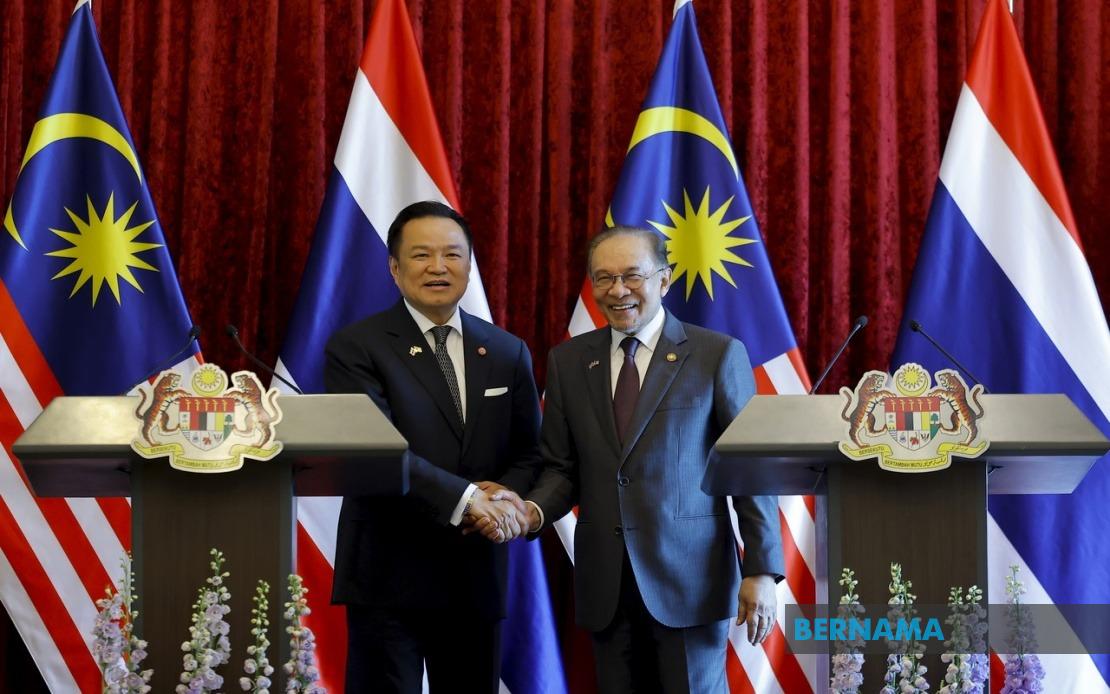
Malaysia and Thailand have charted an ambitious roadmap to deepen economic integration and regional cooperation, committing to accelerate multiple infrastructure projects along their shared frontier while pursuing a trade target of US$30 billion by 2027. The commitment emerged from substantive discussions between Prime Minister Datuk Seri Anwar Ibrahim and Thailand Prime Minister Anutin Charnvirakul during their meeting in Putrajaya on July 9, marking a significant moment in Southeast Asian bilateral relations as both nations prioritise cross-border development.
The agenda encompasses far more than conventional trade discussions. Malaysia and Thailand have specifically agreed to streamline immigration and customs procedures at border crossings, recognising that administrative efficiency directly translates into competitive advantages for businesses operating across both territories. This focus on regulatory harmonisation reflects a broader understanding that seamless movement of goods and people forms the bedrock of sustainable economic partnership. By reducing bureaucratic friction at checkpoints, both countries aim to make cross-border commerce more attractive for investors and traders who might otherwise route operations through alternative regional corridors.
Central to this partnership strategy is the development of special border economic zones, which represent a departure from traditional trade models. These designated areas will operate under tailored regulatory frameworks designed to incentivise manufacturing, logistics, and service sector investments in frontier regions that have historically lagged behind urban centres. For Malaysia, this presents an opportunity to activate the economic potential of states like Perlis and Kedah, which share extensive borders with Thailand. Similarly, Thailand gains the chance to develop its northern provinces into vibrant commercial hubs that can compete with Bangkok-centric development patterns.
Anwar emphasised the historical and cultural synergies underpinning this economic initiative, noting that Malaysia and Thailand share not only geographic proximity but also deep civilisational connections spanning centuries. He stressed that while these bonds are substantial, much untapped potential exists across trade, investment, and sectoral cooperation. The bilateral trade target of US$30 billion by 2027 represents meaningful ambition—current bilateral commerce falls significantly short of this figure, suggesting that achieving this milestone will require genuine acceleration of business partnerships and investment flows rather than modest incremental growth.
The planned visit to Bukit Kayu Hitam and Sadao represents an unconventional diplomatic choice, signalling that both governments view border communities as integral stakeholders rather than peripheral zones. By conducting substantive engagements in these frontier areas rather than remaining confined to the capital, both leaders demonstrate commitment to inclusive development frameworks. This approach also sends a powerful message to investors that infrastructure improvements and economic opportunities are being routed directly into border regions, potentially stimulating local entrepreneurship and employment generation.
Anwar interpreted Anutin's willingness to undertake this border visit as demonstrating personal commitment to strengthening bilateral relations beyond ceremonial gestures. The decision carries symbolic weight in regional diplomacy, where such gestures often precede concrete policy implementation. When senior leaders invest time in visiting peripheral regions, it frequently indicates that promised developments will proceed with earnest administrative backing and resource allocation.
The agreement to fast-track border connectivity projects addresses longstanding infrastructure gaps that have constrained cross-border commerce and people movement. These projects likely encompass road improvements, bridge construction or upgrades, port facilities, and potentially telecommunications infrastructure that would enable frictionless digital transactions. For Malaysia, enhanced connectivity with Thailand opens possibilities for integrating northern states into broader regional production networks, while Thai exporters gain improved access to Malaysian ports and distribution networks serving broader Southeast Asia.
The bilateral relationship carries particular significance for Malaysia given Thailand's position as a major regional economic player and Southeast Asia's second-largest economy by GDP. Deepening ties with Bangkok provides Malaysian businesses access to Thailand's substantial manufacturing base and consumer market while allowing Thai companies to leverage Malaysia's more developed financial sector and established trade relationships. The relationship also holds strategic implications for regional stability and integration, as strong Malaysia-Thailand cooperation sets positive precedents for broader ASEAN cohesion.
From a Malaysian perspective, achieving the US$30 billion trade target within five years requires deliberate sectoral focus. Priority areas likely include automotive components, petrochemicals, electrical and electronic products, and agricultural trade—sectors where both nations possess established comparative advantages. Additionally, tourism integration, labour mobility agreements, and financial services cooperation could contribute substantially to reaching this ambitious benchmark.
The timing of these initiatives reflects broader regional imperatives. As major Asian economies increasingly compete for investment and market access, ASEAN members must demonstrate that intra-regional partnerships offer compelling alternatives to external economic arrangements. By showcasing tangible progress on Malaysia-Thailand integration, both governments strengthen arguments for deepening ASEAN economic architecture more broadly.
Implementation will prove critical to realising these commitments. Border economic zones require sustained investment and coordinated regulatory oversight, while immigration and customs streamlining demands organisational restructuring that often encounters bureaucratic resistance. Both governments will need to establish clear implementation timelines, assign responsibility to specific agencies, and establish monitoring mechanisms to track progress toward the 2027 target.
Looking forward, the Malaysia-Thailand partnership framework could serve as a template for other ASEAN border initiatives, demonstrating how neighbouring nations can translate geographic proximity into mutual prosperity. Success would validate the argument that regional integration, properly structured and adequately resourced, generates benefits for both governments and their citizens while strengthening overall Southeast Asian cohesion in an increasingly competitive global environment.

