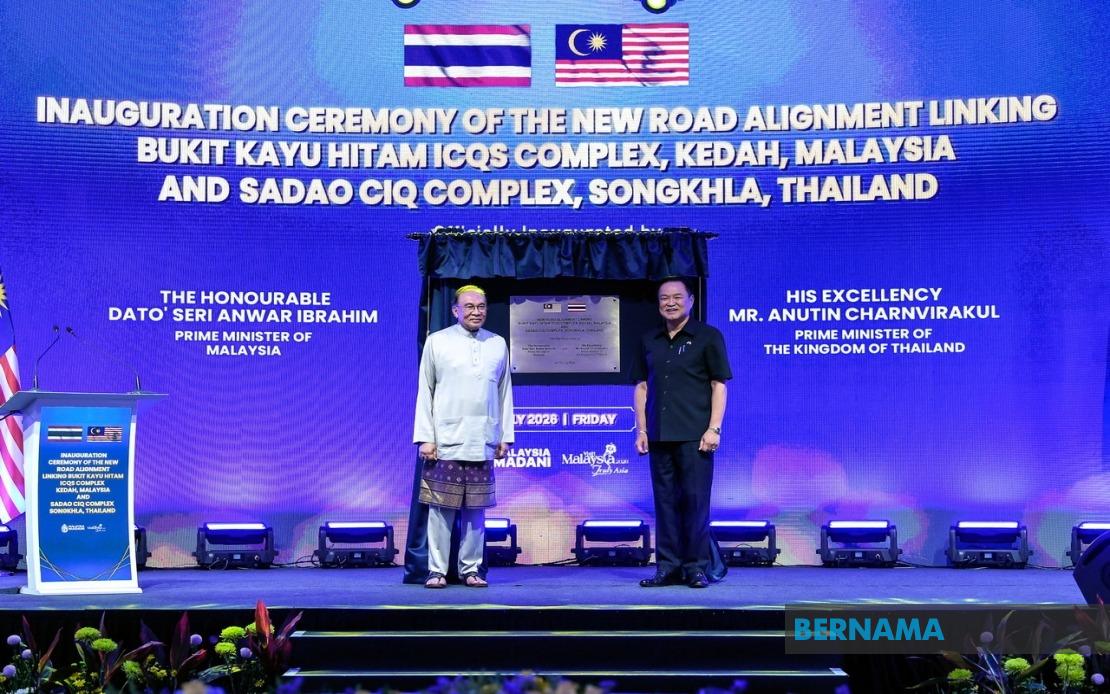
Prime Minister Datuk Seri Anwar Ibrahim has marked a turning point in Malaysia-Thailand economic collaboration by launching a new road alignment that directly links the Bukit Kayu Hitam Immigration, Customs, Quarantine and Security Complex in Kedah with Thailand's Sadao Customs, Immigration and Quarantine Complex. The initiative, jointly inaugurated with Thailand's Prime Minister Anutin Charnvirakul at the border, represents far more than infrastructure connectivity—it signals a comprehensive reimagining of cross-border economic activity that could fundamentally reshape prosperity in northern Malaysia and southern Thailand for years to come.
The road project serves as the physical backbone for a more ambitious vision: establishing a special economic border zone that would encompass the northern states of Peninsular Malaysia, including Perlis, Kedah, Kelantan, Perak and Penang, alongside Thailand's southern provinces. Anwar characterised this approach as an evolution beyond conventional diplomatic engagement, requiring genuine political will from both leaderships to overcome entrenched bureaucratic and structural obstacles. The ambition addresses a longstanding economic imbalance affecting border communities, where geographic proximity to markets has historically failed to translate into shared prosperity due to trade friction and procedural complexity.
Accelerating the resolution of cross-border impediments represents a critical component of this strategy. Malaysia and Thailand have committed to expediting the resolution of longstanding disputes involving customs procedures, immigration protocols, fisheries management and trade regulations that currently burden traders and businesses operating across the frontier. Anwar emphasised that these negotiations, some spanning decades, have been substantially compressed through intensive bilateral collaboration, reflecting both nations' determination to remove obstacles that constrain commerce and livelihoods. The condensed timeline for resolving these issues demonstrates that political commitment can overcome institutional inertia when leadership prioritises economic integration.
The bilateral trade ambition anchors these infrastructure and institutional reforms within concrete numerical targets. Malaysia and Thailand have set their sights on achieving USD30 billion in bilateral trade volume by 2027, a figure that provides measurable benchmarks for evaluating the success of the border zone initiative. For Malaysian exporters, manufacturers and service providers operating in the northern states, this target implies significant market expansion opportunities. The border zone framework would theoretically facilitate smoother movement of goods, reduce transaction costs, and enable more competitive positioning against enterprises in other ASEAN nations.
For the five northern Malaysian states, the special economic zone concept carries particular significance. Historically overshadowed by the Klang Valley and southern Peninsular Malaysia in terms of foreign investment attraction and industrial development, these states have struggled with outward migration of talent and capital. A functioning cross-border economic zone could catalyse industrial clustering, particularly in sectors where comparative advantage exists on both sides of the border—agro-processing, tourism services, light manufacturing and logistics. Such development would address not merely headline GDP growth but also spatial inequality, a persistent challenge for Malaysian policymakers.
Thailand's perspective on this collaboration reflects its own strategic interests in leveraging northern border regions as engines of inclusive growth. Southern Thailand has historically experienced economic marginalisation relative to Bangkok and central regions, with security concerns in provinces like Yala, Pattani and Narathiwat further constraining development. A functioning economic zone with Malaysia offers Thai businesses diversified market access and could catalyse private investment in neglected regions. From Bangkok's standpoint, deepening ties with Malaysia through border zone development also serves broader ASEAN integration objectives and balances Thailand's regional diplomatic positioning.
The timing of this initiative reflects broader shifts in Southeast Asian connectivity priorities. With the Regional Comprehensive Economic Partnership now operational and ASEAN pursuing enhanced intra-regional integration, border-level cooperation becomes increasingly vital. Malaysia and Thailand, as neighbouring economies with complementary strengths, possess natural advantages in pioneering such zones. Success at Bukit Kayu Hitam-Sadao could establish a template for other ASEAN border regions, including Malaysia-Brunei, Malaysia-Indonesia and Thailand-Cambodia frontiers, potentially accelerating continental economic integration across Southeast Asia.
Anwar's emphasis on understanding community needs beyond major metropolitan centres reflects recognition that border zone development must deliver tangible benefits to local populations rather than merely enriching urban elites or multinational corporations. The northern Malaysian states and southern Thailand contain millions of residents whose economic prospects remain constrained by infrastructure deficits, limited enterprise opportunities and labour market segmentation. A genuine special economic zone would require investment in human capital development, vocational training and entrepreneurship support alongside physical infrastructure and regulatory harmonisation.
The road alignment project itself symbolises this commitment to physical infrastructure modernisation. By creating dedicated, efficient connectivity between the two border complexes, the initiative removes a persistent bottleneck that has hampered cross-border commerce. Traders no longer face tortuous routing through congested local roads; instead, a purpose-built corridor enables faster, more predictable transit times. Such improvements, though seemingly technical, generate substantial economic multiplier effects by reducing logistics costs, improving delivery reliability and enabling just-in-time supply chain operations that increasingly characterise regional manufacturing.
Implementation challenges, however, remain substantial. Harmonising customs procedures across two sovereign nations requires aligning their respective regulatory frameworks without compromising either government's legitimate control objectives. Immigration protocols must balance facilitation with security imperatives, particularly given regional terrorism concerns. Fisheries cooperation demands resolving maritime boundary questions and managing shared aquatic resources. These complications explain why Anwar candidly acknowledged that transforming the zone concept into operational reality cannot occur rapidly, despite recent acceleration in negotiations. Patient, technically rigorous implementation will determine whether political commitment translates into sustained economic benefits.
Thailand's Prime Minister Anutin's border visit underscores his government's commitment to this framework. High-level diplomatic presence at border inaugurations signals importance to both domestic constituencies and international observers. For Anutin, championing border development connects his political base in Chachoengsao and eastern Thailand to tangible development initiatives. The visit also demonstrates Thailand's readiness to move beyond symbolic gestures toward substantive economic partnership with Malaysia, potentially influencing how other ASEAN governments approach bilateral border cooperation.
For Malaysian businesses, particularly those in the northern states, this initiative opens strategic possibilities. Manufacturers seeking to access Thai markets or integrate into Thailand-anchored supply chains gain smoother pathways. Service providers—logistics, financial services, hospitality—face reduced operational friction. Agricultural producers can more efficiently reach Thai consumer markets. Tourism operators can more readily coordinate cross-border experiences. These opportunities, while not automatic, become considerably more achievable within a functioning special economic zone framework.
Ultimately, the Bukit Kayu Hitam-Sadao road alignment represents an inflection point in Malaysia-Thailand relations, transforming rhetoric about regional cooperation into concrete infrastructure and institutional reform. Whether this moment crystallises into sustained prosperity for border communities or dissipates into another unfulfilled grand vision depends on execution rigour, sustained political commitment despite inevitable implementation complications, and genuine integration of community voices in zone design. For Malaysian policymakers and the broader region, the months and years ahead will reveal whether South East Asia has finally cracked the code of effective border-level economic cooperation.

