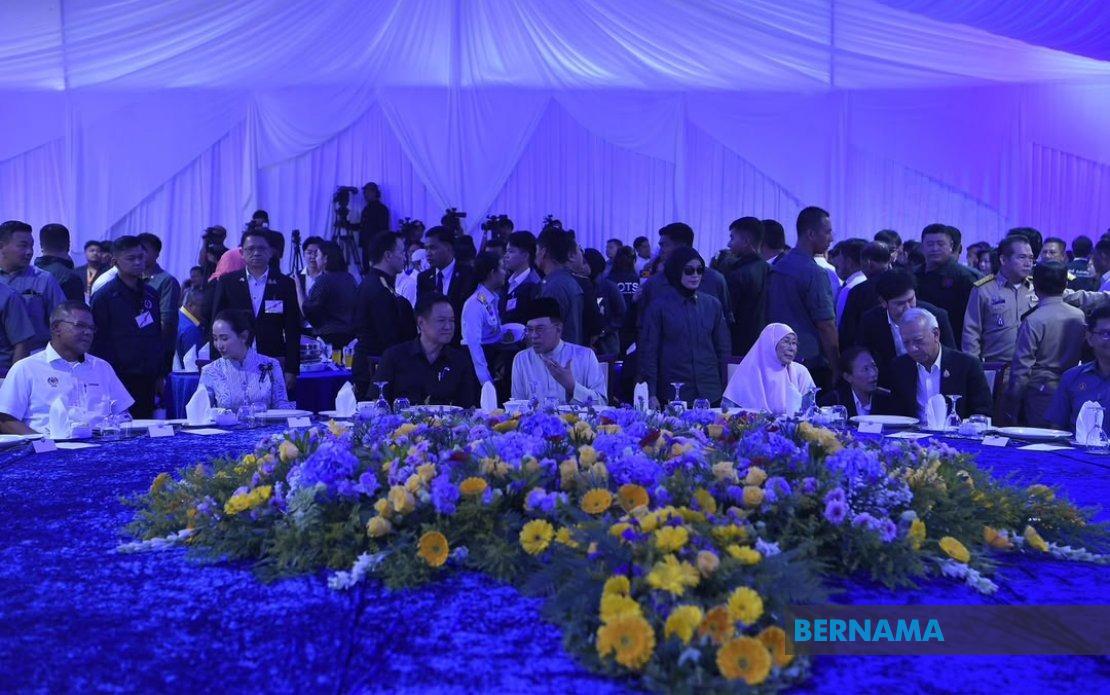
Prime Minister Datuk Seri Anwar Ibrahim and Thai Prime Minister Anutin Charnvirakul jointly inaugurated a new highway connecting Malaysia's Bukit Kayu Hitam Immigration, Customs, Quarantine and Security Complex to Thailand's Sadao Customs, Immigration and Quarantine facility on July 10, signalling a major advancement in bilateral infrastructure cooperation. The opening of this modern crossing represents years of collaborative planning between Kuala Lumpur and Bangkok, with both governments emphasising their shared commitment to deepening diplomatic bonds and fostering seamless cross-border movement across Southeast Asia's most critical land trade corridor.
The new road will commence operations at 6 am Malaysian time on July 11, replacing the existing Bukit Kayu Hitam-Danok crossing which will be permanently decommissioned from midnight the same day. This transition consolidates Malaysia and Thailand's border operations into a single, unified entry point equipped with contemporary facilities designed to streamline processes for millions of travellers and traders who annually traverse this vital international passage. The shift marks a culmination of extensive coordination between both nations' transportation and customs authorities to ensure a seamless transition without disrupting commerce or people movement during the changeover period.
According to a statement from Malaysia's Home Ministry, the infrastructure project embodies both countries' determination to strengthen regional connectivity while advancing the ASEAN Connectivity agenda. The facility's modern design integrates advanced control systems and border management technology, positioning it as a flagship example of contemporary cross-border infrastructure in Southeast Asia. This development carries particular significance for Malaysia, which relies heavily on northern border trade and mobility, with the crossing serving as a critical node in the broader supply chain networks connecting Thailand, Malaysia, and downstream regional economies.
The new crossing is anticipated to generate substantial economic benefits for both nations, particularly for communities inhabiting border regions that have historically experienced infrastructure constraints. By facilitating more efficient movement of goods, services, and people, the facility promises to unlock growth potential in logistics, trade, and tourism sectors that depend on smooth international passage. Enhanced connectivity along this corridor directly supports the ASEAN North-South Economic Corridor initiative, strengthening commercial ties throughout the region and positioning Malaysia as a crucial transit hub in broader Southeast Asian trade networks.
Businesses operating in sectors reliant on Thailand-Malaysia trade have welcomed the development, recognizing that modern border infrastructure reduces transit times, lowers operational costs, and enhances supply chain predictability. Manufacturing enterprises, agricultural exporters, and logistics providers stand to benefit from expedited clearance processes and integrated customs systems that minimise delays. The facility's transparent and efficient border operations should reduce friction points that previously complicated cross-border transactions, thereby attracting greater foreign investment to border industrial zones and enhancing competitiveness for Malaysian companies competing in regional markets.
Malaysia's commitment to modernising its border management infrastructure aligns with the Malaysia MADANI development framework, which prioritises national security, economic advancement, and citizen welfare through contemporary governance approaches. By investing in sophisticated border facilities equipped with digital systems and integrated security protocols, the government demonstrates its resolve to safeguard sovereignty whilst simultaneously facilitating legitimate commerce and travel. This balance represents a sophisticated border management philosophy that recognises security and economic opportunity as complementary rather than contradictory objectives.
The facility's integrated control systems employ advanced technology to enhance security screening capabilities whilst maintaining operational efficiency, allowing authorities to process larger volumes of cross-border traffic without compromising vigilance. This technological foundation proves particularly valuable for combating transnational challenges including smuggling, human trafficking, and illicit trade, whilst simultaneously accommodating the legitimate commerce that underpins regional economic interdependence. The infrastructure investment thus reflects recognition that contemporary border management demands sophisticated tools and coordinated international cooperation.
Thailand's participation in this development demonstrates Bangkok's commitment to strengthening northern connectivity and supporting its own border communities through enhanced infrastructure. The Sadao CIQ facility represents a significant investment in Thai border capacity, enabling more efficient processing of traffic destined for southern Thailand and contributing to broader Thai-Malaysian trade growth. Regional observers view the joint facility as emblematic of maturing Southeast Asian cooperation, where neighbouring nations recognise mutual benefits flowing from coordinated infrastructure development and streamlined cross-border processes.
The formal transition from the Danok crossing represents careful planning to avoid disruption during the changeover period. Both governments coordinated extensively to ensure businesses received adequate notice, travellers understood procedural changes, and enforcement agencies completed training on new systems before operations commenced. This methodical approach reflects professional border management standards and commitment to minimising friction for stakeholders dependent on regular cross-border movement.
The Home Ministry expressed gratitude to numerous Malaysian and Thai agencies, departments, and private sector partners whose collaboration enabled successful project completion. This acknowledgment underscores that modern border infrastructure projects demand extensive inter-agency coordination, technical expertise, and sustained cooperation across governmental and private sectors. The recognition serves to reinforce that complex infrastructure achievements emerge not from individual institutional efforts but from coordinated ecosystems of professional expertise and shared commitment.
Both governments have articulated confidence that the new crossing will inaugurate an enhanced era of Malaysia-Thailand cooperation, with implications extending beyond bilateral relations to influence broader regional dynamics. Enhanced connectivity between two ASEAN members strengthens the bloc's internal cohesion and competitiveness in global markets, whilst demonstrating the practical benefits of regional integration to sceptical audiences. The facility symbolises ASEAN's capacity to translate aspirations into concrete infrastructure improvements that tangibly benefit citizens and businesses throughout member states.
Longer-term implications of this infrastructure development will likely manifest across multiple dimensions including increased trade volumes, expanded tourism flows, and deepening people-to-people exchanges. As operational efficiencies improve and crossing times diminish, the comparative advantage of the northern Malaysia-Thailand corridor may shift, potentially attracting commercial activities previously routed through alternative passages. Urban centres proximate to Bukit Kayu Hitam and Sadao may experience accelerated development as improved connectivity enhances their appeal as residential and commercial hubs.
The opening represents a watershed moment for Malaysia-Thailand bilateral relations, translating diplomatic goodwill into tangible infrastructure benefits that will affect millions of citizens and businesses for decades. Both governments have signalled their serious commitment to sustained cooperation, with this crossing serving as a physical manifestation of shared prosperity through connectivity. The success of this project may catalyse additional cross-border infrastructure initiatives, positioning the Malaysia-Thailand border as a model for seamless, secure, and efficient international passage within Southeast Asia.

