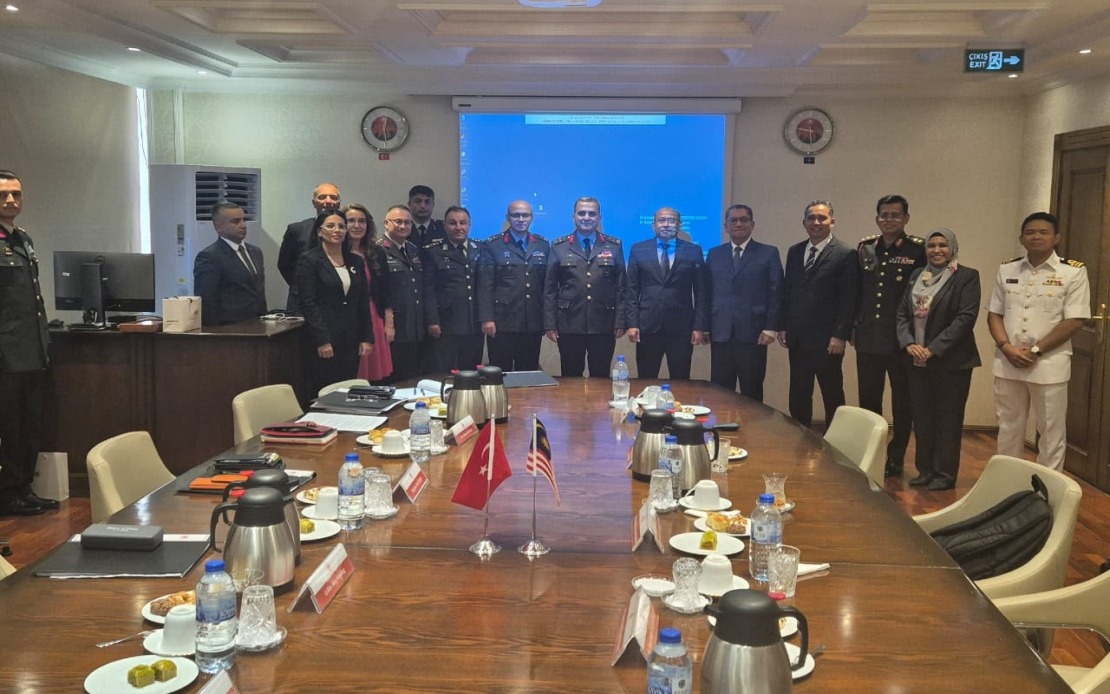
Malaysia and Türkiye have taken a significant step towards deepening their defence partnership by convening their inaugural Malaysia-Türkiye Policy Talk at Türkiye's Ministry of National Defence headquarters in Ankara this week. The milestone meeting represents a formal elevation of bilateral military relations between the two nations, moving beyond ad-hoc engagements to establish institutionalised channels for strategic dialogue. The gathering underscores growing recognition among Southeast Asian and Middle Eastern states of the value in forging defence partnerships that transcend traditional geographic and cultural boundaries.
The Malaysian delegation was led by Datuk Yani Daud, deputy secretary-general of policy at Malaysia's Ministry of Defence, while the Turkish side was represented by Lt Gen Ilkay Altindag, director-general of defence and security at the Ministry of National Defence. The composition of both delegations reflects the high-level nature of the discussions, with policy and strategic specialists taking the lead rather than operational military commanders. This emphasis on policy-level engagement indicates that both countries view the relationship as foundational work requiring institutional framework-building rather than immediate operational coordination.
Central to the discussions was a comprehensive review of defence policy frameworks and strategic positioning in an increasingly complex geopolitical environment. Both nations examined their respective defence doctrines and how these might align or complement each other in addressing shared security concerns. The agenda encompassed broader geopolitical security issues affecting the Indo-Pacific and Middle Eastern regions, reflecting Malaysia's positioning as a bridge nation with interests spanning both spheres. This regional security focus reveals how contemporary defence partnerships increasingly consider transnational challenges including maritime security, counterterrorism, and the maintenance of international law at sea.
The dialogue also prioritised the exchange of perspectives and operational information between defence establishments. Such information-sharing mechanisms are foundational to effective military partnerships, allowing both nations to develop mutual understanding of capabilities, strategic thinking, and security priorities. For Malaysia, engaging with Türkiye provides valuable insights into Middle Eastern security dynamics and Turkish perspectives on regional stability. Conversely, Türkiye gains understanding of Southeast Asian defence considerations and Malaysia's approach to balancing multiple regional powers.
A particularly significant dimension of the talks involved Malaysia's recognition of Türkiye's role in promoting peace in West Asia. Malaysia formally expressed appreciation for Türkiye's contribution to regional stability, specifically citing the recent Makkah Pact as evidence of Ankara's commitment to de-escalation and conflict resolution. This acknowledgment signals Malaysia's broader support for multilateral initiatives addressing Middle Eastern tensions, positioning the country as supportive of diplomatic solutions to regional conflicts. The Makkah Pact, which brought together previously adversarial regional actors, represents the type of confidence-building mechanism that Malaysia itself has long advocated for in Southeast Asia.
Both delegations underscored the fundamental importance of maintaining regional peace and stability as a prerequisite for economic development and prosperity. This shared commitment reflects a common understanding that defence cooperation serves not merely military ends but also broader national development objectives. For Malaysia, such stability is essential for maintaining the security environment necessary for regional trade and investment. Similarly, Türkiye's interests in peaceful borders and stable neighbours align with its economic aspirations and regional influence.
A crucial outcome of the inaugural meeting was the agreement to establish formal Terms of Reference governing the Malaysia-Türkiye Policy Talk framework. These terms of reference will provide structural guidance for future meetings, defining scope, frequency, and institutional mechanisms for discussion. More importantly, the TOR will establish procedures for identifying and evaluating potential defence cooperation instruments and joint programmes. This formal documentation represents a commitment by both nations to regularise engagement and move beyond symbolic gestures towards substantive collaboration.
The establishment of institutionalised dialogue mechanisms carries particular significance for Malaysia's defence strategy. By creating structured channels for engagement with a NATO-affiliated nation possessing significant military capabilities and experience in diverse operational environments, Malaysia positions itself to benefit from knowledge transfer and potentially collaborative defence initiatives. Türkiye's experience managing complex security challenges in its immediate neighbourhood—from counterterrorism operations to maritime security—offers practical lessons applicable to Southeast Asian contexts.
Looking forward, Malaysia has formally extended an invitation for Türkiye to participate in the second iteration of the Policy Talk, scheduled to occur in Kuala Lumpur during the following year. This reciprocal hosting arrangement exemplifies mature bilateral relations where both parties take responsibility for advancing the dialogue. The Malaysian venue will provide an opportunity to showcase the country's defence establishment and allow Turkish officials to engage with regional partners simultaneously, potentially facilitating broader multilateral security conversations.
The timing of this dialogue initiative aligns with Malaysia's Mid-Term Review of the Defence White Paper, a strategic planning document outlining the nation's defence priorities and modernisation objectives through the coming decade. By institutionalising dialogue with Türkiye, Malaysia seeks to advance strategic partnership objectives outlined in this comprehensive defence strategy. The alignment suggests that defence cooperation with Türkiye has been formally integrated into Malaysia's long-term strategic planning rather than representing an isolated diplomatic gesture.
For the Southeast Asian region more broadly, Malaysia's engagement with Türkiye exemplifies a diversification of defence partnerships beyond traditional alignments. The initiative demonstrates how middle-power nations navigate an international system increasingly characterised by complex interdependencies and multiple centres of power. By cultivating defence relationships with nations spanning different regions and strategic cultures, Malaysia enhances its policy flexibility and reduces dependence on any single external security provider.
The nascent Malaysia-Türkiye defence partnership also reflects recognition that contemporary security challenges—from maritime piracy and terrorism to cyber threats and weapons proliferation—transcend traditional geographic boundaries. Both nations confront similar challenges requiring sophisticated responses and international cooperation. Through formalised dialogue and potential joint initiatives, the two countries can share best practices and coordinate approaches to transnational security issues affecting their respective regions and beyond.

