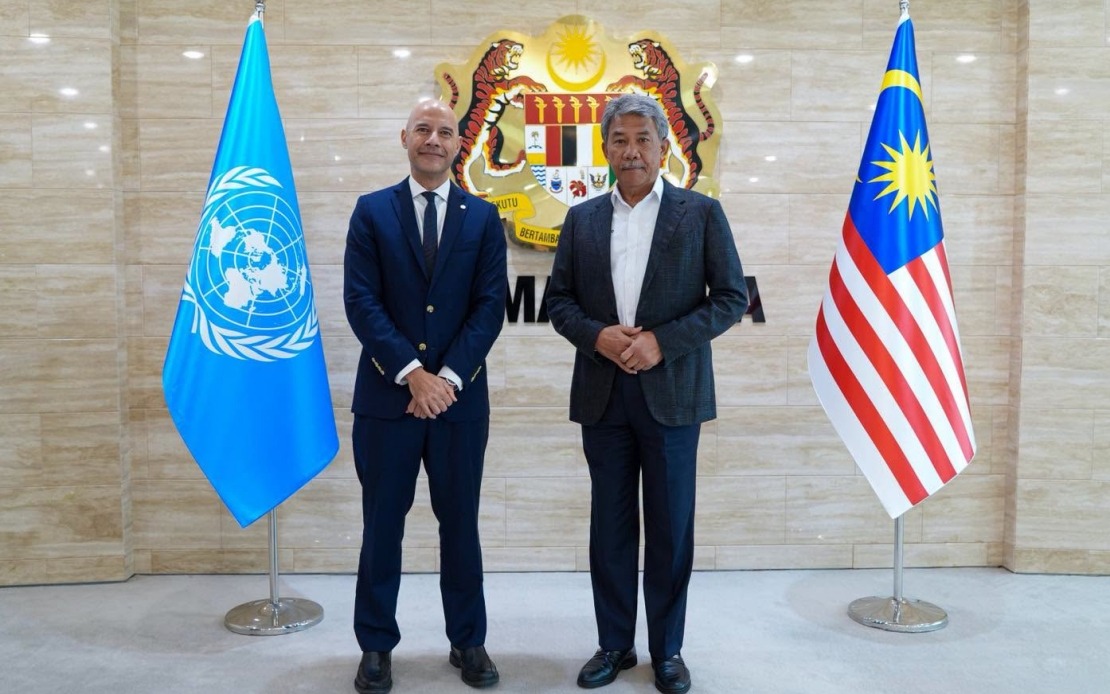
Malaysia's Foreign Minister Datuk Seri Mohamad Hasan has signalled the country's continued commitment to strengthening ties with the United Nations system, hosting a courtesy call from United Nations Resident Coordinator (UNRC) Nikolas Myint at Wisma Putra on Wednesday. The meeting, conducted in a formal diplomatic setting, underscored Malaysia's role as an active participant in the multilateral system and its willingness to deepen engagement with UN agencies operating within its borders.
Myint's visit came months after his appointment as the UNRC for Malaysia, Singapore and Brunei by United Nations Secretary-General on May 31, 2026, a position that represents a significant responsibility in coordinating UN development and humanitarian work across three Southeast Asian nations. His posting to the region reflects the UN's strategic importance in addressing transnational challenges that require coordinated responses across national boundaries, particularly in a region as economically dynamic and geopolitically significant as Southeast Asia.
During their discussion, both officials engaged in substantive exchanges regarding the scope and direction of Malaysia-UN cooperation, focusing on how the multilateral organisation can contribute meaningfully to Malaysia's own development priorities. The Foreign Minister's emphasis on coordination with the UNRC and other UN agencies stationed in Malaysia suggests a recognition that the country's national objectives increasingly intersect with global development agendas, from poverty reduction and environmental sustainability to public health security and human rights advancement.
Mohamad's remarks, shared through official channels, reflected Malaysia's nuanced diplomatic position as a bridge-builder between developed and developing nations. By acknowledging the United Nations' role in addressing "various global challenges," the Foreign Minister positioned Malaysia within the broader international framework that governs responses to transnational issues—from climate change and pandemic preparedness to economic development and peacekeeping operations. This framing is particularly relevant for Southeast Asian nations that, while advancing economically, continue to grapple with development disparities and emerging security threats.
The emphasis on "mutual benefit" in the statement carries particular significance in the Malaysian context. Unlike more transactional bilateral relationships, the Malaysia-UN partnership operates within a framework where both parties bring distinct comparative advantages. Malaysia contributes diplomatic experience, regional knowledge, and political stability, while the UN system offers technical expertise, global networks, and access to international financing mechanisms and development expertise that can accelerate the country's progress toward its sustainable development goals.
Coordination between Malaysia's government and UN agencies has historically covered diverse areas including economic development support, disaster preparedness following natural calamities, public health initiatives, and human rights monitoring. The presence of a dedicated UN Resident Coordinator underscores the depth and breadth of this engagement, extending beyond ceremonial exchanges to substantive policy dialogue and programme implementation. Myint's responsibility for three countries suggests the UN is seeking integrated approaches to regional challenges that transcend national borders, such as human trafficking, transnational crime, and climate resilience.
For Malaysia specifically, the appointment of a new Resident Coordinator presents an opportunity to reset and refresh the country's engagement with the UN system. As the nation pursues its Vision 2050 framework and navigates complex geopolitical dynamics in the region, stronger coordination with the UN could yield tangible benefits in areas ranging from technical capacity-building to access to international best practices in governance and development management. The timing of such diplomatic engagements often signals preparatory groundwork for deeper partnership initiatives.
The courtesy call also reflects broader diplomatic protocols in Malaysia's foreign policy approach. By according appropriate recognition to the UNRC appointment, Malaysia demonstrates respect for the multilateral system and its representatives, a posture that enhances the country's standing within international forums and reinforces its image as a dependable partner committed to rules-based international order. This approach contrasts sharply with isolationist or confrontational diplomatic stances and positions Malaysia favorably in discussions involving global governance reforms.
Looking ahead, the substantive engagement between Mohamad and Myint may lay groundwork for expanded UN programme portfolios in Malaysia. Whether through technical assistance in digital governance, support for climate adaptation strategies, or collaborative approaches to addressing regional security challenges, the relationship established in such courtesy calls frequently develops into concrete partnerships that generate measurable development outcomes and strengthen institutional capacity within the host country.
The meeting also occurs within a broader context of Southeast Asian regionalism and the multilateral system's evolution. Malaysia's engagement with the UN Resident Coordinator reflects the country's balanced approach to international relations, maintaining strong connections to the global institutional framework while simultaneously investing in regional integration mechanisms like ASEAN and the broader East Asian architecture. This multi-layered diplomatic engagement positions Malaysia as a sophisticated player navigating complex international relationships.
From a Southeast Asian perspective, Myint's appointment as Resident Coordinator for three nations signals the UN's recognition that development challenges and solutions in the region often require cross-border approaches. Malaysia, as the largest economy and most developed nation among the three, potentially serves as an anchor for broader regional initiatives while maintaining its own distinct development agenda and international commitments. The strengthened dialogue established through such meetings can facilitate knowledge-sharing and coordinated responses to shared challenges like environmental degradation and technological advancement.

