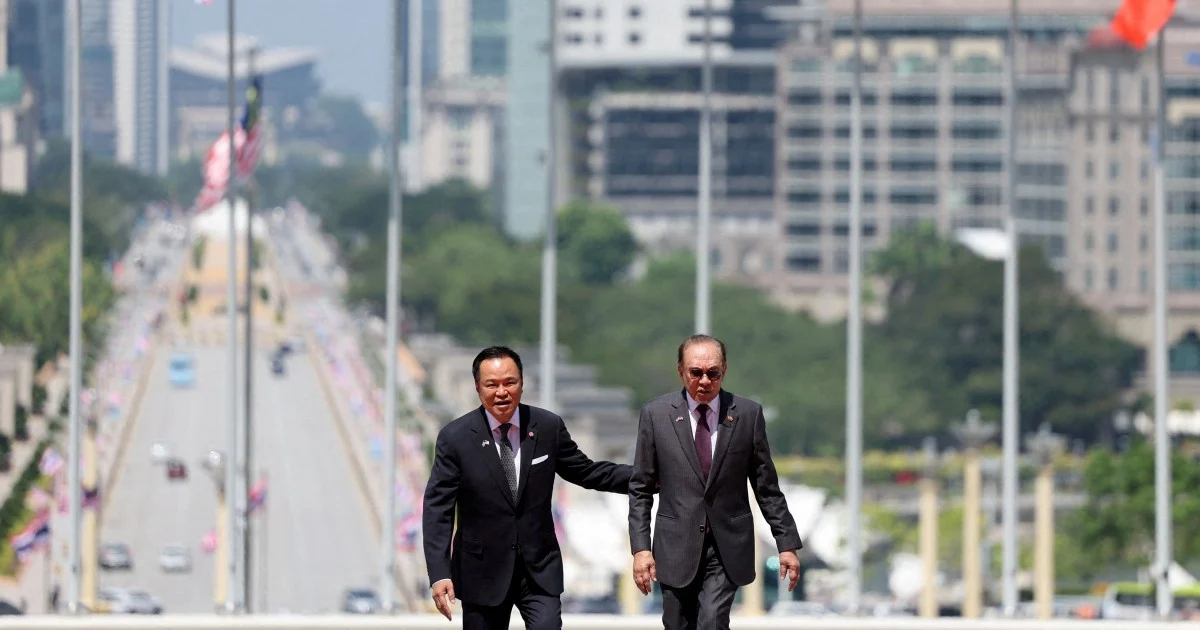
Malaysia's government is positioning itself as a voice for pragmatic regional diplomacy in addressing Myanmar's ongoing political turmoil, with Prime Minister Datuk Seri Anwar Ibrahim reaffirming the nation's conviction that sustainable solutions must encompass multiple stakeholders rather than excluding any significant groups. Speaking in Putrajaya, Anwar presented Malaysia's diplomatic stance as grounded in the principle of self-determination—a position that implicitly critiques both isolation tactics and imposed external solutions that have characterised much international engagement with Myanmar since the military coup of February 2021.
The statement underscores Malaysia's role within ASEAN as a mediator attempting to balance competing interests while maintaining the bloc's founding doctrine of non-interference in member states' internal affairs. By emphasising inclusive engagement, Malaysia is signalling that sustainable political settlements cannot emerge from negotiations involving only military leadership or only civilian resistance movements, but rather require a framework where all significant political actors participate in shaping Myanmar's future trajectory. This diplomatic posture reflects growing recognition that years of sanctions and isolation have failed to produce meaningful political change, instead entrenching positions on all sides.
Myanmar has remained in profound political crisis since the military's overthrow of Aung San Suu Kyi's democratically elected government nearly four years ago. The country has descended into widespread conflict involving military forces, anti-coup resistance movements spanning urban civil disobedience to armed insurgencies, and ethnic armed organisations that control territory along Myanmar's borders. The humanitarian consequences have been catastrophic, with hundreds of thousands displaced, widespread atrocities documented by international observers, and economic collapse creating severe shortages of basic goods and energy. Malaysia, sharing a maritime border with Myanmar and hosting significant populations of Myanmar refugees, faces direct consequences from the country's instability.
Anwar's framing of self-determination as central to any resolution implicitly addresses the complex question of who holds legitimacy in Myanmar. The military government, formally the State Administration Council, contests the previous government's democratic mandate and justifies its 2021 takeover through claims of election irregularities. Opposition groups range from the National Unity Government—a shadow administration claiming to represent Aung San Suu Kyi's legacy—to dozens of armed resistance organisations operating autonomously in different regions. Indigenous ethnic armed organisations have longstanding grievances predating recent turmoil, complicating any future political settlement. An inclusive process would theoretically require acknowledging legitimacy claims across these fundamentally incompatible narratives.
Myalaisa's diplomatic approach reflects the broader ASEAN challenge of addressing Myanmar while maintaining consensus and internal unity. The bloc has struggled to formulate coherent policy since the coup, with some members advocating harder stances while others prioritise dialogue over confrontation. Cambodia's rotating ASEAN chairmanship in previous years proved contentious precisely because other members felt Myanmar's military received insufficient pressure. Malaysia's current emphasis on inclusive engagement represents a middle position—rejecting both the isolation preferred by some Western governments and the unconditional legitimisation of military rule that some analysts perceive in certain ASEAN members' approaches.
The inclusive engagement framework also acknowledges Myanmar's complex ethnic geography. The country comprises dozens of ethnic groups, with the dominant Bamar representing slightly over two-thirds of the population. Various ethnic minorities control substantial territories through armed organisations that predate the recent crisis by decades, some possessing international recognition as political entities. Any lasting political arrangement requires these groups' consent and participation, as historical precedent demonstrates that settlements imposed without their engagement rapidly collapse into renewed conflict. Malaysia understands this dynamic intimately given its own history of negotiating ethnic federalism.
Regional economic implications of Myanmar's prolonged instability extend beyond humanitarian concerns. ASEAN's economic integration initiatives depend upon stable regional connectivity, and Myanmar's dysfunctionality constrains trade routes, investment opportunities, and regional growth. Malaysia specifically has interests in Myanmar's natural resources, potential market access, and strategic positioning along regional supply chains. A political settlement enabling effective governance would benefit Malaysia's economic objectives far more than indefinite instability, even if that settlement differs from Malaysia's preferred configuration.
Anwar's emphasis on Burmese self-determination also carries subtle implications regarding external actors' roles. While Malaysia maintains diplomatic relations with key powers including China and Western governments with Myanmar interests, the statement implies that sustainable resolution cannot be imposed externally. China has maintained substantial economic interests in Myanmar and provided diplomatic cover during international criticism. Western governments and allies have pursued sanctions-based strategies. Neither approach, Malaysia's position suggests, can substitute for Myanmar's own population determining their political future through some form of inclusive dialogue and negotiation.
The challenge for Malaysia's diplomatic approach lies in operationalising inclusivity amid profound mistrust between Myanmar's competing factions. The military continues consolidating control through armed force against resistance movements and ethnic armed organisations. Meanwhile, opposition groups remain fragmented and retain legitimacy principally among portions of Myanmar's urban population and diaspora communities. Creating conditions where genuine inclusive engagement becomes possible requires confidence-building measures, humanitarian access guarantees, and likely international guarantors—diplomatic prerequisites that remain unmet despite years of international attention.
MyLasia's articulation of this position positions the country as continuing its tradition of ASEAN-based pragmatic regionalism—seeking solutions emphasising dialogue over conditionation while avoiding endorsements of either military rule or specific opposition groups. Whether such inclusive engagement can realistically emerge from Myanmar's current deadlock remains uncertain, but Anwar's statement reflects conviction that only internally-driven, broadly-participated processes offer prospects for durable political settlements. For Malaysia and neighbouring ASEAN members, Myanmar's eventual stabilisation through inclusive resolution would serve regional interests far better than indefinite crisis.

