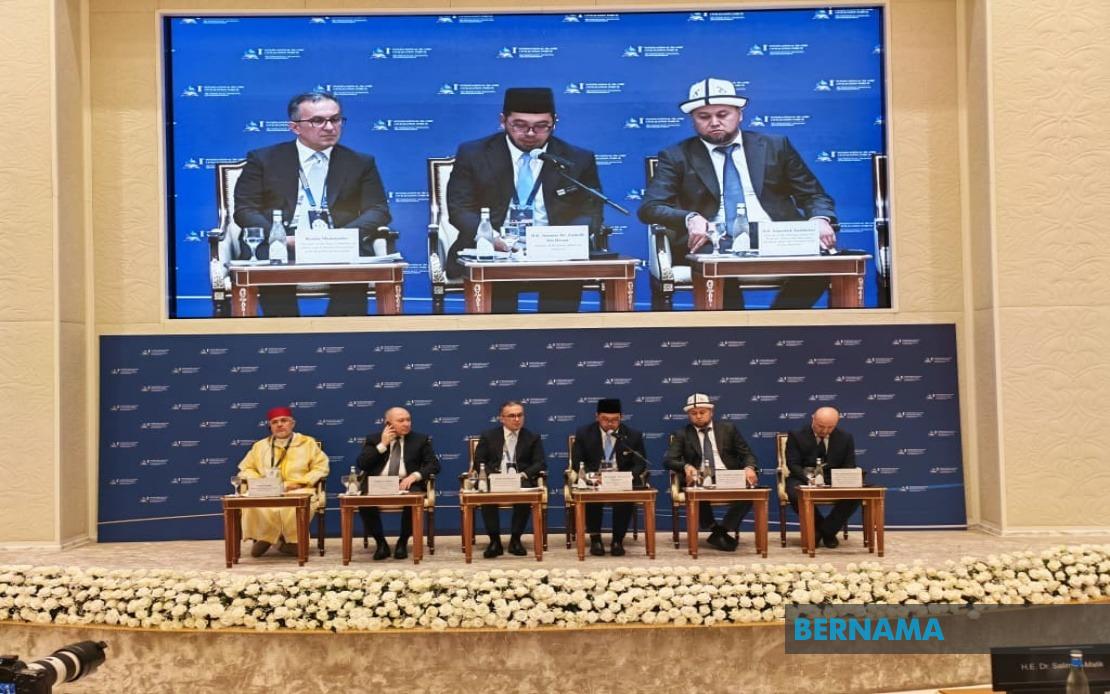
At the International Islamic Civilisation Forum in Tashkent, Uzbekistan, Malaysia's Minister in the Prime Minister's Department (Religious Affairs) Datuk Dr Zulkifli Hasan delivered a sweeping call for the Muslim world to harness the lessons of Gaza's tragedy toward constructing a framework for renewed Islamic leadership on the world stage. Rather than allowing the profound suffering of Palestinian civilians to crystallise into despair or perpetual grievance, Zulkifli framed the crisis as a moral catalyst for the global Islamic community to reaffirm its commitment to universal principles of justice, compassion, and human dignity—values he argues are foundational to Islamic civilisation but have become obscured amid contemporary geopolitical turbulence.
The minister's intervention reflects Malaysia's broader diplomatic positioning as a bridge between the Muslim world and the international community. By situating Gaza within a larger narrative about civilisational purpose rather than treating it as an isolated conflict, Zulkifli attempted to channel Muslim solidarity away from purely reactive posturing toward substantive intellectual and moral renewal. His remarks acknowledged that the humanitarian catastrophe has sparked legitimate questions about the consistent application of international law and the adequacy of global justice mechanisms—concerns that resonate deeply across Southeast Asian Muslim societies where perceptions of double standards in Western foreign policy remain widespread.
Central to Zulkifli's argument is a provocative reframing of how the Islamic world should understand itself. He rejected the notion that Muslim identity and civilisational purpose can be constructed primarily through opposition to external forces or nostalgia for a glorious past. Instead, he posed a question that implicitly challenges decades of Islamic discourse: if the Islamic world has indeed attained greatness historically, what specific contributions should contemporary Muslim societies make to shaping humanity's future? This formulation shifts the conversation from defensive positioning—justifying Islamic civilisation against critics—toward forward-looking leadership and agency.
The minister articulated a vision of Islamic civilisation rooted not merely in architectural splendour or scientific achievement, though he acknowledged these legacies, but in its capacity to nurture just governance structures, cultivate ethical leadership, and maintain respect for human dignity across all contexts. For Malaysian readers familiar with their country's experience managing religious pluralism within a Muslim-majority framework, Zulkifli's emphasis on ethical governance offers a domestic parallel. Malaysia's own model of Islamic institutions functioning within a constitutional democracy represents precisely the kind of fusion of Islamic principles with modern governance that he appears to advocate globally.
Zulkifli's call for intellectual and moral renewal carries implications for how Southeast Asia engages with the broader Muslim world. The region, home to Indonesia, Malaysia, and Brunei alongside significant Muslim minorities in Thailand, the Philippines, and Singapore, often positions itself as demonstrating that Islamic identity and pluralistic democracy are compatible. By urging the Muslim world toward ethical leadership and principled engagement rather than civilisational confrontation, Zulkifli essentially advocates for Southeast Asian approaches to become more central to global Islamic discourse. This positioning serves Malaysia's interest in elevating its voice within international Islamic forums whilst maintaining its commitment to cross-civilisational dialogue.
Particularly significant is Zulkifli's proposal that Muslim societies assume active roles in shaping ethical frameworks governing emerging technologies including artificial intelligence, biotechnology, and quantum computing. This proposition reflects growing recognition that technological governance will define the twenty-first century, and that Muslim-majority nations risk marginalisation if they remain passive consumers rather than active architects of these frameworks. For a technologically advancing nation like Malaysia, which has invested heavily in digital infrastructure and is positioning itself as a regional fintech hub, this argument carries domestic resonance. Islamic ethical frameworks applied to technological development could become a distinctive Southeast Asian contribution to global governance debates.
The minister also invoked Islam's historical openness to knowledge from diverse civilisations—Greek, Persian, Indian, and Chinese—as justification for contemporary Muslim engagement with global intellectual currents. This historical reference counters narratives portraying Islamic civilisation as inherently insular or resistant to external influences. For Malaysian audiences, many of whom inhabit multicultural societies where religious and secular knowledge systems coexist, this emphasis on intellectual pluralism within Islamic tradition resonates. It validates the notion that Islamic identity need not be defined in opposition to secular modernity or Western intellectual traditions.
Environmental stewardship emerged as another dimension of Zulkifli's civilisational renewal project. By connecting Islamic concepts of human trusteeship over creation to contemporary environmental challenges, he positioned the Muslim world as potential contributors to global sustainability discourse. This framing is particularly relevant for Southeast Asia, a region facing acute environmental pressures from deforestation, urban pollution, and climate change impacts. An Islamic environmental ethics could theoretically contribute to conservation efforts whilst maintaining cultural and religious authenticity—a balance many Southeast Asian Muslim-majority nations are actively seeking.
Crucially, Zulkifli explicitly cautioned against interpreting Islamic civilisational renewal as competitive rivalry with other civilisations. Instead, he characterised it as opportunity for the Muslim world to contribute uniquely to humanity through dialogue, partnership, and mutual respect. This framing defuses potential criticism that Malaysia is advocating for Islamic hegemony or isolationism. Rather, the minister presented a vision of Islamic civilisation as a collaborative partner in addressing shared global challenges—pandemics, climate change, technological ethics, economic inequality—that transcend religious boundaries. For Malaysia, which depends on regional stability and international investment, this positioning is diplomatically essential.
The minister's remarks on Malaysia-Uzbekistan relations served to operationalise his broader vision. By emphasising that Uzbekistan's rich Islamic scholarly heritage complements Malaysia's experience in Islamic governance, Islamic finance, and multicultural coexistence, Zulkifli positioned both nations as exemplars of the renewal he advocated. This bilateral framing suggests Malaysia views Central Asian Muslim nations as potential partners in advancing knowledge, ethical innovation, and sustainable development—areas where Southeast Asia and Central Asia might collaborate in servicing the broader Muslim world. For Malaysian policymakers, such partnerships offer avenues for expanding Malaysia's soft power and influence within Islamic forums.
The overall thrust of Zulkifli's intervention suggests Malaysia is attempting to redirect global Islamic discourse toward constructive engagement rather than perpetual grievance management. By acknowledging Gaza's tragedy whilst arguing for forward-looking civilisational renewal, the minister seeks to honour legitimate Muslim concerns about international justice whilst steering discussion toward Malaysian-style Islamic modernism. This approach reflects Malaysia's own historical trajectory—a nation that has integrated Islamic identity with constitutional governance, market economics, and cross-cultural respect. Whether the Muslim world responds to such calls for intellectual and moral renewal, or continues to prioritise immediate political crises, remains uncertain. But Malaysia's willingness to articulate this vision suggests growing confidence in its ability to lead Islamic discourse beyond reactive positions toward constructive global engagement.

