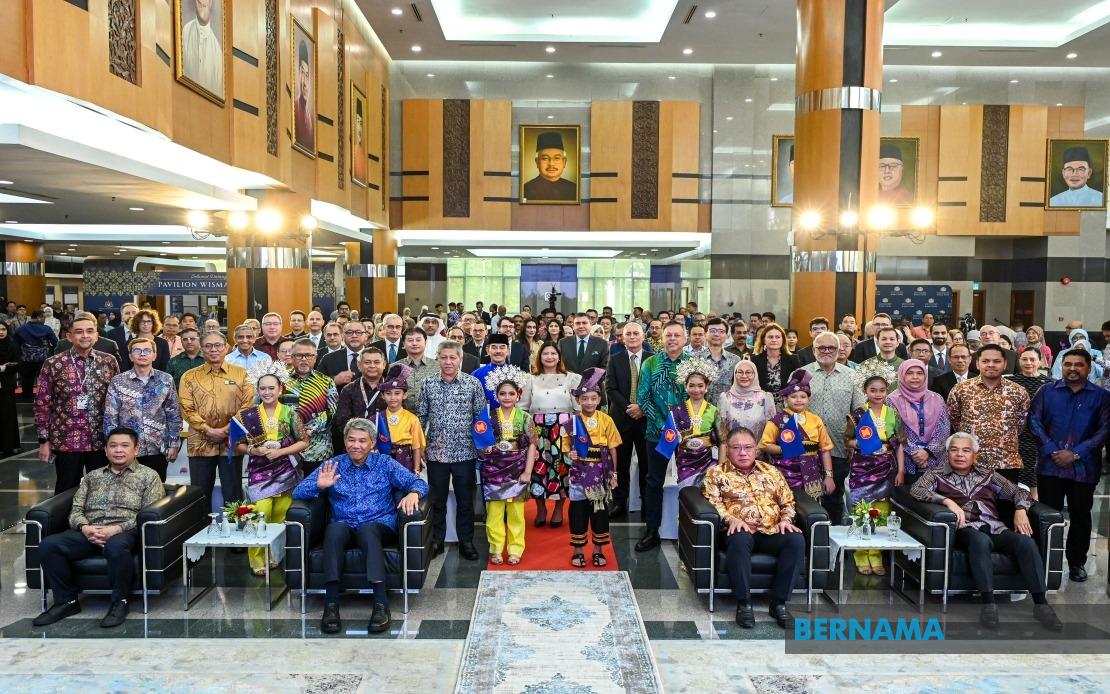
Malaysia commemorated its nearly six decades of involvement within ASEAN at a major anniversary ceremony held in Putrajaya on Monday, bringing together government leaders, diplomats, and representatives from international organisations to reflect on the regional grouping's historical journey and future trajectory. The event drew approximately 300 guests to the Foreign Ministry headquarters, where officials highlighted Malaysia's central role in shaping ASEAN's institutional development since the bloc's inception in 1967.
The gathering, held under the thematic banner "59 Years of Navigating Together", served as a platform for the Malaysian government to reinforce its dedication to the 11-member regional organisation. Foreign Minister Datuk Seri Mohamad Hasan presided over the proceedings, which included remarks from Tourism, Arts and Culture Minister Datuk Seri Tiong King Sing and Deputy Foreign Minister Datuk Lukanisman Awang Sauni. The ministry's official statement positioned the celebration as an opportunity to acknowledge ASEAN's resilience across its three foundational pillars—political-security cooperation, economic integration, and socio-cultural exchange.
Agreed upon on August 8, 1967, through the signing of the Bangkok Declaration, ASEAN emerged from an initial partnership of five nations: Indonesia, Malaysia, the Philippines, Singapore, and Thailand. These founders sought to establish a cooperative framework that would bring stability and prosperity to Southeast Asia during the Cold War era. Over more than half a century, the grouping has expanded significantly, reflecting the region's evolving geopolitical landscape and the appeal of ASEAN's founding principles of mutual respect for sovereignty and non-interference in internal affairs.
The bloc's enlargement demonstrates both ASEAN's gravitational pull and its adaptability as a regional institution. Brunei became the sixth member in 1984, followed by Vietnam's accession in 1995, which marked a substantial shift as the bloc began incorporating former adversaries from the Cold War period. Laos and Myanmar joined in 1997, Cambodia in 1999, and most recently, Timor-Leste was admitted during the 47th ASEAN Summit in October of the previous year, bringing total membership to eleven and establishing ASEAN as one of Southeast Asia's most inclusive regional platforms.
For Malaysia, ASEAN membership has been fundamental to its foreign policy architecture and regional standing. As one of the founding members, Kuala Lumpur has consistently championed the organisation's core principles while leveraging the grouping to amplify Malaysia's voice in broader Indo-Pacific discussions. The country has hosted multiple ASEAN summits and chaired the organisation on several occasions, using these leadership roles to advance its vision of regional stability and economic cooperation. Malaysia's commitment extends to active participation in ASEAN's numerous subsidiary bodies and mechanisms, ranging from military-to-military dialogue forums to academic and cultural exchanges.
The ceremonial programme at Putrajaya incorporated multimedia elements that underscored ASEAN's shared narrative. A specially commissioned video montage titled "ASEAN Journey: Navigating Our Future, Together—59 Years of Malaysia in ASEAN" was screened during the event, providing visual documentation of Malaysia's evolving relationship with the regional bloc. This production served to educate younger audiences about ASEAN's achievements while casting Malaysia's role as integral to those accomplishments. The subsequent cake-cutting ceremony, conducted by Foreign Minister Mohamad, functioned as a symbolic gesture of unity and shared celebration among the gathered delegates.
The emphasis on navigating together reflects contemporary challenges confronting the region. ASEAN faces mounting pressure from competing great-power interests, supply chain vulnerabilities exposed by recent global disruptions, climate change impacts, transnational security threats, and internal governance questions regarding enforcement of the ASEAN Charter. These multifaceted pressures require sustained commitment from all member states to preserve the consensus-based decision-making framework that has historically defined the association. Malaysia's reaffirmation of its dedication at this anniversary moment signals continuity in its approach to regional stewardship and multilateral engagement.
The three structural pillars identified in the Foreign Ministry's statement—political-security cooperation, economic frameworks, and socio-cultural bonds—form the conceptual backbone of ASEAN integration. Politically, ASEAN has maintained relative peace among member states through dialogue mechanisms and conflict-avoidance protocols, a remarkable achievement given the region's history of tensions. Economically, initiatives including the ASEAN Free Trade Area and ongoing Regional Comprehensive Economic Partnership negotiations represent efforts to deepen trade interdependencies and collective prosperity. The socio-cultural pillar encompasses people-to-people exchanges, academic collaborations, and tourism promotion that cultivate shared identity and mutual understanding among Southeast Asian societies.
Malaysia's strategic position within ASEAN carries particular significance for the bloc's effectiveness. Located at the geographical heart of Southeast Asia and serving as a maritime and air transportation hub, Malaysia facilitates regional connectivity. Additionally, as a multiethnic, multireligious democracy with substantial Muslim and Chinese populations, Malaysia embodies the pluralistic character that ASEAN aspires to promote. The country's economic development trajectory, though facing recent challenges, demonstrates pathways for prosperity that other member states observe closely, particularly regarding technology transfer and industrial diversification.
The 59th anniversary observance arrives at a juncture when ASEAN's relevance is actively debated in international forums. The bloc's principle of non-interference has drawn criticism from Western governments concerned about democratic governance in certain member states, while major powers including China and India seek to leverage ASEAN's centrality in regional architecture for their own strategic advantage. Malaysia's participation in reaffirming ASEAN's solidarity and shared commitment helps shore up the organisation's institutional coherence amid these external pressures and internal differences among member states with varying political systems and economic interests.
Looking forward, Malaysia's continued engagement with ASEAN agenda-setting will influence how the regional grouping addresses transnational challenges including maritime security, cybercrimes, pandemics, and climate adaptation. The country's expertise in various sectors, from financial services to renewable energy development, positions it to contribute substantively to ASEAN's capacity-building initiatives. The anniversary celebration, while commemorative in nature, thus functions simultaneously as a reminder of enduring commitments and a launchpad for renewed effort in advancing the collective interests of Southeast Asia's peoples and governments in an increasingly complex global environment.

