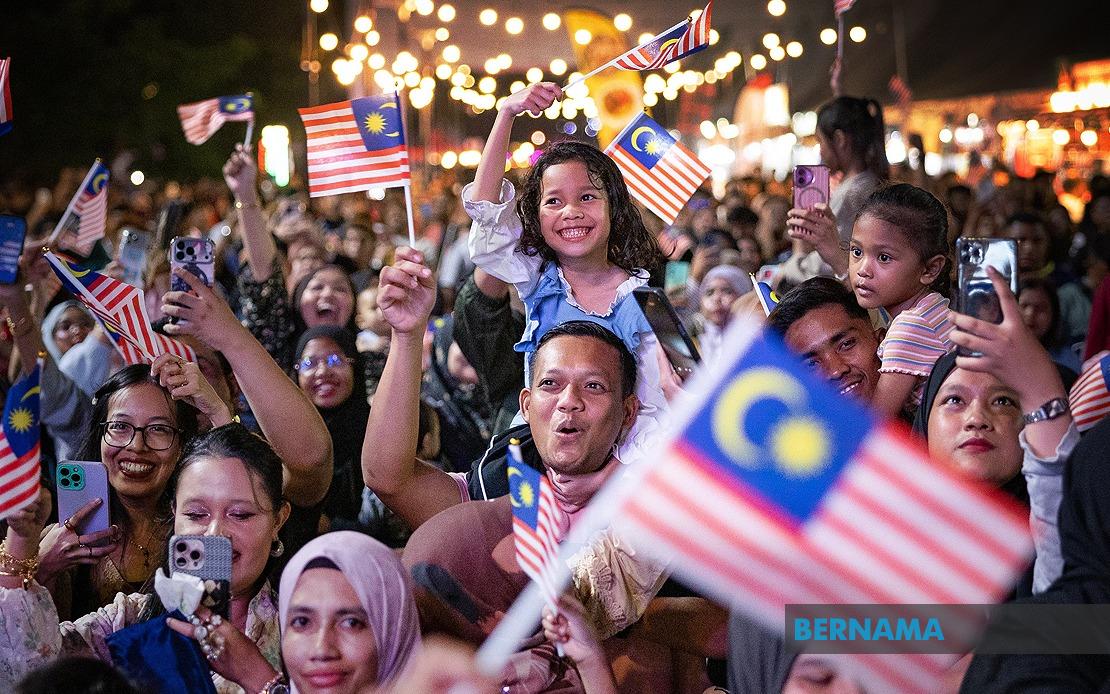
Malaysia's 69th National Day Eve unfolded Friday night with scenes of jubilant celebration across the nation, as hundreds of thousands of citizens gathered in towns and cities to mark the countdown to independence. The most dramatic show of patriotic enthusiasm centred on Kuala Lumpur's Dataran Merdeka, where more than 100,000 people filled the historic square to participate in 'Kita Bagi Jadi @ Ambang Merdeka 2026', a concert experience that blended contemporary entertainment with reflections on national identity.
The atmosphere at the capital's focal point began building from early evening, with families, young adults and elderly Malaysians arriving by 8 pm to secure vantage points. According to surveys conducted at the venue, the crowd composition spanned every demographic, united by waving the Jalur Gemilang flag as the beautifully illuminated Sultan Abdul Samad Building provided a symbolic backdrop. The colonial-era structure, a monument to Malaysia's journey from colonial rule to nationhood, served as more than mere décor—it anchored the evening's narrative of a nation's passage through time.
The entertainment centrepiece was a 90-minute concert showcasing Malaysia's contemporary music talent alongside historical and cultural narratives. Local artists including Aina Abdul, Aman RA, Nadia Aqilah, Asmidar, Haziq Rosebi, Mimifly, Izen Kong and Pasya performed against a production backdrop supported by approximately 350 performers in total. The programming deliberately interwove storytelling about Malaysia's heritage with modern musical expression, reflecting an intentional effort to position independence celebrations as relevant to younger audiences increasingly connected to contemporary entertainment formats.
Government presence underscored the occasion's official significance. Hannah Yeoh, the Minister in the Prime Minister's Department overseeing the Federal Territories portfolio, attended alongside Kuala Lumpur Mayor Datuk Seri Fadlun Mak Ujud. The participation of high-ranking officials signalled the administration's emphasis on National Day observance as a cornerstone of national unity messaging at a time when Malaysian political discourse frequently centres on communal and regional divisions.
The evening's major spectacle arrived when Menteri Besar Datuk Seri Amirudin Shari made his entrance at 9.20 pm, introducing a sequence of military and emergency services displays. The elite VAT 69 Commando unit executed a skydiving demonstration, while contingents paraded through the venue alongside elaborately decorated vehicles. Notably, both the Fire and Rescue Department and the Malaysian Armed Forces contributed special performances, transforming the celebration into a comprehensive showcase of state institutional pride and discipline. This emphasis on military and security force participation reflects a broader pattern in Southeast Asian National Day festivities, where such displays reinforce notions of state strength and cohesion.
The midnight moment crystallised into the evening's crescendo. Led by Menteri Besar Amirudin, the assembled crowd shouted 'Merdeka' three times—a ritual verbal assertion of independence that carries deep historical resonance, echoing the original countdown at independence in 1957. Fireworks illuminated the Kuala Lumpur skyline while light shows synchronised across the venue. The finale concert featured veteran Malaysian artists Datuk Ramli Sarip, Datuk Awie, Gerhana Skacinta, Merrah and Wani Kyrie, ensuring that the symbolic transition into National Day itself was marked by the voices of musicians who have soundtracked Malaysia's modern era.
Parallel celebrations extended well beyond the capital, indicating that the patriotic impulse transcended urban epicentres. In Perlis, the sports complex drew more than 46,000 visitors to state-level festivities that opened with the national anthem and featured martial arts displays. The state's Chief Minister Datuk Seri Ab Rauf Yusoh attended with his wife, Datin Seri Zuriyah Abd Aziz, and executive council members, demonstrating how National Day observance functions as a regularised occasion for state leadership visibility and direct engagement with constituents.
Royal messaging provided thematic direction for the evening's patriotic undercurrents. In his formal address, Tuanku Syed Sirajuddin contextualised contemporary independence within historical struggle, reminding the public that the freedoms Malaysians now exercise emerged from prolonged resistance, meaningful sacrifice and inter-communal unity. The Sultan's emphasis on knowledge, integrity, unity and civic responsibility positioned National Day not merely as historical commemoration but as an annual reaffirmation of the social contract binding citizens to national governance. This framing carries particular relevance given ongoing debates about national cohesion and the foundations of Malaysian multiculturalism.
Programming across major venues reflected a deliberate integration of entertainment, civic participation and grassroots engagement. Beyond the main stages, Dataran Merdeka hosted the Bulatan Sultan Azlan Shah Run, Jualan Rahmah subsidised food initiatives, thrift markets, free health screenings, karaoke competitions and even the Tantarina Haunted House attraction. This layered approach recognised that National Day celebrations function simultaneously as cultural performance and community gathering, where patriotic sentiment emerges not only from official speeches or military displays but from shared social experiences.
The scale of participation—with over 100,000 at Dataran Merdeka alone and tens of thousands more across regional venues—suggests that despite Malaysia's complex ethnic and political divisions, the independence milestone retains powerful symbolic currency. The evening demonstrated how strategic programming, institutional participation and the invocation of shared historical narratives can galvanise public enthusiasm across demographic lines. For Malaysia, a nation where political rhetoric frequently emphasises fragmentation risks, such moments of visible, multi-generational gathering carry subtle but significant implications for national cohesion discourse.

