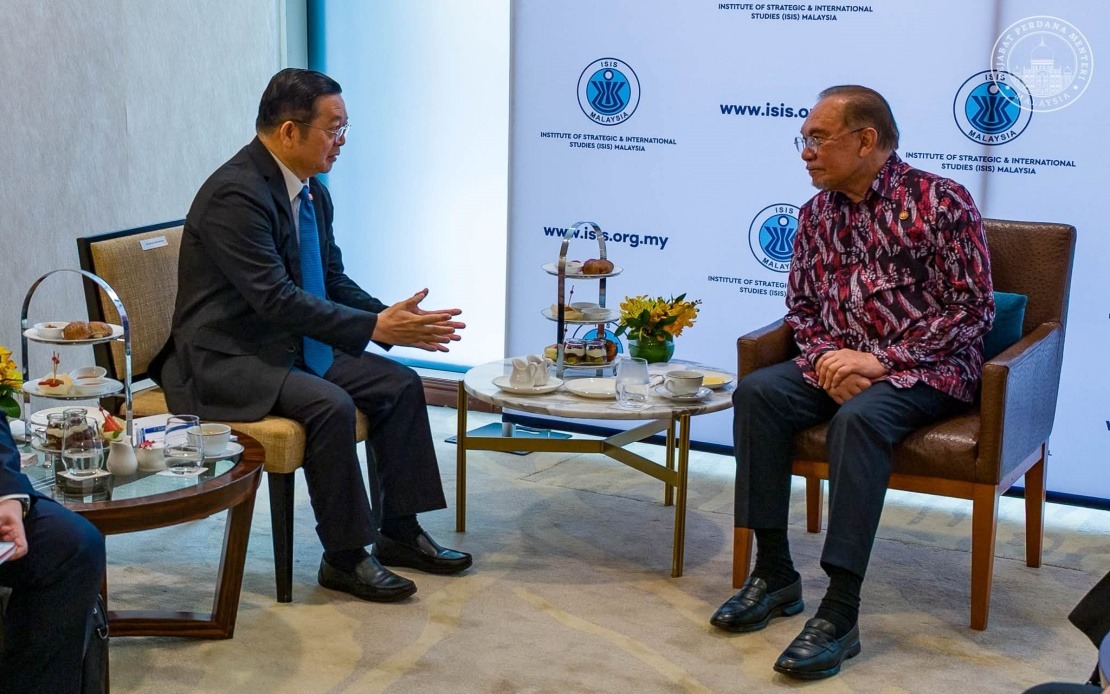
Prime Minister Datuk Seri Anwar Ibrahim has reaffirmed Malaysia's commitment to deepening ASEAN's institutional strength and cohesion, positioning the bloc as a capable forum for addressing the aspirations of its 650 million people. Speaking after delivering the keynote address at the 39th Asia-Pacific Roundtable here, Anwar underscored that Malaysia remains dedicated to fortifying ASEAN as a resilient and inclusive community in an era of mounting external pressures and internal complexities.
The premier's remarks came during a meeting with ASEAN Secretary-General Dr Kao Kim Hourn, a timely engagement reflecting the diplomatic tempo at a critical juncture for the regional bloc. Anwar, who simultaneously holds the Finance Ministry portfolio, used the occasion to signal that Malaysia views ASEAN coherence not merely as a diplomatic aspiration but as a practical necessity for regional prosperity and security. The exchange between Malaysia's top leader and the ASEAN chief underscore the centrality of Malaysia's voice within a 10-nation grouping often challenged by competing national interests.
The agenda traversed several fault lines currently testing ASEAN's unity and neutrality. The Myanmar situation, with its deteriorating humanitarian crisis and fractured governance structures, remains a persistent pressure point within the grouping, particularly given the bloc's cherished principle of non-interference yet simultaneous commitment to democratic governance. The South China Sea disputes, involving competing territorial and maritime claims by multiple ASEAN members and China, continue to impose constraints on ASEAN's ability to speak with unified purpose on external security matters. These two issues alone encapsulate the tension between ASEAN's core commitment to centrality—its presumed role as arbiter and mediator—and the reality of divided member interests.
Beyond these traditional security concerns, Anwar highlighted the expanding agenda now demanding ASEAN's collective attention. Artificial intelligence, a transformative technology reshaping economies and societies, represents a domain where ASEAN nations must develop coordinated approaches to governance, workforce transitions, and competitiveness. The prime minister's reference to these emerging technological challenges signals Malaysian thinking that ASEAN's relevance depends on addressing 21st-century issues alongside conventional statecraft concerns.
Timor-Leste's recent accession to full ASEAN membership introduces fresh institutional dynamics and management tasks. The inclusion of Southeast Asia's youngest nation enlarges ASEAN's geographic footprint and demographic reach but also necessitates careful integration of a nation with distinct development trajectories and security preoccupations. Anwar's mention of navigating the post-accession phase indicates Malaysia's recognition that Timor-Leste's incorporation requires deliberate attention to ensure productive engagement and institutional functionality.
The ASEAN Community Vision 2045 represents the bloc's aspirational blueprint for socioeconomic integration and sustainable development across the next two decades. Anwar's emphasis on implementation reflects a Malaysian perspective that ASEAN's credibility hinges on translating rhetorical commitments into tangible outcomes in areas ranging from digital connectivity to poverty reduction to environmental stewardship. For Malaysia, a middle-income nation seeking to anchor itself as a regional leader, demonstrating progress on Vision 2045 objectives enhances its standing within ASEAN decision-making structures.
The West Asia conflict, encompassing the ongoing Israeli-Palestinian tensions and broader regional instability, increasingly affects ASEAN calculations. The wars in Gaza and elsewhere resonate across ASEAN's Muslim-majority populations and complicate the bloc's efforts to maintain strategic equidistance from major powers. Anwar's reference to weighing these developments' implications suggests Malaysia's concern that regional tensions originating thousands of kilometres away could destabilise ASEAN's internal cohesion or draw members into polarised global alignments.
Anwar's reiteration of ASEAN's foundational principles—unity, centrality, and close cooperation—appears deliberately timed. As geopolitical pressures intensify and strategic competition among great powers deepens, ASEAN nations face sustained temptation to prioritise bilateral relationships over collective interest. Malaysia, as a moderate-sized power with significant stakes in maintaining ASEAN's institutional functionality, has positioned itself as an advocate for preserving these principles precisely because they afford medium powers disproportionate influence within regional outcomes.
Malaysia's framing of its ASEAN role as fundamentally constructive contrasts sharply with zero-sum geopolitical narratives increasingly dominant in global discourse. By stressing collaboration and shared prosperity rather than competition and exclusion, Malaysia signals allegiance to multilateralism even as traditional multilateral institutions face erosion elsewhere. This positioning serves Malaysia's strategic interests while reinforcing ASEAN's claimed identity as a zone of peaceful dispute resolution and mutual benefit.
The broader context informing Anwar's statements involves recognising ASEAN's diminished leverage relative to major powers. China's economic dominance, the United States' security commitments, India's growing assertiveness, and Japan and South Korea's technological prowess all circumscribe ASEAN's freedom of manoeuvre. Within this constrained environment, Malaysia and other ASEAN members must demonstrate that the bloc remains relevant and capable, both as a collective entity and through individual member contributions to regional solutions. Anwar's consistent emphasis on constructive engagement reflects this calculation.
Looking forward, Malaysia's commitment to strengthening ASEAN will be tested through concrete actions across multiple domains. Whether ASEAN can develop coherent positions on Myanmar's political trajectory, establish binding maritime conduct standards in the South China Sea, coordinate AI governance frameworks, and deliver Vision 2045's socioeconomic objectives will determine whether pledges like Anwar's translate into substantive regional outcomes. For Malaysian policymakers, maintaining ASEAN's viability remains central to navigating the competitive regional landscape while preserving space for smaller powers to exercise meaningful agency.

