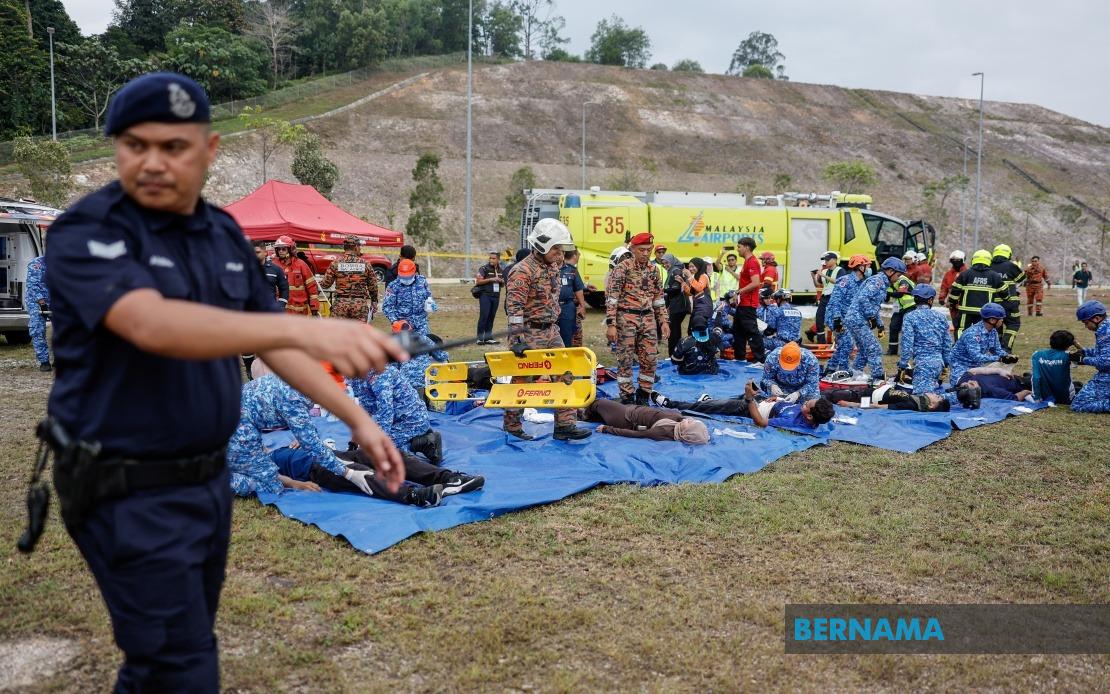
Malaysia's aviation emergency response framework faced a significant test when more than 20 government and private-sector agencies participated in Ex Urban Falcon 2026, a comprehensive simulation exercise designed to evaluate Malaysia's capacity to manage an air disaster occurring well beyond traditional airport boundaries. Held on July 16 at the Denai Alam Rest and Service Area along the Damansara-Shah Alam Elevated Expressway, the drill centred on a fictional ATR72 aircraft accident located approximately six kilometres from Sultan Abdul Aziz Shah Airport in Subang, marking a departure from previous exercises that had focused primarily on scenarios near airport perimeters.
According to Muhammad Hidayat Ismail, general manager of Airport Fire and Rescue Services (AFRS), the exercise represented a pioneering effort to test emergency protocols under conditions that depart significantly from routine airport-based operations. The simulation sought to validate whether Malaysia Airports Holdings Berhad (MAHB) and cooperating agencies could effectively coordinate emergency operations consistent with the aerodrome emergency plan, particularly when incidents occur beyond the conventional response zone. Under the National Aeronautical Search and Rescue Manual (NAMSA), AFRS maintains operational responsibility across a radius extending to eight kilometres from an airport's midpoint, establishing a comprehensive coverage area that necessitates coordination with agencies operating in populated and industrial zones surrounding major airports.
The selection of a location six kilometres from Sultan Abdul Aziz Shah Airport was intentional, positioning the simulated incident at the outer limits of AFRS's mandated response area whilst creating realistic logistical challenges that ground-based response teams would encounter in genuine emergencies. Muhammad Hidayat identified one of the most formidable obstacles confronting rescue personnel: the considerable time required to reach off-airport crash sites given the necessity to navigate through congested urban roads and process multiple toll collection points. These practical constraints distinguish off-airport incidents from airport-based emergencies, where pre-positioned equipment and personnel can respond within minutes. The exercise thus provided participating agencies with authentic conditions reflecting the friction inherent in mobilising emergency resources through Malaysia's increasingly dense suburban infrastructure.
A critical distinction between aviation disasters occurring within airport boundaries versus those happening in surrounding communities concerns victim survival rates and environmental factors. Muhammad Hidayat emphasised that crashes in off-airport locations, characterised by uneven terrain, built-up residential areas, and industrial zones, typically result in substantially lower survivor percentages compared to accidents on airport grounds where emergency services maintain constant readiness. This reality carries profound implications for resource allocation and response strategy, fundamentally altering the ratio of medical rescue operations to body recovery and victim identification procedures. The drill incorporated this sobering reality by designing scenarios where casualty numbers potentially exceeded survivor counts, compelling participating agencies to confront the psychological and logistical demands associated with large-scale disaster victim identification operations.
The Royal Malaysia Police assumed primary responsibility for Disaster Victim Identification (DVI) coordination during the exercise, a function that assumes heightened complexity in off-airport environments where remains may be dispersed across larger geographical areas and contaminated by structural debris or environmental hazards. The integration of DVI operations into the broader response framework demonstrated how aviation disasters transcend purely firefighting and rescue dimensions, encompassing forensic investigation, family support, and bureaucratic processes that extend far beyond the initial emergency response phase. This multi-disciplinary approach reflects international best practices established through examination of historical aviation accidents where coordination failures during victim identification phases have compounded the trauma experienced by affected families and communities.
From a technological perspective, Muhammad Hidayat indicated that Malaysia's emergency response infrastructure incorporates aircraft firefighting vehicles engineered to international standards established by the International Civil Aviation Organisation (ICAO) and enforced by the Civil Aviation Authority of Malaysia (CAAM). These specialised vehicles represent substantial capital investments designed to suppress aviation fuel fires and manage hazardous material containment, yet their deployment to off-airport locations introduces additional complexity regarding vehicle accessibility along routes designed for standard traffic rather than emergency apparatus. The exercise thus tested not merely the capabilities of equipment in isolation but the practical feasibility of delivering this technology to unconventional incident locations within timeframes that maximise operational effectiveness.
The composition of participating organisations reflected the comprehensive nature of aviation disaster response in contemporary Malaysia. Malaysia Airports Holdings Berhad coordinated with the National Disaster Management Agency (NADMA), the Selangor state government, and PROLINTAS-DASH, the private concessionaire managing the elevated expressway where the simulation occurred. This configuration acknowledged that off-airport incidents necessarily involve multiple jurisdictional authorities whose cooperation cannot be assumed without deliberate coordination mechanisms. The involvement of the expressway operator proved particularly significant, as it highlighted how private-sector entities controlling critical infrastructure must be integrated into emergency response frameworks to facilitate rapid clearance and resource deployment.
The exercise assembled approximately 450 personnel representing critical agencies across the public and private sectors, creating a realistic surge capacity scenario that emergency planners must anticipate when coordinating large-scale operations. This scale of mobilisation introduces substantial administrative and communication challenges, as coordinating several hundred personnel across multiple organisations inevitably generates confusion regarding command authority, resource allocation, and operational priorities. The drill permitted agencies to identify communication breakdowns, identify overlapping responsibilities, and test coordination protocols under conditions simulating the stress and information uncertainty accompanying genuine disasters.
Muhammad Hidayat characterised the observed performance during the exercise as demonstrating competent execution of established procedures, with firefighting and rescue operations proceeding according to documented protocols. However, he acknowledged that this initial assessment merely constituted a preliminary evaluation, with comprehensive analysis deferred to a dedicated workshop scheduled for July 26 and 27. This two-day workshop would aggregate observations from all participating agencies, identify systemic vulnerabilities, and develop targeted improvement measures addressing deficiencies revealed during the simulation. The structured approach to post-exercise analysis represents a sophisticated understanding that debriefing and systematic improvement constitute integral phases of emergency preparedness rather than peripheral administrative tasks.
The significance of Ex Urban Falcon 2026 extends beyond immediate technical assessments of agency readiness, encompassing broader implications for public confidence in Malaysia's aviation safety framework. Muhammad Hidayat asserted that the coordinated commitment demonstrated by participating organisations reinforced public trust in the nation's capacity to respond effectively to potential aviation disasters. This assertion reflects recognition that public perception of institutional competence derives substantially from visible demonstration of preparedness rather than abstract assurances regarding capability. Regular, realistic exercises constitute a form of institutional accountability, signalling to the flying public that aviation authorities maintain vigilant readiness for catastrophic scenarios that might otherwise remain invisible to ordinary citizens.
For Malaysian aviation stakeholders and regional carriers relying on Sultan Abdul Aziz Shah Airport and other domestic facilities, the exercise carried implications regarding emergency response adequacy in increasingly congested airspace and densely populated airport environments. As Southeast Asian aviation expands and cities surrounding major airports intensify in population density and infrastructure complexity, the probability that aviation incidents would occur beyond airport perimeters increases correspondingly. Malaysia's explicit focus on off-airport disaster scenarios positions the nation at the vanguard of regional emergency preparedness, establishing protocols and testing frameworks that neighbouring countries may subsequently emulate. The exercise thus contributed not merely to immediate national security but to advancement of regional aviation safety standards.
The findings and recommendations emerging from the July 26-27 workshop would likely address several technical and procedural dimensions critical to off-airport response effectiveness. Enhanced coordination with expressway management and toll authorities regarding emergency clearance procedures, refined communication protocols ensuring clarity regarding command authority across multiple jurisdictions, and improved vehicle routing systems accounting for real-time traffic conditions would constitute probable focus areas. Additionally, training programmes might be developed to familiarise personnel with navigation and operational challenges specific to off-airport environments, since routine airport-based training may not adequately prepare responders for the logistical complexities inherent in reaching distant crash sites within critical time windows.
Looking forward, the sustained commitment demonstrated through Ex Urban Falcon 2026 and the subsequent analytical workshop establish a foundation for continuous refinement of Malaysia's aviation disaster response framework. The exercise methodology itself—simulating realistic scenarios beyond conventional boundaries—provides a model for testing institutional readiness under conditions approximating genuine emergency circumstances. As aviation activity in Southeast Asia continues expanding and demographic growth brings residential and commercial development ever closer to airport perimeters, the imperative for rigorous, realistic emergency preparedness exercises becomes increasingly apparent. Malaysia's proactive approach to this challenge suggests recognition that aviation safety transcends technical aircraft engineering and extends into the complex domain of institutional coordination across governmental and private-sector organisations.

