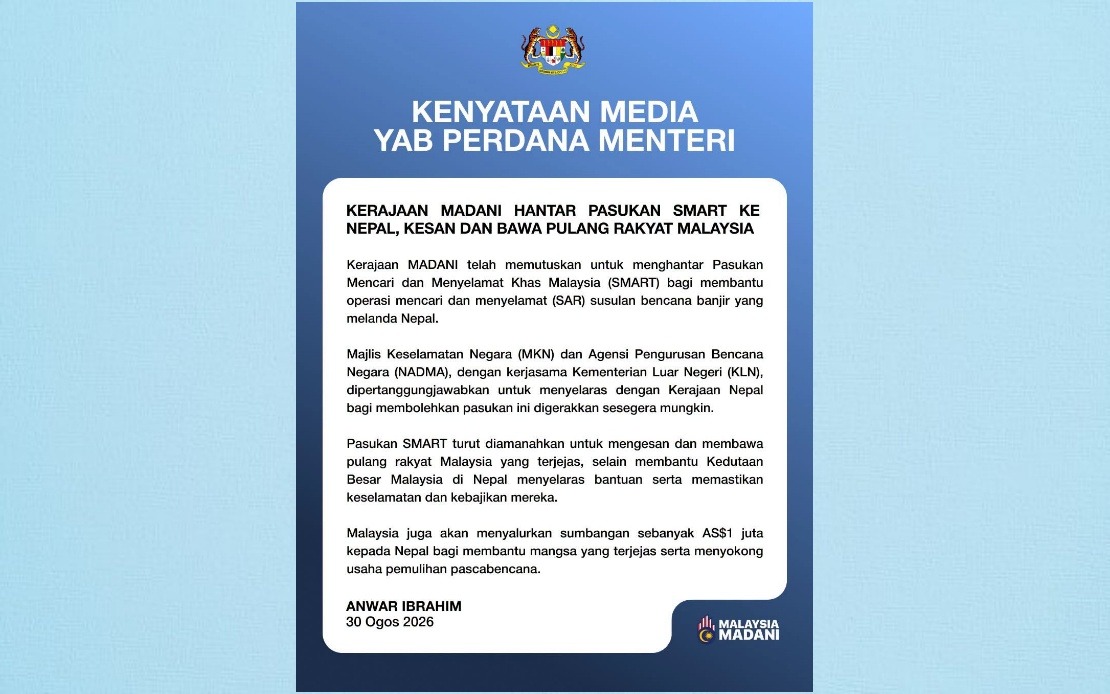
In response to the catastrophic flooding that ravaged Nepal's Rasuwa district on August 26, the Malaysian government has mobilised its disaster response capabilities through the deployment of the Special Malaysian Disaster Assistance and Rescue Team (SMART) to assist in search and rescue operations. Prime Minister Datuk Seri Anwar Ibrahim announced the initiative, underscoring Malaysia's commitment to supporting its affected citizens and neighbouring nations during humanitarian crises. The decision reflects the MADANI Government's broader strategy of maintaining regional stability and strengthening bilateral ties with South Asian partners through practical, on-ground assistance.
The coordination framework for this intervention encompasses multiple government agencies working in tandem to ensure an efficient and comprehensive response. The National Security Council (MKN) and the National Disaster Management Agency (NADMA) have been designated as the primary coordinating bodies, operating in collaboration with Malaysia's Foreign Ministry to liaise directly with Nepalese authorities. This multi-agency approach enables streamlined communication with Nepal's government structures and facilitates rapid deployment of personnel and equipment. By leveraging existing diplomatic channels and disaster management protocols, the coordination mechanism aims to position the SMART team for immediate impact on recovery operations.
Beyond the immediate search and rescue mandate, the SMART deployment carries a dual responsibility that extends to the welfare and protection of Malaysian nationals caught in the disaster zone. The team has been explicitly tasked with locating Malaysian citizens affected by the floods and landslides and facilitating their safe return home. This personalised mission objective reflects how Malaysia's disaster response protocols integrate national interest with humanitarian principles, ensuring that citizens stranded in disaster zones receive priority attention. The SMART team will also work closely with the Malaysian Embassy in Nepal to coordinate broader aid distribution efforts and maintain ongoing communication regarding the safety and welfare of all affected Malaysians in the region.
The financial commitment accompanying the operational deployment underscores Malaysia's commitment to substantive support rather than symbolic gestures. The US$1 million contribution to Nepal is earmarked for immediate humanitarian relief as well as longer-term post-disaster recovery initiatives. This funding structure recognises that flooding disasters create cascading needs extending far beyond the initial emergency phase—populations require food, shelter, medical care, and water sanitation during acute crisis periods, while rebuilding infrastructure and restoring livelihoods demand sustained financial input. By framing the assistance package to address both immediate and recovery-stage requirements, Malaysia positions itself as a partner invested in Nepal's full restoration rather than a transactional aid provider.
The trigger for this intervention arose from devastating natural events that unfolded with tragic speed. On August 26, severe flash floods and landslides struck Rasuwa district in central Nepal, a mountainous region where weather systems and terrain combine to create acute risk of water-related disasters during monsoon seasons. The Foreign Ministry subsequently confirmed that 55 Malaysian nationals remained unaccountable in the aftermath, a figure that galvanised the government's decision to mobilise active rescue operations rather than rely on passive information gathering through diplomatic channels. This threshold—more than five dozen citizens uncontactable in a disaster zone—justified the deployment of specialised rescue personnel and equipment despite the logistical complexities of operating across international borders during emergency conditions.
The SMART team's activation carries particular significance for Malaysia's regional standing as a capable and responsive actor in South Asian affairs. By demonstrating willingness to deploy trained personnel and financial resources to assist Nepal, Malaysia reinforces its image as a reliable partner committed to collective disaster management principles. Regional powers in Asia increasingly compete through soft power mechanisms, and humanitarian responses constitute high-visibility demonstrations of capacity and commitment. For Malaysia specifically, supporting Nepal during crisis periods strengthens bilateral relations with a country that has strategic importance along India's borders and maintains independent diplomatic voice in regional forums. The visible presence of Malaysian rescue professionals and the allocation of substantial aid resources generate goodwill that extends beyond the immediate disaster context.
The operational environment in Rasuwa district presents considerable challenges for foreign rescue teams unfamiliar with the terrain and local conditions. The district's mountainous geography, combined with monsoon-driven weather patterns that persist during the rescue window, means that rescue operations must contend with ongoing environmental hazards. Landslides remain probable as saturated soils continue to destabilise, flooding may recur if additional rainfall occurs, and access routes may be compromised or destroyed. The SMART team's deployment therefore requires not only rescue expertise but also rapid environmental assessment capabilities and adaptive operational planning. These challenges necessitate close coordination with Nepalese authorities and potentially other international rescue organisations already operating in the affected zone, creating a complex incident command structure that must balance Malaysian interests with broader disaster response objectives.
For Malaysia, this intervention also carries domestic implications regarding disaster preparedness and response capacity. The decision to activate SMART demonstrates that the team maintains operational readiness despite competing domestic demands—Malaysia itself remains vulnerable to flooding, particularly during monsoon months when northeast and southwest monsoon systems bring heavy precipitation. By deploying personnel internationally, the government implicitly signals confidence in its ability to maintain domestic disaster management capabilities while conducting regional operations. This staffing calculation reflects broader resource constraints that affect all Southeast Asian nations attempting to build world-class disaster response capacity within budgetary limits. The visibility of Malaysian rescue professionals working in Nepal may also enhance public confidence in domestic disaster management institutions, reinforcing the legitimacy of continued investment in NADMA and related agencies.
The case of the 55 uncontactable Malaysian nationals illustrates the vulnerability patterns that emerge when tourists, workers, and expatriates traverse South Asian trekking routes and mountain regions during monsoon seasons. Rasuwa district attracts adventure tourists and trekkers seeking to experience the Himalayan environment, creating seasonal populations of foreign nationals concentrated in vulnerable areas. When disaster strikes, communication infrastructure collapses alongside physical infrastructure, making location of affected persons extraordinarily difficult during critical rescue windows. The Malaysian government's decision to specify this cohort as a priority reflects recognition that rapid location of citizens maximises rescue success rates, as early intervention typically produces better health outcomes than delayed recovery operations conducted days after initial impact.
Looking forward, the Nepal deployment may catalyse broader regional conversations about disaster preparedness frameworks encompassing multiple South and Southeast Asian nations. Cross-border rescue operations remain underdeveloped in Asia compared to European Union mechanisms, partly because of varying national capacities and partly because of diplomatic sensitivities regarding foreign personnel operating within national territory. Malaysia's active participation in Nepalese rescue operations, conducted with appropriate government coordination, demonstrates a model that other regional powers might emulate. Enhanced mechanisms for rapid cross-border disaster assistance could eventually encompass Malaysia, Thailand, Vietnam, Indonesia and other nations with significant disaster risks and the capacity to mobilise rescue resources, creating a regional mutual aid framework that strengthens collective resilience across South and Southeast Asia.

