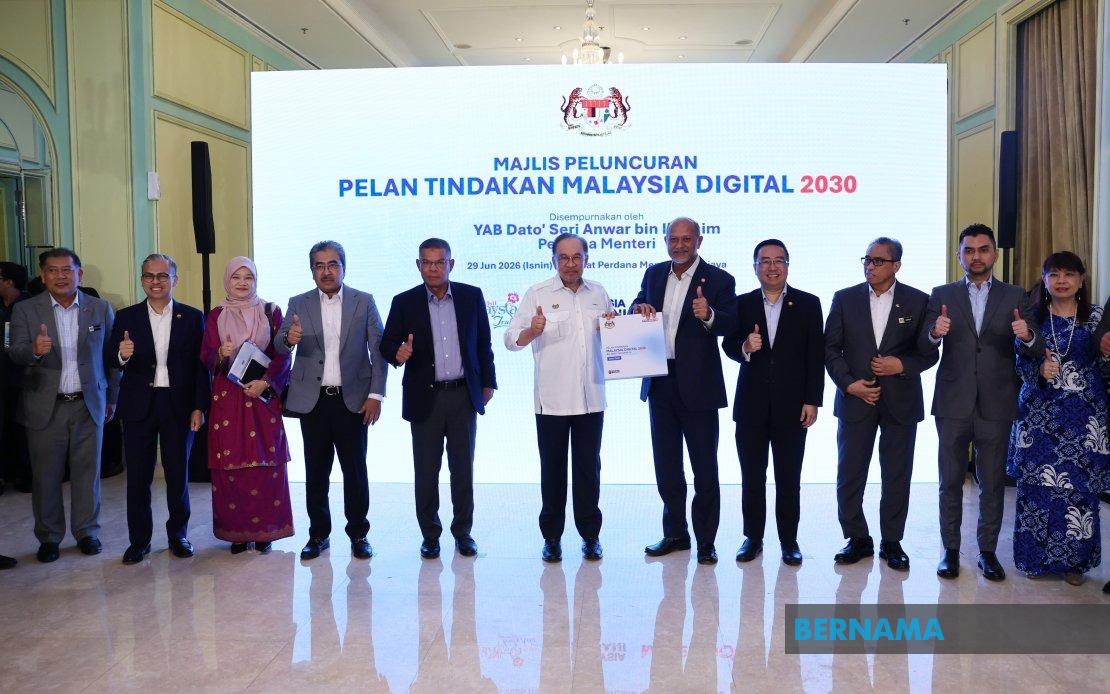
Prime Minister Datuk Seri Anwar Ibrahim unveiled Malaysia Digital 2030 (MD2030) in Putrajaya on June 29, signalling a fundamental reorientation of national digital strategy. The action plan, which governs 2026-2030, represents Malaysia's commitment to evolving from a passive consumer of foreign technology into a proactive architect of homegrown digital innovation. This strategic pivot comes as Southeast Asia's digital economy becomes increasingly competitive, with regional neighbours investing heavily in their own artificial intelligence and technology sectors.
The framework encompasses seven interconnected pillars, each anchored to a specific government ministry operating under integrated coordination. Chief Secretary to the Government Tan Sri Shamsul Azri Abu Bakar will oversee the Government pillar focused on modernising public administration through GovTech Malaysia, while Investment, Trade and Industry Minister Datuk Seri Johari Abdul Ghani will lead efforts to position the nation as a regional digital innovation and trading centre. Digital Minister Gobind Singh Deo, Communications Minister Datuk Fahmi Fadzil, and other sector leads will supervise the remaining six pillars, ensuring no government department operates in isolation from the broader digital transformation agenda.
Ambitious numerical targets anchor MD2030's credibility and measurability. The government aims to elevate digital economy contributions to 30 per cent of gross domestic product by 2030, a substantial increase from current levels that would fundamentally reshape Malaysia's economic structure. Creating 500,000 high-value digital employment positions represents not merely job quantity but deliberate focus on quality roles that command competitive salaries and require advanced technical or creative skills. Additionally, authorities target RM4.5 billion in public sector savings through systematic digitalisation, reflecting efficiency gains that could redirect resources toward healthcare, education and infrastructure. The ambition to deliver 95 per cent of government services entirely online end-to-end mirrors trends in Estonia and Singapore, positioning Malaysia among regional digital frontrunners.
The Economy pillar articulates a "Made by Malaysia" positioning strategy, encouraging homegrown technology companies to develop products for domestic and export markets rather than remaining dependent on foreign vendors. This approach recognises that sustainable digital economies require indigenous innovation ecosystems supported by venture capital, research institutions and entrepreneurial talent. Initiatives targeting High Growth High Value sectors acknowledge that not all economic activities contribute equally to prosperity; selective sector development concentrating on advanced manufacturing, financial technology and digital creative industries offers superior returns than broad-based generalisation.
Infrastructure development forms the physical backbone enabling digital transformation. The Infrastructure pillar commits to nationwide high-quality internet connectivity, addressing the digital divide that has historically disadvantaged rural and semi-urban communities. Simultaneously, investment in data centres, cloud computing infrastructure and smart city technologies reflects recognition that digital services require sophisticated underlying systems. Malaysia's geographic position as a regional connectivity hub positions the country to develop export-oriented data centre industries, generating both employment and foreign exchange.
The Talent pillar addresses perhaps the most critical constraint to digital ambition: workforce capability. Rather than relying on imported expertise, Malaysia seeks to build comprehensive talent policies enabling workforce transition into digital roles through retraining and agile skill development. Positioning the nation as a regional digital talent destination could attract diaspora professionals and create brain gain reversing decades of emigration of skilled Malaysians. This pillar implicitly acknowledges that technological infrastructure means little without the human capital to operate, innovate and manage complex systems.
Social inclusion provisions distinguish MD2030 from purely economically focused strategies. The Society pillar explicitly targets rural community empowerment through the Malaysian Digital Inclusion Index, ensuring that digital transformation benefits extend beyond affluent urban populations. Rural digitalisation initiatives address longstanding inequality whereby technology adoption concentrates in metropolitan areas, perpetuating regional economic disparities. Socially impactful digital solutions could encompass telemedicine extending healthcare access, agricultural technology improving farming productivity and e-commerce platforms enabling rural entrepreneurs to reach national markets.
Data governance emerges as a governance priority through the Trust and Security pillar, which balances innovation acceleration with robust protection frameworks. The forthcoming National Digital Trust and Data Security Strategy 2026-2030 reflects global recognition that digital economies require citizen confidence and secure infrastructure. Establishing the National Data Commission indicates serious intent to manage data as a strategic national asset rather than treating information management as a secondary technical concern. This approach parallels developments in the European Union, where data governance frameworks have become central to digital competitiveness.
The Innovation pillar completes the framework by establishing mechanisms translating research discoveries into commercial products. Building a robust Research, Development, Commercialisation, Innovation and Economy ecosystem addresses the notorious gap between Malaysia's respectable research output and modest commercialisation track record. The National AI Office, Malaysia Digital Economy Corporation, CyberSecurity Malaysia and Malaysia Centre for the Fourth Industrial Revolution collectively form an institutional ecosystem supporting innovation translation, distinguishing MD2030 from aspirational statements lacking implementation machinery.
Minister Gobind's articulation of moving "beyond being a technology consumer to becoming a respected producer of digital innovation" encapsulates the strategy's philosophical foundation. Malaysia's previous approach concentrated on adopting foreign technologies, creating dependence on multinational corporations and limiting local value capture. MD2030 inverts this dynamic by treating Malaysia as a knowledge creator rather than knowledge importer, potentially reshaping regional technology markets. For Malaysian entrepreneurs and researchers, the framework signals genuine government backing for indigenous innovation, potentially redirecting venture capital and talent toward local ventures.
Implementation through a whole-of-government approach contrasts with compartmentalised approaches where different agencies pursue parallel agendas. By designating the Digital Ministry as lead coordinator with cluster heads from relevant departments, authorities establish accountability mechanisms and reduce institutional fragmentation. This coordination architecture becomes critical given MD2030's ambition; achieving simultaneous progress across government reform, workforce development, infrastructure expansion and innovation ecosystems requires extraordinary administrative coherence.
For Malaysian citizens and businesses, MD2030 promises both opportunity and obligation. The framework creates conditions for digital entrepreneurs to compete globally while requiring workforce participation in continuous learning and skills development. Regional implications extend beyond Malaysia; successful implementation would establish ASEAN's most developed digital economy after Singapore, potentially influencing neighbours' strategic directions. The five-year implementation window beginning 2026 provides medium-term visibility for businesses and investors planning technology investments and hiring decisions, though execution risks remain substantial given the complexity of coordinating multiple government agencies and private sector partners.

