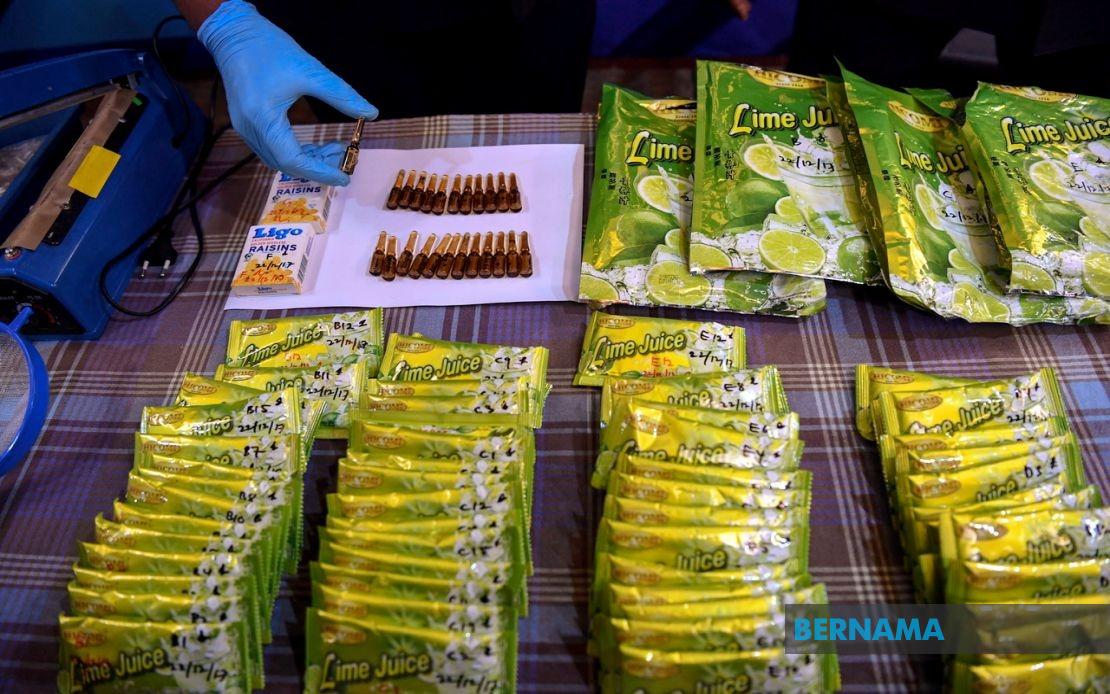
The Malaysian government is mounting an unprecedented campaign against the proliferation of synthetic drugs that have infiltrated local markets and communities, with Home Minister Datuk Seri Saifuddin Nasution Ismail signalling that the problem has evolved into a critical national security issue. Speaking through a parliamentary reply this week, the minister outlined how methamphetamine, fentanyl, and psychoactive pills commonly referred to as "piu-piu" have created fresh challenges for law enforcement, distinguishing them as particularly dangerous due to their potency, addictive properties, and capacity to trigger fatal overdoses.
The scale of the challenge becomes apparent when examining enforcement data released by the ministry. Between 2023 and June 2026, the Royal Malaysia Police documented 238,704 arrests across the country linked to various synthetic drug offences. This figure represents not merely a collection of individual cases but rather a systemic infiltration of these substances into Malaysian society, from urban centres to isolated rural communities. The breadth of these arrests suggests that synthetic drugs have moved beyond fringe markets to achieve more widespread distribution, compelling authorities to recalibrate their strategies accordingly.
The Royal Malaysia Police have responded by deploying coordinated operations including Op Tapis and Op Tapis Khas, which span geographic boundaries and involve multiple government agencies working in tandem. The National Anti-Drugs Agency and the Royal Malaysian Customs Department have joined forces with police to create a more comprehensive enforcement network. This inter-agency collaboration represents a recognition that traditional compartmentalised approaches to drug enforcement are insufficient when confronting sophisticated trafficking networks that exploit jurisdictional gaps and logistical vulnerabilities.
Technological innovation has become central to the enforcement strategy. Authorities are deploying drones and surveillance camera networks to detect trafficking activities before drugs reach street level, representing a significant shift towards prevention-focused intervention. The integration of these modern tools into drug enforcement operations suggests that Malaysia is moving beyond reactive responses to synthetic drug problems, instead attempting to establish proactive detection and interdiction capabilities that can identify smuggling routes and distribution networks before criminal organisations consolidate their presence.
Sarawak, a state that faces particular vulnerability due to its geography and international borders, has witnessed substantial enforcement activity. Between January and early June this year alone, authorities arrested 7,097 individuals in the state, comprising drug traffickers, users, and those found in possession. During the same period, law enforcement seized 418.01 kilogrammes of drugs valued at RM53.73 million, demonstrating both the volume and commercial scale of trafficking operations. Additionally, authorities confiscated RM1.95 million in syndicate assets, disrupting the financial structures that enable large-scale drug distribution networks to function.
The legislative framework governing drug offences is undergoing review to address gaps created by the emergence of new synthetic substances. The government is exploring amendments to the Dangerous Drugs Act 1952 to incorporate newly identified psychoactive substances under the legislation's regulatory schedules. This procedural response acknowledges a fundamental problem: drug manufacturers continuously modify chemical formulas to create substances that fall outside existing legal definitions, allowing them to operate in grey zones until governments can formally classify these compounds as controlled. By updating the legislative framework, authorities aim to eliminate the lag time between drug emergence and legal prohibition.
Forensic capabilities represent another dimension of the enhanced response. The ministry is investing in laboratory infrastructure to profile emerging synthetic drugs, including fentanyl analogues and designer opioids, enabling faster detection and identification. This capacity is essential for understanding trafficking patterns and consumption trends, as synthetic drugs are inherently variable in composition and potency. By developing superior analytical capabilities, Malaysian authorities can better track which specific compounds are entering circulation and adjust enforcement priorities accordingly.
Beyond enforcement measures, the government recognises that law enforcement alone cannot address the broader drug problem. Prevention initiatives have expanded substantially, with 1,144 drug awareness programmes conducted nationwide between 2023 and June 2026. These educational campaigns target communities, schools, and workplaces, attempting to create cultural resistance to drug use before individuals encounter these substances. The rationale is straightforward: synthetic drugs are particularly addictive and dangerous, making prevention more cost-effective and humane than attempting to rehabilitate heavy users or managing overdose crises.
The Sarawak situation exemplifies the particular challenges facing Malaysian authorities. The state's extensive borders and remote communities create environments where traffickers can operate with reduced surveillance. Between January and early June this year, authorities took action against 131 individuals under provisions designed for intensive intervention with hardened drug addicts, indicating that enforcement is moving beyond simple prosecutions towards more comprehensive rehabilitation and containment measures. This suggests that decision-makers recognise drug addiction as partially a public health challenge requiring medical intervention, not merely a criminal justice problem.
The emphasis on these multiple strategies reflects an understanding that synthetic drugs represent a fundamentally different threat than traditional narcotics. Their chemical variability, extreme potency, and the rapidity with which new formulations emerge create enforcement challenges that conventional drug strategies struggle to address. Malaysian authorities are attempting to develop comprehensive responses spanning enforcement, legislative adaptation, technological deployment, and community engagement. Success will depend on sustaining these efforts across multiple agencies and maintaining public support for prevention initiatives, particularly in communities where drug use carries severe social consequences.
For Southeast Asian governments observing Malaysia's approach, the comprehensive strategy offers valuable lessons about addressing synthetic drug threats before they become entrenched. The combination of strengthened enforcement capabilities, legislative flexibility, technological adoption, and prevention focus represents a sophisticated response to evolving drug markets. However, the continued rise in arrests and seizure quantities suggests that traffickers are adapting faster than authorities can respond, indicating that Malaysia's drug policy framework will require continuous evolution to remain effective.

